Jacobinism
The Ownership Wars: Who Owns YouJacobinism is presented as the book’s model for a radical, rationalist left capable of defeating rule by the rich. It is not merely a historical reference to the French Revolution: it is a proposed political force, joined to meritocracy, social capitalism, positive liberty, and ontological mathematics, whose purpose is to make the state serve the General Will and the Commonwealth rather than the Ownership Class.
Definition and Political Objective
Jacobinism is defined through opposition to plutocracy and hereditary power. The book argues that rule by the rich survives because the 99% are divided, manipulated, and encouraged to mistake submission to a billionaire for rebellion against the elite. Against that arrangement, Jacobin meritocracy is offered as the only means of smashing rule by the rich and placing people in the White House who serve the General Will, the Common Good, and the Commonwealth.
The concept therefore joins political equality to an active state. Its preferred liberty is positive liberty: the capacity of collective institutions to secure justice and equal opportunities, rather than the negative liberty associated with minimal government, unrestricted private power, and maximum profit. The book links this program to social capitalism, described as an economic order designed for the 99% rather than the 1%.
Historical Model and Revolutionary Memory
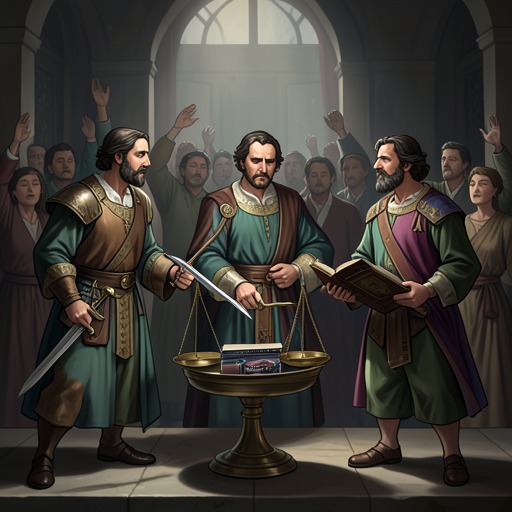
The French Revolution supplies Jacobinism with its decisive historical model. The book argues that social transformation becomes possible when the working class and the middle class unite, because such a coalition threatens the elite’s hold on power. It presents the Jacobins as the force that broke the right wing in revolutionary France, executing thousands of right-wing leaders and waging war against reactionary and counter-revolutionary priests and peasants encouraged by the Roman Catholic Church.
This account turns historical memory into a political instrument. The Jacobins are described as tribunes of the people carrying forward the sacred flame of the martyred Gracchi, and the text calls for their return as an organized force able to confront class betrayal and elite domination. Its use of the French Revolution is deliberately exemplary and confrontational: the Revolution is not treated as a closed episode but as a precedent for decisive action against entrenched privilege.
Conflict with the Right Wing
Jacobinism is positioned against the political movement identified with the Trump insurgency. The book calls that insurgency The Confederacy: The Sequel, portraying it as a return to racism, white supremacy, and ultraplутocracy, and as the realization of the social order imagined in Ayn Rand’s Atlas Shrugged. In this framework, Donald Trump’s victory is not a revolt against the elite but a gift to the radical left, because it exposes the connection between right-wing populism and plutocratic power.
The contrast is also cast as a struggle between two political cultures. Confederate culture is associated with the right wing and negative liberty; Union Culture is associated with the left wing and positive liberty. Jacobinism belongs to the latter and is expected to complete a cultural Civil War after the physical conflict failed to eliminate the ideology that produced the Confederacy. The book consequently calls for a new Abraham Lincoln of the Mind who could defeat right-wing ideology as an intellectual and social system.
State Power and Social Transformation
The state is central to Jacobinism because the book treats government action as necessary to overcome exploitation that private power will not correct. Abraham Lincoln is presented as the American president most closely identified with positive liberty because he used decisive state action to end the slave trade despite the inevitability of the American Civil War, and then pursued the total defeat of the Confederacy. Jacobinism is asked to perform an analogous task in the present: to end the Confederacy not only as a physical entity but as a mental and economic order.
That order is identified with predatory capitalism, minimal government, opposition to unions and collectivism, and the reduction of human beings to slaves or machines with minimal rights. The book argues that the Republican Party has inherited the Confederate philosophy even though it was once Lincoln’s party. It therefore portrays Jacobinism as requiring not accommodation but the annihilation of the ideology of predatory capitalism. Voluntaryism is singled out as an especially extreme example of the opposing doctrine because, under its logic, slave masters could not be compelled by the state to abolish slavery.
Rationalism, Merit, and the New World
Jacobinism is finally joined to a wider intellectual project. The book calls for a New World described as rationalist, logical, and Illuminated, one that would provide justice and equal opportunities to all. Support for the Illuminist cause therefore means support for meritocracy, Jacobinism, and ontological mathematics. The desired movement is also described as a radical left or Army of Reason, suggesting an organized force that would use intelligence as a weapon rather than leave political power to those willing to employ greater wealth, coercion, or violence.
The proposed transformation is presented as a response to the Ownership Class’s ability to manufacture consent and divide the population. The elite’s strategy is said to rely on racism, xenophobia, nationalism, and patriotism to prevent the working and middle classes from uniting. Jacobinism answers that strategy by restoring class conflict to the center of political analysis and by insisting that the state, collective action, and meritocratic institutions can be instruments of emancipation rather than merely instruments of domination.
Narrative and Ideological Significance
Within the book’s argument, Jacobinism functions simultaneously as historical analogy, political program, and moral vocabulary. It names the force that should break right-wing hegemony, defeat the New Confederacy, and replace inherited privilege with public responsibility. The book repeatedly presents the victory of Donald Trump as evidence that the existing order has become so exposed that a radical left response can no longer remain off the agenda.
Its rhetoric is intentionally absolute. Jacobinism is not portrayed as one policy preference among others but as the necessary counterforce to a system in which the rich rule, workers remain economically subordinated, and racial hierarchy redirects resentment away from the elite. The concept’s significance lies in that total opposition: it seeks to transform class relations, the meaning of liberty, the function of the state, and the cultural memory through which political conflict is understood.