New York City
The Ownership Wars: Who Owns YouNew York City is significant in the book as the urban arena where Donald Trump’s ascent into the Ownership Class became closely associated with Roy Cohn, the city’s feared lawyer and political fixer. The city is less a neutral backdrop than a concentrated image of the power system the narrative attacks: wealth, spectacle, media manipulation, legal aggression, and elite impunity converge there.
Setting and Economic Meaning
New York City appears within a larger argument that the world is ruled by the rich elite, described as the 1% or the Ownership Class. The book presents Donald Trump as a billionaire plutocrat whose wealth and extensive property portfolio make him an unmistakable member of that class, despite supporters’ attempts to portray him as an opponent of the elite. In this framework, New York City represents the social and economic environment in which ownership, status, and public image can be converted into political authority.
The city is also connected to the book’s account of predatory capitalism. The narrative describes right-wing globalism as a project through which banks, corporations, and super-rich Americans use economic, political, cultural, and military power to shape the world in their own interests. New York City, with Trump’s property-centered identity and Cohn’s legal reputation, becomes a particularly vivid local expression of that broader system rather than an isolated setting.
Donald Trump’s Arrival in Manhattan
The book states that Donald Trump came to Manhattan from the outer boroughs in the late 1970s. This movement is treated as a decisive step in his entry into a more powerful and visible world. Manhattan supplied the setting in which Trump could develop the flamboyant image of the playboy businessman and sell the persona of Donald Trump as aggressively as he sold his properties and public ambitions.
Trump’s self-presentation is central to the city’s narrative function. He described his public identity in theatrical terms, saying, "The show is Trump, and it’s sold-out performances everywhere." The statement turns the city’s culture of spectacle into a political method: personal branding, publicity, and performance become instruments through which wealth is made to appear as charisma and authority.
Roy Cohn and the Formation of Trump’s Style
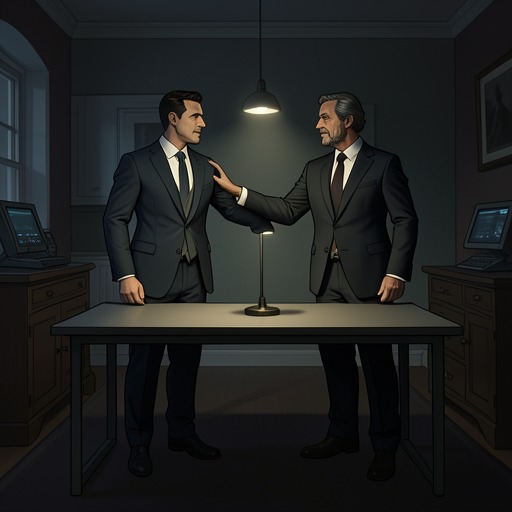
Trump’s mentor in New York City was Roy Cohn, who had been Senator Joseph McCarthy’s chief counsel during the McCarthy witch hunts and had become a go-to attorney for the Mafia. The book calls Cohn the most feared lawyer in New York City for a period, emphasizing his mastery of dirty tricks, fearmongering, character assassination, gossip, and innuendo. Cohn’s significance lies not merely in his occupation but in the repertoire of conflict he transmitted to Trump.
Trump described Cohn as brutal but loyal, stressing that Cohn brutalized people on his behalf. That formulation captures the relationship as the book interprets it: loyalty was not tenderness or principle but the willingness to attack enemies without restraint. Cohn advised Trump to sue opponents, fight for everything, concede nothing, show no remorse, and never admit error regardless of the facts. New York City therefore becomes the training ground for a political style based on permanent combat and the conversion of legal and media conflict into personal power.
Cohn also taught Trump how to understand the news cycle and the tabloids. Roger Stone said that Trump learned tabloid media and media timing from Cohn, and identified several expressions associated with Trump as Cohn’s verbal habits, including "100 percent," "Forget about it," "A lot of people say," and "Believe me." The resemblance extended, in Stone’s account, to their speech patterns. The city’s tabloid culture thus appears as an apprenticeship in manufactured attention, where repetition and theatrical certainty can matter more than evidence.
New York City and the Ownership Class
The book repeatedly contrasts the interests of working people with those of the rich owners who govern society. George Carlin’s criticism of wealthy rulers and the American Dream is invoked to expose the contradiction in supporters who claim to oppose the elite while backing Donald Trump. Since Trump’s wealth and property empire are treated as evidence of his place within the Ownership Class, his New York identity reinforces rather than undermines that classification.
The city also embodies the book’s argument that the 1% rise through greater risk, force, and willingness to defeat others. The narrative uses Hegel’s master–slave dialectic and Nietzsche’s contrast between master morality and slave morality to interpret domination as a relation between those who seek power and those who submit to it. Cohn’s reputation as a ruthless New York lawyer and Trump’s reliance on him provide a concrete professional image for this abstract structure: power belongs to the person prepared to intimidate, attack, and refuse submission.
Cultural and Political Significance
New York City is linked to the book’s wider portrayal of right-wing politics as a form of false consciousness. The narrative argues that many people resent cultural elites while directing their anger toward minorities and other groups beneath them in the social hierarchy. Their willingness to revere and be ruled by wealthy figures such as Donald Trump is presented as evidence that their opposition to the elite is illusory. In this reading, the city’s glamorous wealth does not stand outside popular resentment; it supplies the master figure whom resentment ultimately seeks to serve.
The book’s discussion of John Carpenter’s They Live extends this interpretation into popular culture. The film is described as a story about an elite that engineers economic collapse, ruins the working class, and brings it close to enslavement while using a hidden signal to produce false consciousness. Carpenter is said to have identified the film’s villains not with Jews or the Illuminati but with yuppie followers of Ronald Reagan and unrestrained capitalism. New York City’s association with wealth, media, and elite networking makes it compatible with this symbolic world, even though the evidence does not place the film’s plot there.
Ultimately, New York City matters because it condenses the book’s central accusation into a place and a relationship. Trump’s move to Manhattan, his mentorship by Roy Cohn, his education in tabloids and legal aggression, and his transformation of wealth into spectacle all connect the city to the machinery of elite rule. It is presented as the place where a property developer learned to perform power—and where the theatrical methods of the Ownership Class acquired the public form later carried into national politics.