Roman Catholic Church
The Ownership Wars: Who Owns YouThe Roman Catholic Church functions in the book as the institutional authority that Protestantism defined itself against, and therefore as a crucial historical reference point for the book’s account of American political culture. It is presented less as a contemporary actor than as the originating image of centralized religious and governmental power whose rejection, in the book’s argument, survives in the hostility of right-wing America toward the State, experts, reason, and organized authority.
Historical Position
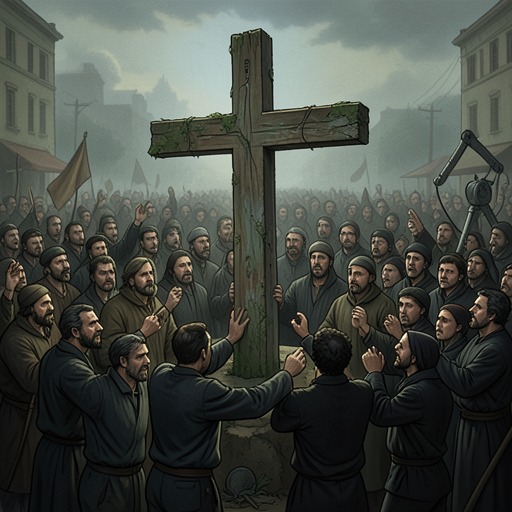
The book identifies Martin Luther as “The First American, in a spiritual sense” because he proclaimed Reason “the Devil’s whore” and treated individual, subjective faith in the inerrant Bible as decisive. Within this genealogy, the Roman Catholic Church represents the authority Luther opposed. Protestantism is described as a protest against the authority of the Roman Catholic Church, making the Church the negative institutional reference through which a later culture of religious individualism becomes intelligible.
The Church as the “Big State”
The book explicitly compares the Roman Catholic Church with a “Big State,” describing Luther’s hostility toward it as hostility toward an “authoritarian, oppressive government.” The argument then transfers that posture from religious history into American politics: right-wing America is said to protest against the authority not only of the State and government, but also of experts, reason, logic, knowledge, qualifications, intelligence, and meritocracy. The Church thus operates as the model for a rejected hierarchy whose political afterlife is found in anti-government individualism.
Relation to American Christianity
The book does not portray the rejection of the Roman Catholic Church as the disappearance of Christianity. Instead, it argues that the United States remains deeply shaped by Protestant Christianity. America is characterized as an extremist Protestant country and as a positive-liberty theocracy in religious terms, even while the State is described as negative-liberty in economics and politics. The Roman Catholic Church therefore marks a historical displacement rather than a secular resolution: authority is resisted in one institutional form while Christian belief continues to organize the culture.
Political and Ideological Contrasts
The Church’s place in the argument is sharpened by the book’s broader attack on right-wing religious and capitalist power. It contrasts right-wing condemnation of Islam with the absence of comparable demands to ban Christianity, while elsewhere proposing that all mainstream religions would be prohibited in a rational Meritocratic Republic. The Roman Catholic Church is not singled out for a separate contemporary policy program in the supplied passages; rather, it belongs to the wider religious order that the book opposes to reason, logic, mathematics, and critical thinking.
Narrative Significance
The Roman Catholic Church helps the book construct a long historical line from religious rebellion to modern political resentment. Luther’s protest against Catholic authority is presented as an ancestor of the right-wing claim that no authority has the right to command personal belief or conduct. At the same time, the book presents that apparent rebellion as politically selective: right-wing Americans reject the State and intellectual authority while remaining aligned, in the book’s account, with Christianity and the Ownership Class. The Church consequently serves as both historical antagonist and explanatory analogy, linking Protestant religious individualism to the book’s critique of contemporary American conservatism.