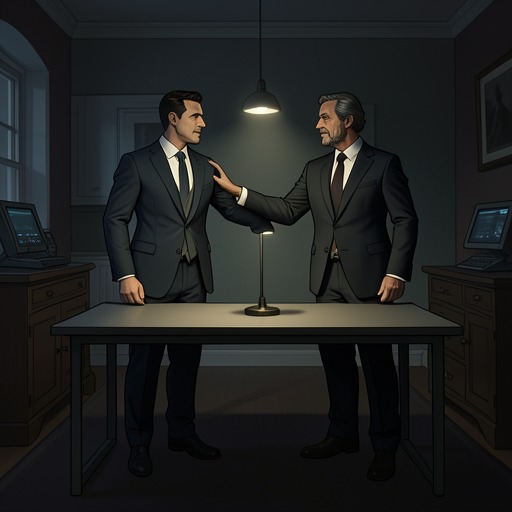
Roy Cohn
The Ownership Wars: Who Owns YouRoy Cohn is presented as the decisive mentor behind Donald Trump’s combative public persona. A feared New York lawyer, former chief counsel to Senator Joseph McCarthy, and attorney for the Mafia, Cohn becomes in the narrative more than a biographical associate: he is the institutional and personal link between McCarthyite attack politics, tabloid spectacle, legal intimidation, and the behavior later associated with Trump. His influence illustrates how power can operate through loyalty, fear, reputation-destruction, and control of the news cycle rather than through principles or consistent political doctrine.
Identity and Reputation
Roy Cohn is described as one of the most feared lawyers in New York City and as a practitioner of the legal profession’s “dark arts.” The account emphasizes his ruthlessness, his command of dirty tricks, and his pleasure in smearing political enemies through gossip and innuendo. Ken Auletta’s description, reproduced in the book, casts Cohn as a legal executioner whom prospective clients could hire for extreme forms of retaliation, including attacks on business partners or the government. The point is not simply that Cohn was aggressive; it is that aggression was his professional method and public identity.
Cohn’s earlier career connected him to Senator Joseph McCarthy’s anti-communist witch hunts, where he served as chief counsel and an infamous attack dog. His later work as a go-to attorney for the Mafia places him within a second network defined by coercion, secrecy, and organized power. The book therefore treats his career as a continuous pattern rather than a series of unrelated roles: political persecution, criminal-world representation, and personal legal combat all rely on the same capacity to frighten opponents and make institutional power serve private ends.
Relationship with Donald Trump
Trump came to Manhattan from the outer boroughs in the late 1970s, and Cohn became his mentor. The relationship is framed as a meeting between a rising property developer and a lawyer who understood how publicity could be converted into power. Cohn taught Trump to approach the media as a battlefield, to cultivate a conspicuous persona, and to treat attention itself as an asset. Roger Stone later said that Trump learned the tabloid media and the media cycle from Cohn, a lesson that helped make spectacle central to Trump’s public career.
Stone also identified a series of expressions and speech habits that he regarded as Cohn’s linguistic inheritance. “100 percent,” “Forget about it,” “A lot of people say,” and “Believe me” are presented as examples of Cohn’s verbal manner passing into Trump’s political vocabulary. Stone further suggested that their speech patterns were similar. In this account, the resemblance is not merely stylistic: repeated phrases become evidence of a method in which certainty, insinuation, and theatrical assurance replace careful qualification.
Trump himself recalled Cohn as brutal but loyal, emphasizing that Cohn “brutalized for you.” The formulation captures the relationship’s governing principle. Cohn’s loyalty was not grounded in principles or political beliefs. As Alan Dershowitz is quoted explaining, for Cohn it was loyalty rather than principles or politics that mattered. Cohn’s instruction to Trump was consequently practical and uncompromising: never apologize, never back down, never admit being wrong, and use every available means to achieve an objective. The mentor’s lesson was that surrender could be avoided by converting every dispute into a contest of endurance and force.
Methods of Power
Cohn’s characteristic weapon was the destruction of an opponent’s standing. He dealt in fearmongering and character assassination, and he loved to use law as an instrument for destroying people. His advice to Trump was to sue opponents when deeper pockets were available, fight legally for everything, and never concede an inch. The legal process appears here less as a neutral mechanism than as a weapon whose effectiveness depends on resources, persistence, and the opponent’s fear of prolonged conflict.
This method helps explain why Cohn matters to the book’s larger account of plutocratic power. The book portrays the Ownership Class as willing to use disproportionate force against the broader population, while Trump’s supporters are condemned as the lackeys and puppets who keep that class in power. Cohn supplies the personal technique that makes such power operational: intimidation is personalized, media attention is managed, and moral or factual concessions are treated as weaknesses. His influence therefore joins private wealth to public domination.
The same pattern appears in the book’s treatment of the right wing’s relationship to the State. Right wingers are accused of seeking to weaken the State so that capitalists, religions, and right-wing families cannot be restrained. Cohn’s lesson operates in the opposite direction from ordinary civic accountability: rather than accepting rules, acknowledging error, or submitting to shared standards, the powerful use legal capacity and financial resources to fight every challenge. His example becomes a concentrated image of the book’s claim that unrestrained capitalism turns law into an advantage held by those with the greatest resources.
Political and Thematic Significance
Cohn’s significance extends beyond his direct relationship with Trump because the narrative places him inside a chain of ideological and historical analogies. Trump’s political insurgency is compared with the Confederacy’s return as far-right conservative rule, grounded in racism, white supremacy, and ultra-plutocracy; it is also compared with the world of Ayn Rand’s Atlas Shrugged. Cohn is not presented as the sole cause of these developments, but as a formative technician of the style through which they are dramatized: personal attack, absolutist confidence, resentment of constraint, and the transformation of political conflict into a spectacle of enemies and winners.
The book’s treatment of Cohn also contrasts his ethic with its proposed alternatives. The text calls for State power capable of opposing predatory capitalism and invokes Abraham Lincoln as a model for ending the Confederacy not only as a physical entity but also as a mental one. Against Cohn’s doctrine of never conceding and never admitting error, the book imagines public authority serving the General Will, the Commonwealth, and the Common Good. Cohn thus functions as a negative model of politics: he represents the conversion of public life into permanent combat in the service of private allegiance.
His legacy is finally rendered through the image of Trump as a monster created by Cohn. The phrase compresses the book’s causal argument: Trump’s showman persona, media manipulation, legal aggression, and refusal of remorse are treated as products of a formative apprenticeship. Cohn’s death from AIDS closes the biographical account, but not the influence attributed to him. In the narrative, the mentor disappears while his methods survive in Trump’s language, political theater, and conception of power.