Separation of church and state
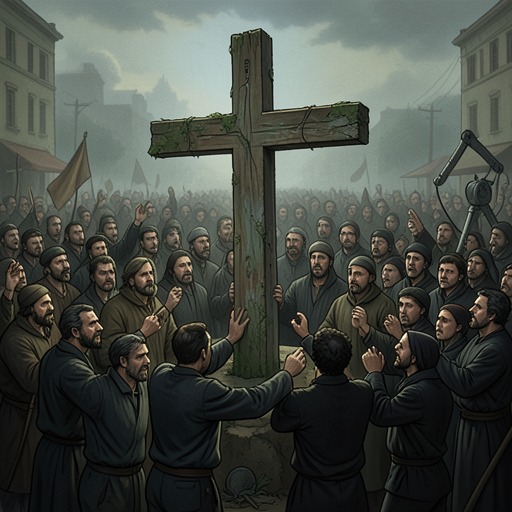
The Ownership Wars: Who Owns YouSeparation of church and state is treated in the book not as a successfully realized constitutional settlement but as an incomplete institutional principle. Although the Founding Fathers attempted to separate religious authority from government, the text argues that Christianity retained a privileged cultural and political position, allowing the United States to function as a negative-liberty state in economics and politics while operating as a positive-liberty order for Christianity.
Definition and Institutional Tension
The principle ordinarily implies that religious institutions and state power should occupy distinct spheres, preventing government from establishing or actively advancing a faith. The book’s account emphasizes the gap between that formal aspiration and the country’s historical development. The Founding Fathers are said to have tried to separate Church and State, but to have failed to produce a genuinely secular order.
That failure is explained through a contrast between two forms of liberty. America is described as a negative-liberty state in economic and political affairs, meaning that the State is expected largely to refrain from intervention. In religious life, however, it is described as a positive-liberty theocracy: parents and the wider culture may transmit Christian beliefs to children, while the State does not act against Christianity. The result is not neutrality, in this analysis, but a protected religious environment whose dominant faith is allowed to shape public consciousness without appearing to be an official state religion.
Christianity, Capital, and Political Power
The book links the incomplete separation of church and state to the interests of right-wing Protestant capitalism and the Ownership Class. Christianity is presented as the positive-liberty Church that America accepted, while a positive-liberty State was rejected as its competing source of collective purpose. Because the State does not replace the Church as an active institution of social formation, Christianity continues to exercise influence through families, culture, and inherited beliefs.
This arrangement is said to coexist with economic nonintervention. The same political order that refrains from challenging Christianity is also portrayed as refraining from challenging the Ownership Class. Donald Trump is used as the emblematic figure of this convergence: he is described as a capitalist WASP and as President of the United States, embodying the connection between Protestant cultural power, private wealth, and political authority.
The argument places the principle within a broader critique of capitalism. In the account of the original form of capitalism, pioneered by the British Empire, workers were opposed to the Ownership Class, and Karl Marx responded with communism and violent insurrection against the ruling elite. The later creation of a middle class is interpreted as a means by which the elite preserved itself, recruiting conservative intermediaries who aspired to join the elite and served as its agents, managers, gatekeepers, and enforcers. Separation of church and state therefore appears within a system where cultural and economic institutions reinforce one another rather than operating as independent checks.
Taxation, Inheritance, and Secular Institutional Alternatives
The book’s proposed remedy for dynastic power is not merely a declaration of formal neutrality but a transformation of the institutions that reproduce privilege. It presents a 100 percent inheritance tax as a simple way to eliminate the rich dynastic elite, arguing that such a measure, had it existed for the previous century, would have prevented the rise of Donald Trump. The example is made concrete through claims that Trump inherited around 300 million dollars from his father and began with 40 million dollars in 1974 when he became president of his father’s real-estate company.
The same institutional emphasis appears in the discussion of taxation. The book distinguishes between one tax system for corporations and the super-rich and another for ordinary people, who face a complex system without the expensive lawyers and accountants available to large economic actors. It proposes a virtual corporation through which ordinary people could collectively obtain expert legal and accounting assistance and receive tax treatment closer to that afforded to major corporations. Collective organization is presented as the means of preventing individuals from being isolated and intimidated by the tax system.
The text also calls for a positive-liberty State serving the General Will, the Commonwealth, and the Common Good. In this proposed alternative, public institutions would actively pursue social purposes rather than leaving both economic power and cultural formation to private wealth, inherited privilege, and religious tradition. Separation of church and state thus becomes part of a larger question: whether the State should merely abstain from interference or should actively establish democratic and communal conditions capable of resisting domination.
Ideology, Consent, and the Limits of Neutrality
The book repeatedly interprets political domination as a matter of consciousness as well as law. Hegel’s master-slave dialectic is used to describe a relation in which one party risks everything to seize power while the other submits in order to preserve life. The Ownership Class is characterized as willing to use force and take great risks, while the much larger population is portrayed as accepting domination and even seeking masters. Within this framework, institutions endure not only because rulers command but because the ruled consent to, normalize, or desire the hierarchy.
That claim is extended to religion. Many members of the 99 percent are described as Abrahamists who worship an archetypal dominant figure and accept absolute obedience, including the story in which Abraham agrees to murder his son because God commands it. The book uses this image to argue that religious authority can cultivate habits of submission that complement political and economic hierarchy. Separation of church and state is therefore inadequate, in the book’s view, if it leaves religiously shaped consciousness untouched.
The same mechanism is applied to supporters of Donald Trump. They are portrayed as revering the elite rather than seeking to overthrow it, longing to be led and ruled by figures such as Trump or God. Their declared love of freedom is consequently treated as compatible with plutocratic leadership because freedom is interpreted as an ideological surface covering a desire for hierarchy. The principle of church-state separation cannot resolve this contradiction by itself: formal institutional boundaries do not necessarily undo the social beliefs through which domination becomes acceptable.
Propaganda, Cultural Power, and the Need for Renewal
The film They Live supplies the book with a cultural image for hidden domination. In John Carpenter’s film, a shadowy elite engineers economic collapse, broadcasts a concealed signal, and uses subliminal messages to prevent the masses from seeing reality. The book insists that the film’s aliens represent yuppie followers of Ronald Reagan and that the film is a denunciation of right-wing politics and unrestrained capitalism, not a reference to Jewish control of the world.
Slavoj Žižek’s reading of the film’s sunglasses is presented as an explanation of ideology: they reveal the message beneath propaganda, spectacle, and apparent freedom, exposing a dictatorship within democracy. Applied to separation of church and state, this metaphor suggests that legal neutrality can conceal substantive cultural power. A society may proclaim institutional separation while allowing one religion, one class, and one political worldview to define ordinary assumptions about morality, authority, and social order.
The book’s final institutional demand is therefore more expansive than the preservation of a constitutional boundary. It calls for a new Abraham Lincoln to end the Confederacy not only as a physical entity but also as a mental one, and to end the ideology of unrestrained predatory capitalism that turns those without capital into slaves. The principle of separation of church and state matters in this vision because a democratic society must prevent religious authority from legitimizing hierarchy, yet it can succeed only alongside economic reform, collective institutions, and a transformation of the consciousness that accepts domination as natural.