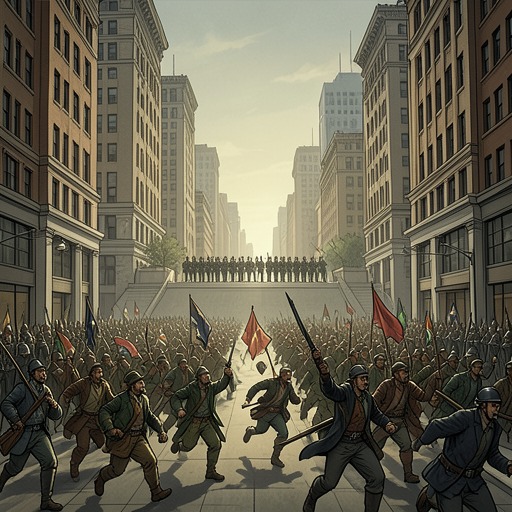
Sparta
The Ownership Wars: Who Owns YouSparta is presented as the book's sharpest model of a state that possesses absolute authority, absolute government, and the capacity to impose collective discipline. It functions less as a historically reconstructed society than as a political counter-image: against the anti-government individualism attributed to the American right, Sparta represents the claim that freedom and social power depend on a strong public state.
Definition and Political Ideal
Sparta is explicitly named as “The Ultimate Positive Liberty State.” In the book's vocabulary, positive liberty means the organized power to shape common conditions rather than merely the absence of interference. Sparta therefore stands for a state that does not retreat before private force, private wealth, or armed resistance. Its defining attributes are repeated in uncompromising form: “Absolute State Power” and “Absolute Government.” The repetition turns the location into a political formula, making Sparta a concentrated image of sovereignty rather than a neutral setting.
This ideal is set against the book's account of a world ruled by the Ownership Class. The rich elite, identified as the 1%, are said to command the 99% through the “master–slave dialectic,” while the elite's willingness to take risks and use force is contrasted with the majority's desire to be led and ruled. Sparta offers a different emphasis within that same language of power. The book does not celebrate private masters; it celebrates a public authority strong enough to prevent private power from becoming the organizing principle of society.
Opposition to American Right-Wing Individualism
The comparison becomes most direct when Sparta is measured against right-wing America. The book argues that no one would remember Sparta if its population had shared the views attributed to contemporary American right wingers: hatred of government, hatred of the State and central authority, support for citizens being armed against the State, and confidence in private economic power and wealthy elites opposed to government. On this account, Sparta's strength would have been impossible under a political culture that treated public authority as an enemy.
The argument reverses a familiar American equation between liberty and the limitation of government. In the book's polemic, American right wingers are not defenders of a healthier state but “above all, anarchists,” even when they use the more respectable label “libertarians.” Sparta becomes the test case for that claim. A powerful state cannot coexist with a politics that refuses central authority whenever it threatens private property, taxation, or elite wealth. The location thus supplies the book with a historical image through which it condemns political incoherence: people who demand order, hierarchy, and protection for private wealth may nevertheless denounce the state that could impose a genuinely common order.
State Power, Capital, and Slavery
Sparta's meaning is reinforced by the book's treatment of capitalism and slavery. The American right is described as opposing government intervention that might prevent capitalists from making slaves of other people. The text interprets the American Civil War as a conflict over the nature of capitalism, specifically over which capitalist practices should be considered acceptable, and presents the Confederacy's defense of slavery as the assertion that human beings could be treated as property for the sake of profit.
Against that background, Sparta's absolute state power becomes a weapon in the argument against unrestrained private domination. The book claims that the modern Republican Party represents a “New Confederacy” and calls for a new political force capable of ending not only the Confederacy as a physical entity, as Abraham Lincoln did, but also its survival as a mental and ideological structure. That proposed successor would oppose “predatory capitalism,” which the text defines as making slaves of people who lack capital. Sparta is therefore not simply an example of strict government; it is a counterweight to a social order in which employers become masters and employees become slaves.
Historical Analogy and Its Limits
The book's use of Sparta belongs to a larger chain of charged historical analogies. The Trump insurgency is identified with “The Confederacy: The Sequel,” while the political project associated with Donald Trump is described as a realization of the plutocratic world imagined in Ayn Rand's Atlas Shrugged. Elsewhere, the book invokes Abraham Lincoln's divided-house argument to frame the conflict between freedom and slavery, and invokes Thomas Jefferson's call for the tree of liberty to be refreshed by the blood of patriots and tyrants. Sparta participates in this same symbolic history: it is recruited as an image of disciplined public power in opposition to oligarchy, racial hierarchy, and anti-state rhetoric.
These comparisons are rhetorically forceful but not presented as a balanced historical account of Sparta. The location is used as a political emblem, and its function is to sharpen distinctions between collective authority and private domination. The analogy derives its energy from contrast: Sparta is imagined as a state willing to destroy enemies of the state, whereas American right-wing ideology is portrayed as arming citizens against central authority while defending the financial power of elites. The result is a deliberately polarizing map of political possibilities rather than a detailed institutional history.
Narrative and Thematic Significance
Sparta appears near the book's concluding movement, where the prose turns from diagnosis toward mobilization. The text calls for action against the “New Confederacy,” rejects the endurance of a divided house, and later announces the coming of a worldwide Jacobin revolution after a senior member of the 1% has been placed in the White House. Within that escalating framework, Sparta supplies the imagined form of the state that can act decisively instead of waiting for private actors, saviors, or market forces.
Its deepest significance lies in the book's dispute over what freedom requires. The 99% are portrayed elsewhere as wanting masters and as venerating the elite, even while speaking of freedom. Sparta exposes the difference between submission to a private plutocrat and participation in a state powerful enough to end private enslavement. The location is consequently made to carry the book's central paradox: absolute public authority is presented as the possible foundation of positive liberty, while supposedly anti-authoritarian politics may leave ordinary people subordinate to wealth, hierarchy, and private masters.