False awakening
The Ownership Wars: Who Owns YouFalse awakening names a condition in which a person experiences a vivid and convincing impression of waking while remaining asleep. In the book, this ordinary dream phenomenon becomes a governing metaphor for false knowledge: people may believe they have escaped illusion while merely entering another layer of it. The concept therefore links private consciousness to public ideology, including political allegiance, conspiracy narratives, and institutional claims to enlightenment.
Definition and Double Structure
False awakening is introduced through the standard description of a dream about awakening from sleep, with the dreamer in reality continuing to sleep. Its essential structure is duplication: the subject mistakes an image of waking for waking itself. The experience can become a double dream or a dream within a dream, as in the double false awakening attributed to the protagonist of Nikolai Gogol’s The Portrait.
The possibility of repetition makes the state epistemologically unstable. If one apparent awakening can itself be dreamed, there is no immediate guarantee that the next level is genuine. The book asks how a self-styled awakened person could know that the person had not undergone a double false awakening, or even an infinite sequence of them. Awakening is consequently treated not as a single psychological transition but as a problem of verification.
Types and Phenomenology
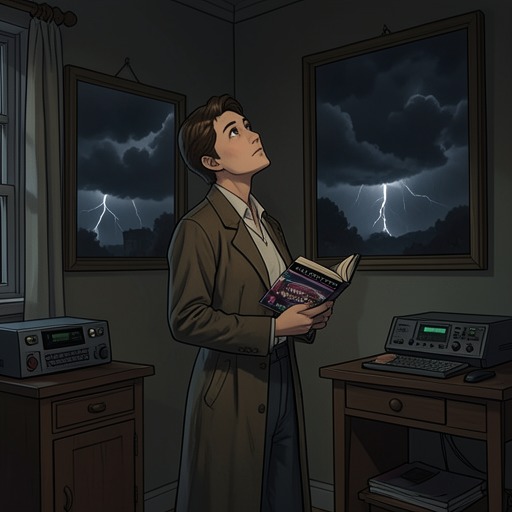
The discussion draws on a distinction proposed by Celia Green between two types. Type 1 is more common and involves seeming to wake in surroundings that are not necessarily realistic or do not resemble the dreamer’s own bedroom. Type 2 appears more realistic at first, but develops an atmosphere of suspense, apprehension, or uncanniness. The surroundings may initially seem normal before unusual sounds, movements, or a stormy and stressed atmosphere gradually become perceptible.
The account connects Type 2 false awakening with Karl Jaspers’s description of a primary delusionary experience. In both cases, the world is not necessarily altered in its immediate sensory detail, yet everything seems enveloped by a subtle, pervasive uncertainty. The person feels that something suspicious is occurring and that ordinary things have acquired a new meaning. Charles McCreery’s interpretation treats this similarity as related to sleep phenomena intruding into waking consciousness, potentially through hyper-arousal, micro-sleeps, hallucinations, delusions, or sleep paralysis.
From Dream to Worldview
The book extends Type 2 false awakening beyond sleep. For most people, death is said to involve a comparable sequence: a person awakens believing that everything is normal, only to discover that reality is radically different because consciousness has entered another body through reincarnation. In this formulation, the apparent continuity of ordinary life is itself provisional, and the final transition is imagined as a true awakening that overtakes the false one.
The same structure is applied to collective belief. The world is described as full of people who believe they have woken while remaining metaphorically asleep. Voting for billionaire plutocrat Donald Trump is offered as the central political example. His supporters may understand their vote as a revolt against the elite, but the book argues that Donald Trump belongs precisely to the Ownership Class and the 1 percent, so the vote consolidates rather than challenges elite power. The political believer therefore mistakes an image of resistance for resistance itself.
This critique also overlaps with the film They Live, written and directed by John Carpenter. In that film, an economic collapse ruins the working class while a hidden signal creates a false consciousness, conceals the ruling class’s alien appearance, and feeds subliminal messages to the population. The underground Resistance seeks to hack the signal and awaken the masses. The book treats the film as a vivid representation of the belief that people inhabit an imposed reality, while also stressing Carpenter’s association of the villains with affluent followers of Ronald Reagan rather than with the ethnic or religious targets chosen by right-wing conspiracy theorists.
Gurus, Conspiracy, and Authority
False awakening is used to question the authority of teachers who claim to have reached enlightenment. The book demands that every guru explain how a teaching produces genuine awakening rather than another false awakening. That demand is sharpened by the observation that vulnerable people can acquire false memories when authority figures ask leading questions. Charismatic gurus, the argument continues, may similarly generate false awakenings through persuasive but misleading teachings.
The resulting judgment is severe: the guru system is described as a racket that produces people who call themselves enlightened while lacking any real understanding of enlightenment. Such people are characterized as victims of false awakenings and of illusory enlightenment, also called endarkenment. The book applies the same suspicion to the Buddha, questioning whether there is evidence that his awakening was anything other than false and noting that he provided no method by which others could independently prove his claim.
The concept also exposes a contrast in the book’s treatment of conspiracy theories. It rejects Alex Jones and David Icke as purveyors of paranoid right-wing narratives, yet the surrounding argument repeatedly describes hidden control by elites, the Ownership Class, media systems, or ideological forces. Icke’s theory is summarized as a story in which humanity has been genetically manipulated by the Babylonian Brotherhood, a hybrid race of extraterrestrial reptilians associated with the Illuminati. In that account, beings linked to Draco, subterranean caverns, Babylonian mythology, fallen angels, Saturn, and the Moon impose an artificial five-sense prison that humans mistake for reality.
The book’s criticism of such theories rests on political direction as much as on evidentiary standards. In the author’s interpretation, They Live provides imagery later used by Icke, but Carpenter’s aliens symbolize right-wing wealth and power. The false awakening motif thus separates liberation from merely changing the name of the alleged controller: discovering a hidden signal is not enough if the resulting interpretation simply replaces one unverified total explanation with another.
Political and Epistemic Significance
False awakening is ultimately a model of mistaken emancipation. It describes the recurring failure to distinguish appearance from transformation: a dreamer thinks sleep has ended; a voter thinks plutocracy has been defeated; a follower thinks a guru has delivered enlightenment; a conspiracist thinks secret knowledge has replaced ordinary ignorance. In each case, the subject experiences certainty as proof, even though certainty may be the very mechanism by which the illusion persists.
The concept also supplies a formal image for the book’s attack on scientism. The book argues that an ideology can loudly demand evidence while resting, in its own view, on the unsupported claim that existence can arise indeterministically from non-existence. This parallel is important to the motif: false awakening is not confined to supernatural belief or private dreaming. Any system that treats its own premises as self-validating risks turning an apparent exit from ignorance into a deeper enclosure.
By ending with the question of whether awakening has truly occurred, the book refuses a reassuring threshold between sleep and knowledge. Its repeated awakenings are nested, contestable, and vulnerable to manipulation. False awakening therefore functions not merely as a dream state but as a diagnostic of consciousness itself: the most dangerous illusion is the conviction that illusion has already been overcome.