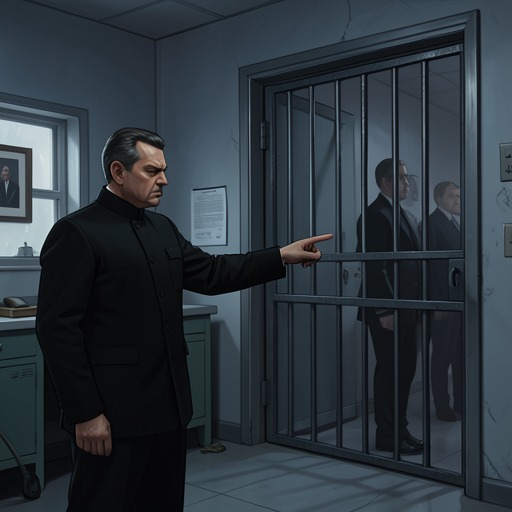
George Carlin–Donald Trump opposition
The Ownership Wars: Who Owns YouGeorge Carlin–Donald Trump opposition is constructed as one of the book’s central political contradictions. George Carlin’s critique identifies the Ownership Class—the wealthy business interests that control land, corporations, legislatures, courts, and major media—as the real power in American life. Donald Trump, described as a billionaire plutocrat with a vast property portfolio, is presented as an unmistakable member of that class. The opposition therefore does not rest on a personal quarrel; it is a conflict between an anti-oligarchic analysis and the popular elevation of one of the oligarchy’s most visible representatives.
Carlin’s Account of the Ownership Class
George Carlin’s political argument begins by rejecting the idea that elections provide meaningful freedom of choice. Politicians, in his formulation, are installed to create the appearance of popular control, while the owners control the important land, corporations, legislatures, judges, and news organizations. Lobbying allows them to spend billions pursuing more for themselves and less for everyone else. The political system is thus described as an arrangement in which formal democracy masks concentrated economic power. Carlin’s sharper concern is not only that the wealthy possess institutions, but that they shape the population that those institutions govern. The owners do not want citizens capable of critical thinking, because informed and educated people might recognize how badly the system treats them. They want obedient workers who are sufficiently trained to operate machines and complete paperwork but sufficiently disempowered to accept lower pay, longer hours, reduced benefits, the disappearance of overtime, and vanishing pensions. Social Security is likewise portrayed as another resource that the owners seek to reclaim for their financial allies on Wall Street. The image of a “big club” crystallizes this analysis. The owners belong to it; ordinary people do not. Media repeatedly instructs those outside the club what to believe, think, and buy, turning economic domination into a cultural and psychological relationship. The result is not merely exploitation from above but a population trained to defend the arrangements that subordinate it.
Trump as the Contradiction in Carlin’s Politics
The book treats Donald Trump as the clearest possible contradiction to any claim that Carlin’s anti-Ownership Class politics can coexist with support for Trump. Trump is described as one of the richest men on Earth, worth more than ten billion dollars by his own estimation, and as the holder of one of the world’s largest property portfolios. He also refused to disclose his tax affairs to the people over whom he served as President. These details make the book’s challenge concrete: if the Ownership Class means the super-rich elite who own property and rule through wealth, it is difficult to exclude Trump without abandoning the category itself. The opposition is sharpened by the question of whose interests Trump would serve. The book contrasts blue-collar workers earning roughly $30,000 a year with billionaires resembling Trump and his wealthy associates. It rejects the fantasy that a billionaire can become an instrument against billionaires merely by adopting anti-elite language. Placing such a figure in the White House is therefore interpreted not as a revolutionary attack on the elite but as the elevation of one of its leading members. The inheritance argument supplies a further material contrast between Trump’s self-presentation and the book’s class analysis. The text advocates a 100 percent inheritance tax as a way to prevent the continuation of rich dynastic elites and states that Trump inherited approximately $300 million from his father. It also reports that Trump began with $40 million in 1974, when he took over his father’s real-estate company, and notes that he nevertheless went bankrupt six times. In this account, Trump’s wealth is not evidence of having defeated the elite on behalf of ordinary people; it is evidence of inherited advantage operating within rentier capitalism.
The Carlinists’ Alleged Double Standard
The book’s most pointed charge concerns people who once claimed to agree with George Carlin but later became supporters of Donald Trump and the far right. It calls this transformation hypocritical because Carlin’s central claim is that America is governed by the Ownership Class, whereas Trump is presented as a paradigmatic member of that class. The contradiction is not treated as a minor inconsistency in political taste. It is described as a failure to apply one’s own stated principles to the political leader one admires. The contrast is reinforced through Kelly Carlin’s account of her father. Asked whether her father would support Donald Trump, she answered emphatically that he would not and said that he would recognize Trump as misogynistic and racist, even while appreciating the freak-show quality of American politics. The distinction matters: fascination with political spectacle is not the same as support for the performer who commands it. In the book’s interpretation, Trump’s theatricality may attract attention, but it cannot reconcile him with Carlin’s political commitments. The text consequently presents the choice as absolute. A person cannot, in its formulation, stand simultaneously with George Carlin’s attack on plutocratic power and with Donald Trump as its political embodiment. There is no neutral middle ground between the side of ordinary people and the side of the plutocratic elite. This uncompromising framing turns the Carlin–Trump relation into a moral and ideological sorting mechanism.
Class Power, Resentment, and Obedience
The book explains Trump’s support through a broader account of false consciousness and deference to hierarchy. It argues that the 99 percent are numerous enough to overthrow the 1 percent but often accept domination because they desire masters, seek control from above, or lack the will to pursue power themselves. The Hegelian master–slave dialectic is used to describe this structure: the master risks everything to seize power, while the slave values survival more than power and submits in order to preserve life. The book extends this philosophical model into a harsh account of the Ownership Class, which it portrays as willing to use extraordinary risk and force, and of its supporters, who long to be led and ruled. Donald Trump’s appeal is then connected to ressentiment. The book argues that his voters resented cultural elites in government, universities, and coastal regions, but directed their anger downward rather than against the billionaire elite they supported. Racial hierarchy becomes the substitute for class emancipation: white conservatives could accept being governed by a wealthy master so long as they believed themselves placed above Black and Hispanic people. Trump’s promises to restrict unwanted immigrants, build a wall, support the police, and restore an earlier vision of American greatness are interpreted as dog whistles promising to return racial minorities, women, and gay people to subordinate positions. This is why the book treats Trump support as compatible with intense rhetoric about freedom. The supporters’ freedom is depicted as a desire to be recognized and favored by the master, not a desire to abolish mastery. They revere the elite and cannot imagine political existence without it. Trump’s promise is that the elite will choose them and place them above other subordinated groups; Carlin’s critique instead insists that the ownership structure itself is the problem.
Institutions, Ideology, and the Limits of the Analogy
The opposition also extends beyond Trump personally to competing explanations of how power is maintained. George Carlin attributes political failure to the social system that produces politicians: they come from American families, schools, churches, businesses, and universities, and are elected by American citizens. His “garbage in, garbage out” formulation makes the public and its institutions mutually responsible for the political result. The book applies that logic directly to Trump’s presence in the White House: Americans put him there, so responsibility cannot be displaced onto an imagined external enemy. The book further insists that politicians are secondary actors compared with wealthy business interests. Education is said to remain inadequate because the real owners do not want a genuinely educated population, and politicians merely read the script prepared by the Ownership Class. A proposed “virtual corporation” for ordinary taxpayers offers a contrasting institutional response: by joining together to hire lawyers, accountants, and tax specialists, individuals could obtain treatment closer to that available to large corporations. Collective organization would prevent the tax system from separating and intimidating them one by one. At the same time, the book’s strongest comparisons are polemical rather than demonstrated historical equivalences. It calls the Trump insurgency “The Confederacy: The Sequel,” links it to racism, white supremacy, and ultra-plutocracy, and presents it as Ayn Rand’s Atlas Shrugged made real. It also compares contemporary employment under capitalism with slavery and describes right-wing resistance to government taxation and regulation as a defense of the power to enslave. These analogies express the scale of the book’s condemnation, but their force depends on the shared features the text selects—hierarchy, property, racial domination, and resistance to public authority—rather than on an identity between the historical systems.
Narrative and Political Significance
The relation between George Carlin and Donald Trump ultimately functions as a diagnostic of political consciousness. Carlin’s language strips away the performance of representative government and directs attention toward ownership, media control, labor discipline, and the distribution of wealth. Trump’s political success, as the book interprets it, demonstrates how effectively a member of the Ownership Class can present himself as an enemy of the elite by mobilizing resentment, spectacle, and racial hierarchy. The contrast is also embedded in the book’s wider cultural argument. They Live, discussed through John Carpenter’s comments, is presented as a critique of yuppies and unrestrained capitalism rather than a coded attack on Jews or the Illuminati. Its hidden signal and revealing glasses become an image for ideology: beneath propaganda and apparent freedom lies an invisible order sustaining domination. Carlin’s analysis performs a similar unveiling, while Trump’s support is presented as the refusal to recognize what the glasses would reveal. The final significance of the opposition is therefore not that George Carlin offered a complete political program and Donald Trump merely violated it. Rather, the relation exposes a recurring mechanism of elite rule: popular anger can be redirected away from the wealthy and toward weaker groups, allowing the dominated to defend the very hierarchy that governs them. In the book’s terms, supporting Trump while claiming Carlin’s politics is the purest form of that reversal—an anti-elite identity converted into loyalty to the elite.