Meritocracy
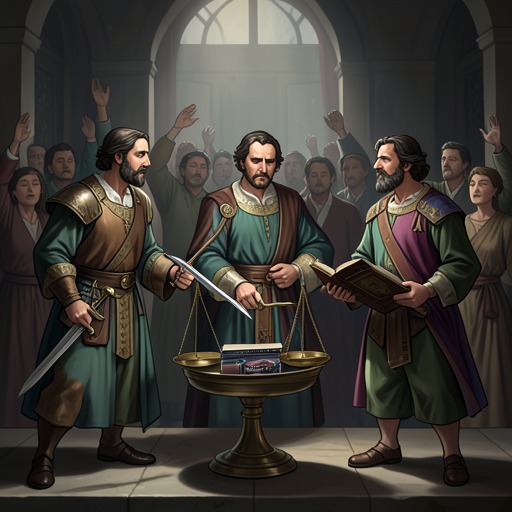
The Ownership Wars: Who Owns YouMeritocracy is the book’s proposed replacement for hereditary privilege and Ownership Class rule. It is defined not merely as rewarding individual ability, but as reorganizing political power, taxation, education, inheritance, and economic management so that opportunity depends on merit rather than family birth. Against Donald Trump as the emblem of inherited wealth, the book imagines Meritocracy as the institutional basis of a more rational, egalitarian, and intellectually governed society.
Definition and Political Purpose
Meritocracy is set against the hereditary principle, understood as the transfer of power, wealth, and status from one generation of a family to the next. The book treats this principle as the mechanism by which the 1%, the Ownership Class, and the Old World Order preserve a permanent social hierarchy. Inheritance allows private family wealth to become public power, while nepotism and cronyism convert economic advantage into political influence. Meritocracy therefore begins with a rejection of the idea that birth should determine a person’s authority or life chances.
The book presents Meritocracy as an alternative to both plutocracy and communism. Its proposed model is rational capitalism, also called social capitalism, in which publicly elected and accountable meritocrats control the economy in the interests of the whole country rather than leaving decisive power to unelected bankers, corporate heads, and super-rich owners. Capitalism is not rejected as such; it is to be governed so that its productive capacity serves the common good instead of allowing the rich to accumulate ever greater wealth and control.
Inheritance, Class, and the Trump Contrast
Donald Trump functions as the book’s central negative example. The text insists that he is not a self-made man but the product of privilege, inheritance, nepotism, and cronyism. He took over his father’s business and inherited a fortune, making him, in the book’s argument, the opposite of a meritocrat. A proposed 100 percent inheritance tax is offered as the simplest means of preventing the formation of a permanent dynastic elite; had such a tax existed for the previous century, the text argues, figures such as Trump would not have been elevated by inherited wealth.
The argument is reinforced with concrete claims about Trump’s starting position. The New York Times is cited for the estimate that he inherited around 300 million dollars from his father, while the National Journal is cited as saying that he began with 40 million dollars in 1974, when he became president of his father’s real-estate company. These details are used to dismantle the mythology of self-made success and to show how easily inherited capital can be mistaken for personal merit. The book also links Trump’s refusal to release his tax returns to the broader capacity of the wealthy to conceal or minimize their obligations through lawyers, accountants, lobbyists, and public-relations specialists.
Meritocracy is consequently presented as a class conflict over who should inherit the future. The text declares its opposition to billionaire plutocrats, to allegiance to the 1%, and to abolishing inheritance tax in order to create a permanent hereditary caste of the super-rich. Trump’s insurgency is described as a return of far-right conservative rule founded on racism, white supremacy, and ultra-plutocracy, and is compared to the world imagined in Ayn Rand’s Atlas Shrugged. In this framing, support for Trump is not an anti-elite revolt but a form of false consciousness in which people defend a member of the elite while claiming to oppose elite rule.
Economic and Institutional Program
The book’s Meritocracy requires institutional change rather than a mere change of rhetoric. It calls for replacing the hereditary principle with the meritocratic principle and for subordinating the private family to society or the community. The family, in this account, must not be allowed to rule the public sphere simply because it controls inherited wealth. The principle is extended to education: private schools are to be abolished because parental wealth should not determine a child’s opportunities.
Taxation is another central institution. The text describes two tax systems, one designed for corporations and the super-rich and another imposed on ordinary people, who lack the expensive professional assistance available to the powerful. Its proposed response is a “virtual corporation” through which ordinary citizens could collectively obtain lawyers, expert accountants, and tax specialists, preventing them from being isolated and intimidated by the tax system. The wider aim is uniform treatment: corporations should be treated like ordinary people, or ordinary people should receive the same advantages available to corporations, with no special deals or separate laws for the strong and the weak.
The book also proposes making taxation automatic by taxing every payment entering a bank account. Such a system would eliminate tax returns and make it difficult to launder, hide, offshore, avoid, or evade income. The proposal is connected directly to the demand for transparency from public officials: a person holding public power should not be permitted to conceal tax affairs from the public. Meritocracy thus depends on administrative capacity and common rules, not merely on selecting supposedly talented leaders.
Jacobin and Intellectual Dimensions
The preferred political form is described as Jacobin Meritocracy. The book presents it as the only way to smash rule by the rich and argues that people in the White House should serve the General Will, the Commonwealth, and the Common Good. The Jacobin reference places Meritocracy within a revolutionary tradition opposed to dynastic power, while the accompanying language of rationalism, logic, illumination, and ontological mathematics gives the project an explicitly intellectual character.
This intellectual dimension distinguishes the book’s ideal meritocrat from a merely wealthy or technically successful person. The text contrasts “Last Men,” who choose capitalist democracy as presently constituted, with “Supermen,” who choose Meritocracy. Human fulfillment is represented as a transformation from ordinary mortality into an optimized and potentially immortal condition; the goal is not to optimize only the top 1% but to optimize humanity as a whole. The resulting conflict is described as zero-sum: either the Ownership Class continues its rule, or the broader population succeeds and brings that rule to an end.
The book extends the same principle to science. It argues that scientific rationalists and idealists such as Gottfried Wilhelm Leibniz and Kurt Gödel have been constrained by a scientific Ownership Class seeking total control over knowledge. It proposes that discoveries should be presented through both conventional scientific materialism and empiricism and their philosophical inverse, scientific idealism and rationalism. In this vision, meritocratic authority is linked to logic, deduction, mathematics, and a priori reasoning rather than to institutional orthodoxy alone.
Universal Admission and New Humanity
Meritocracy is not defined by race, sex, sexuality, or inherited social identity. The proposed New Hyperborea would admit the finest minds regardless of whether they were male or female, black, white, or any other color, straight or gay, and regardless of whether they came from poor or rich backgrounds. People from wealthy families would be eligible only if they repudiated inheritance, privilege, cronyism, and nepotism, which the book identifies as the foundations of anti-meritocracy.
The project is therefore presented as a reconstruction of humanity itself. Old Humanity is said to have failed, and its values must be rejected and revalued. The book distinguishes this ideal from Nazi racial mythology: Nazi Germany is described as a perversion of Nietzschean philosophy centered on an unsublimated, brutal, racist warrior, whereas the desired figure is the sublimated Superman represented by the genius, artist, and great soul. The exemplary ruler would be a Caesar with the soul of Pythagoras, Plato, Leibniz, Goethe, or Friedrich Nietzsche, combining power with philosophical and creative excellence.
Historical Role and Narrative Function
Meritocracy is introduced as the potential backlash to Trump’s “insane plutocracy.” The Trump experiment is interpreted as an attempt by the Old World Order to test whether democracy can be displaced by a direct representative of the elite, rather than by the conventional political class that normally serves as a buffer between the rich and the population. Because Trump is described as an actual member of that elite, his rise is said to expose the system’s underlying structure and create the opening for Meritocracy to emerge as an opposing program.
The concept also supplies the book’s answer to the class divisions associated with capitalism. The narrative recalls an earlier form of predatory capitalism in which workers hated the Ownership Class, then argues that the creation of a middle class provided the elite with collaborators, managers, gatekeepers, and enforcers. Meritocracy is intended to break this arrangement by making public institutions serve the commonwealth rather than reproduce class inheritance. Its opponents are accordingly linked to the Confederacy, slavery, unrestrained predatory capitalism, and the modern Republican right; the book calls for a new Abraham Lincoln to end not only the Confederacy as a physical entity but also its survival as a mental and economic ideology.
The same structure appears in the book’s reading of They Live. The film’s hidden signal produces false consciousness, disguises the elite, and prevents the working class from seeing its near enslavement to the rich. Meritocracy occupies the position of the awakening and counterforce: the social order that would expose the mechanisms by which wealth, media, taxation, and inherited power reproduce domination. Its significance lies less in a settled constitutional blueprint than in its role as the book’s organizing ideal—a demand that ability replace ancestry, accountability replace ownership, and collective human development replace the optimization of a dynastic minority.