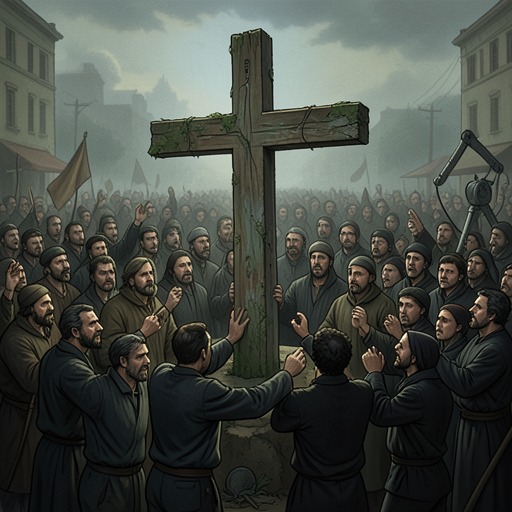
Protestant Reformation
The Ownership Wars: Who Owns YouThe Protestant Reformation is treated as a decisive precedent for the book’s account of modern right-wing politics: a protest against centralized authority that, in this interpretation, elevated individual conviction above shared standards of reason and knowledge. Its legacy is then traced through American conservatism, libertarianism, and the political support of Donald Trump.
Rebellion Against Church Authority
The book identifies Martin Luther as the spiritual “First American” because he proclaimed the primacy of individual, subjective faith in an inerrant Bible over reason and institutional religious authority. Protestantism is therefore characterized as a protest against the authority of the Roman Catholic Church, which the text presents as a “Big State” or an authoritarian and oppressive government. The important continuity is not a detailed history of the Reformation but a political and psychological pattern: resistance to an established authority is transformed into the claim that personal belief should override collective standards.
Luther’s hostility toward the Roman Catholic Church is paraphrased through a series of attitudes associated with modern right-wing Americans: no authority should dictate an individual’s conduct; personal conviction should outrank expert judgment; and private beliefs, opinions, and experiences should determine what counts as truth. The Reformation thus functions in the book as an origin story for a broader anti-authoritarian temperament, rather than simply as a religious conflict within Christianity.
From Protestantism to Right-Wing America
The book explicitly compares Protestantism’s protest against ecclesiastical authority with right-wing America’s protest against the State, government, experts, reason, logic, knowledge, qualifications, intelligence, and meritocracy. The analogy depends on a shared rejection of mediating institutions. In both cases, authority is viewed with suspicion, while the individual’s immediate conviction is treated as sufficient grounds for judgment.
This historical continuity culminates in the book’s description of contemporary America as “Dunning-Kruger America,” with Donald Trump cast as its “Dunning-Kruger President.” The comparison is not offered as a neutral genealogy. It is an indictment: the author argues that the rejection of expertise has become a political identity, allowing confidence and personal belief to substitute for competence, evidence, and earned qualification.
Authority, Capitalism, and Political Inheritance
The Reformation’s anti-authoritarian legacy is placed within a larger critique of institutions that organize wealth and power. The book contrasts the Protestant rejection of the Roman Catholic Church with modern resistance to taxation and government intervention, while also arguing for a strong State capable of restraining predatory capitalism. Its proposed 100% inheritance tax is presented as a way to prevent the perpetuation of a dynastic elite and to eliminate the inherited wealth associated with Donald Trump.
The text also links the modern class system to the historical development of capitalism. It describes early capitalism, pioneered by the British Empire, as a system in which workers broadly opposed the Ownership Class; it then argues that the creation of a middle class helped the elite preserve itself by producing aspiring intermediaries and supporters. In this framework, the Protestant pattern of opposition to centralized authority does not necessarily liberate the majority. It can instead produce individuals who resist the State while defending inherited wealth, private power, and the interests of the Ownership Class.
Reason, Science, and the Ownership Class
The book extends its critique from religion into the philosophy of science. It argues that the “conspiracy against Leibniz” and Kurt Gödel, as well as against scientific rationalists and idealists generally, reflects a desire by the scientific Ownership Class to control science and exercise unchallenged power. Against conventional scientific materialism and empiricism, it proposes a rival orientation based on scientific idealism and rationalism, logic, deduction, mathematics, and a priori analytic reasoning.
Within that argument, the Reformation’s elevation of individual faith becomes the negative counterpart of the book’s demand for a more rigorous intellectual order. The author does not treat all religious belief as intrinsically invalid; instead, the central target is the displacement of reason by private certainty. The same structure is said to reappear when political actors reject experts, qualifications, and evidence because these authorities conflict with their personal beliefs.
Historical Analogy and Polemical Function
The Protestant Reformation is not reconstructed in its full historical complexity. It is used as a compressed historical analogy through which the book interprets later conflicts over the State, capitalism, taxation, science, and political legitimacy. The analogy gives the author a long historical arc: religious protest against the Roman Catholic Church is connected to anti-government politics, right-wing capitalism, and the political culture surrounding Donald Trump.
That use of history is deliberately confrontational. The Reformation becomes less a completed religious transformation than a recurring political form: opposition to an established authority, distrust of expertise, and insistence that personal conviction should govern public life. In the book’s final synthesis, this legacy helps explain how a movement that claims to oppose elites can support a billionaire president and defend institutions that reproduce concentrated wealth. The Protestant Reformation therefore serves as both historical precedent and polemical warning about the consequences of turning resistance to authority into hostility toward reason itself.