Anti-Roma prejudice and persecution
The Painted BirdAnti-Roma prejudice and persecution determine how The boy is seen, treated, and kept at risk in The Painted Bird. His dark appearance and unfamiliar speech invite people to assign him an identity he cannot safely escape; under occupation, that classification can endanger both him and anyone who offers shelter. The novel shows persecution not only as official policy, but also as a repeated social practice: suspicion, avoidance, public humiliation, and the readiness to treat a vulnerable child as a threat.
Appearance, Speech, and Social Classification
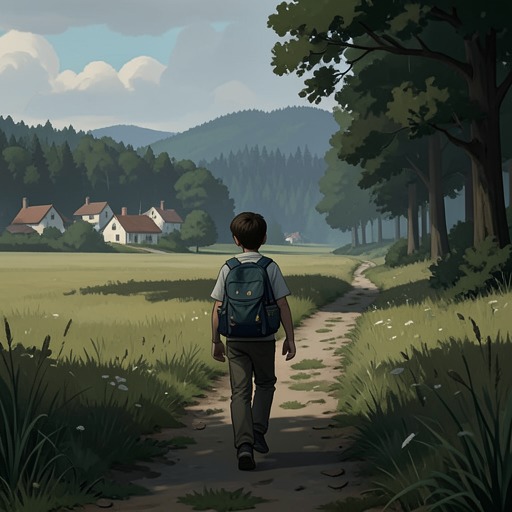
Separated from his parents amid wartime population transfers, The boy spends four years in villages whose inhabitants differ markedly from him. The peasants are described as fair-haired and light-eyed, while he is olive-skinned, dark-haired, and black-eyed. He speaks the language of an educated class, which local people can barely understand. Appearance and speech therefore become immediate, visible grounds for treating him as an outsider, before they know anything about his family or past.
The consequences extend beyond insult. The villagers regard him as a Roma or Jewish stray, and German occupation makes sheltering either group dangerous: people and communities who harbor them may face severe punishment. The boy’s presence can thus expose those around him to danger, giving prejudice a coercive force beyond personal dislike. In a region where the customary order favors the strong and wealthy, he has little protection against the judgments of those who control food, shelter, and work.
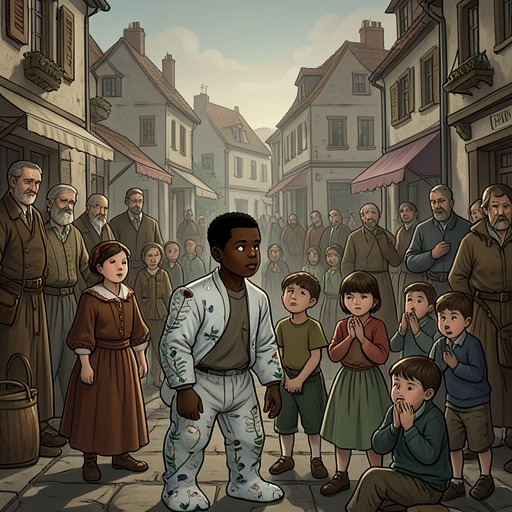
That classification is repeated in ordinary encounters. When a crowd gathers around him, its members speak in a dialect he does not know; dogs are held nearby, and the people’s suspicious looks frighten him. At a farm, adults inspect him and repeatedly call him Roma, while his attempt to communicate in his own language provokes laughter. The owner later makes him perform for guests, displaying his rapid, urban speech as an oddity. The same difference that marks him as suspect can be turned into entertainment, without granting him a voice that others will recognize as authoritative.
Folk Beliefs and the Stigma of Dark Eyes
Local superstition supplies another language for explaining and policing the boy’s difference. Marta attributes sickness to the evil influence of dark eyes, including his, and orders him to avoid looking directly at her or the household animals. Her rules make his gaze itself seem dangerous: he is told to spit three times and cross himself if he looks into the wrong eyes. The belief is not merely an abstract suspicion; it governs his movements and helps make ordinary features appear threatening.
Olga the Wise One develops this association into a broader account of supernatural danger. She calls the boy the Black One and teaches him that his dark eyes mark him as possessed by an evil spirit, capable of casting spells without intending to. She suspects he may also be a vampire and gives him a bitter drink with garlicked charcoal to restrain the supposed danger. Other villagers cross themselves, pregnant women flee, and bolder peasants set dogs on him. Olga’s presence offers some protection, but it does not remove the stigma: away from her hut, the boy must rely on escape.
These episodes show how folk explanations can turn an imposed identity into a supposed bodily menace. The boy is not only classified as Roma or Jewish; his eyes are also treated as evidence that he may bring illness or harm. The result is a double bind: a feature that makes him vulnerable to persecution is recast as a reason to fear and avoid him.
Occupation, Exposure, and Local Complicity
The danger follows him even when the people holding power belong to different groups. When Partisans find the boy hidden in an attic, they assume he is a Roma foundling. They decide to send him to a German outpost, reasoning that this will make the commander less suspicious of a village already behind on its compulsory deliveries. One of them warns that the village could be burned because of a single child identified as Roma. The scene makes clear that persecution is sustained not only by direct orders, but also by people calculating how to protect themselves from the occupying power by passing the danger on.
At another farm, the boy tries to avoid suspicion by answering cautiously when questioned about his past. The farmer repeatedly asks whether he is a Jewish or Roma orphan. The boy insists that he is a Christian and an obedient worker, and the farmer eventually hires him. His employment offers temporary security, but acceptance depends on his usefulness and on his ability to reassure the farmer; it does not undo the suspicion surrounding him.
The pressure becomes more explicit during the mushroom season, when the farmer shaves the boy’s black hair and gives him a large cap to make him less conspicuous. Meanwhile, stories circulate about trains carrying Jews and Roma to their deaths. The villagers interpret the persecution of Jews through religious prejudice, presenting it as deserved punishment, and direct threats at the boy as someone they identify with the targeted groups. Even when he tries to appear unconcerned, he privately wonders whether people with dark hair and eyes are all destined to die, and what such divisions mean for children born into families with different features.
The Railway and the Scale of Persecution
The railway scenes widen the subject from the boy’s treatment in individual villages to the organized persecution described in the novel. Locked freight cars carry Jews and Roma toward concentration camps. The villagers hear accounts of the sorting of prisoners and the removal of their possessions, but many respond with curiosity or religious justification rather than solidarity. When trains pass, some villagers wave to the railway workers and guards; people visible through the small windows wave back, apparently mistaking the greeting for welcome. The scene sets the villagers’ friendly gestures against the passengers’ desperate signals.
The boy also sees what happens around the tracks. People search for those who have fallen from trains, and the treatment of the dead reflects the same hierarchy of value that governs their treatment of living outsiders. In one episode, villagers find a young, badly injured child near the railway. They fear his dark eyes; after he dies, they take his clothes and leave his body where the German patrol will find it. Later, the boy picks up human ash from beside the line. Unable to identify a person in it, he fears that the dead will remain with him as a haunting presence. Prejudice here reaches beyond immediate violence: the victims are made anonymous, while their remains and personal possessions enter the surrounding landscape.
The author’s later discussion of criticism distinguishes the novel’s literary scenes from the historical material he cites in its defense. He refers to a survivor’s testimony about the destruction of an Eastern European village and to camp documents recording the killing of children considered unfit for labor, as well as records concerning Jewish and Roma victims. He argues that such testimony complicates claims that the novel exaggerates wartime brutality. This distinction matters: the novel portrays how prejudice works through the boy’s experiences, while the cited documents establish that organized persecution and mass violence were not merely inventions of its plot. Together, they frame anti-Roma prejudice as both intimate and systemic: a child can be marked by his appearance in a village, while the larger machinery of persecution turns that mark into a sentence of exclusion and death.