Birds
The Painted BirdBirds in The Painted Bird are animals in the boy’s daily world and the novel’s defining image of exclusion: a creature altered so that its own community treats it as an alien. Their recurring presence connects practical trapping and trade with a symbolic pattern of separation, attempted return, and rejection.
Symbolic Origin and Meaning
The image draws on a peasant custom the author says he witnessed in childhood. Villagers trapped birds, painted their feathers, and released them; the birds’ own flocks then attacked the conspicuously changed newcomers. The author joined this memory to the symbolic use of birds in Aristophanes’ play The Birds, where a natural setting allowed the handling of real events and figures without the constraints of historical writing. For The Painted Bird, the image helped establish a mythic, timeless setting, deliberately unbound from a particular geography or history.
The bird’s altered appearance is crucial to the pattern. Painting does not change its longing to rejoin its fellows, but it changes how the flock sees it. The bird tries to return to a familiar group and instead becomes more conspicuous through the very colors applied to it. In this emblem, belonging depends not on the creature’s own sense of kinship but on the group’s response to visible difference. The scene gives the book’s title its literal source while also establishing a figure for the vulnerability of an outsider.
Capture, Labor, and Exchange
The boy encounters Birds first as part of his work for Lekh, who sells them in neighboring villages. Lekh takes him on because he is small, thin, and light enough to reach trapping places that Lekh cannot: slender branches, dense patches of nettle and thistle, and waterlogged islands in bogs and swamps. The boy’s body thus determines his place in the bird trade. He is useful precisely because his smallness lets him enter spaces beyond an adult trapper’s reach.
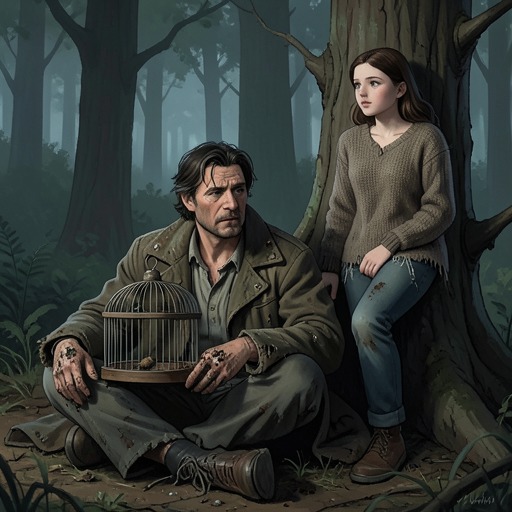
Lekh has no family, and his hut is filled with Birds of many kinds, from sparrows to owls. He carries caged birds from village to village, displaying their beauty and songs in exchange for food and other necessities. The trade makes birds both living presences and a means of subsistence: villagers barter milk, butter, sour cream, cheese, bread, sausage, vodka, fruit, and cloth for them. Their captivity sustains Lekh, while their appearance and singing are the qualities he offers to buyers.
Trapping continues as a repeated routine rather than a single encounter. At dawn Lekh and the boy approach nests; later, they remove the Birds caught in traps set the previous day. Lekh handles each captive, sometimes soothing it and sometimes threatening it, before placing it in a large bag. As the prisoners struggle and gradually quiet, the birds’ friends and relatives circle overhead. Lekh answers their presence with insults, and, when they persist, uses a sling to drive them away. The scene places the captured animal’s distress beside the flock’s attempt to remain near it, making the separation part of the work itself.
The Painted Birds
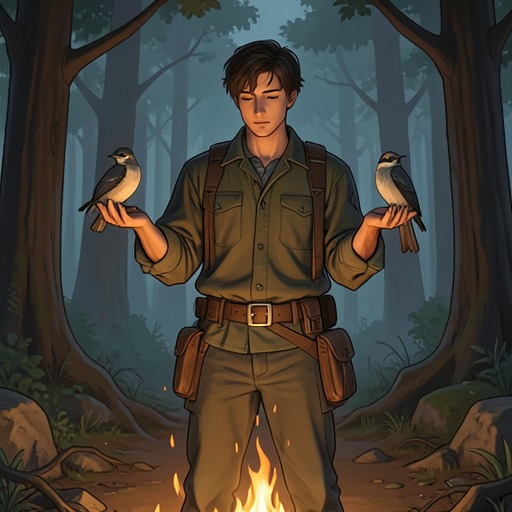
When Stupid Ludmila fails to appear in the forest, Lekh grows angry and withdrawn. He eventually selects the strongest bird in its cage, ties it to his wrist, and prepares paints from varied ingredients. He covers its wings, head, and breast in vivid colors. The boy then holds the bird lightly in the forest, where its calls attract a flock of its own kind. Once enough birds gather, Lekh signals for the captive to be released.
The released bird flies toward the flock and tries to join it. At first the group is confused; then the bright coloring marks the newcomer as different, and the Birds drive it away. The boy and Lekh later find the painted bird dead. The scene repeats the childhood custom described in the author’s account of the novel’s conception, but in the story it also belongs to Lekh’s response to Ludmila’s absence. He paints and releases one captive after another, making the practice more than an isolated demonstration: it becomes a repeated action during a period of loss and resentment.
The pattern reaches a particularly stark form with a raven. Lekh paints its wings red, breast green, and tail blue, then releases it when a flock gathers above the hut. The flock attacks, and the bird falls to the ground still alive but unable to take flight. The scene ends not with a successful return but with the collapse of the bird’s effort to rise again. Its many colors, intended to make it striking, instead ensure that it cannot pass unnoticed among its own kind.
Narrative and Thematic Role
Birds give the novel a recurring natural image through which difference becomes visible and the limits of belonging become legible. Their flocking, calling, and attempts to stay near captured companions are not simply background to human action: they shape the boy’s labor and expose what that labor costs the animals. The birds above the trapper’s bag answer captivity with collective presence, even as Lekh’s sling forces them away.
The painted bird concentrates that tension into a compact sequence: capture, alteration, release, attempted reunion, and rejection. Its return to the flock does not restore its former place, because the group responds to its changed appearance rather than to its attempt to join. That structure resonates with the novel’s governing image of the outsider without reducing the birds to a simple allegory. They remain creatures trapped and traded by people, and the boy witnesses both their ordinary captivity and the deliberate destruction that follows their release. Through them, the book’s title joins an observed village custom to a broader, unsettling account of how difference can turn the hope of belonging into exposure.