Children’s home
The Painted BirdThe Children’s home is the boy’s temporary postwar address: a crowded institution that offers shelter while exposing how little safety or belonging can be guaranteed to children displaced by war. Spread across several old houses on a side street, it receives him amid a city full of soldiers and returning crowds. Inside, official routines, scarcity, and the children’s unease shape daily life. The boy resists the institution’s efforts to remake him, clinging to his uniform and to the hope of returning to Red Army instructor Gavrila. His later departure with his birth parents does not erase the attachments and conflicts formed there.
Setting and Admission
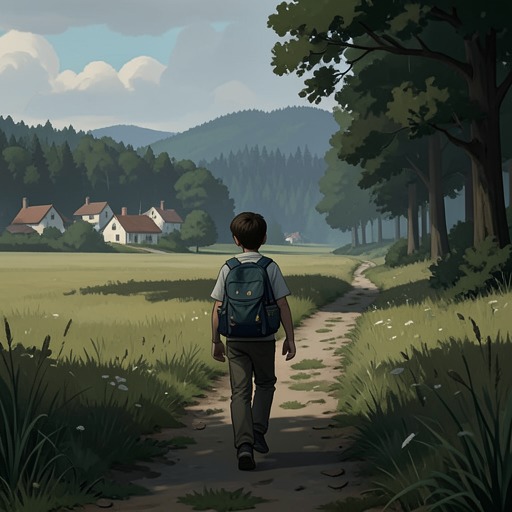
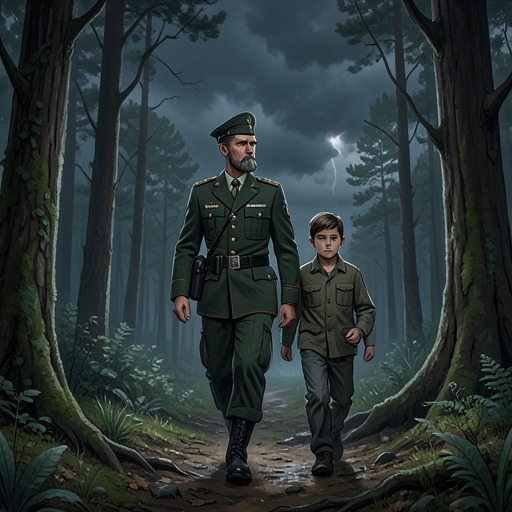
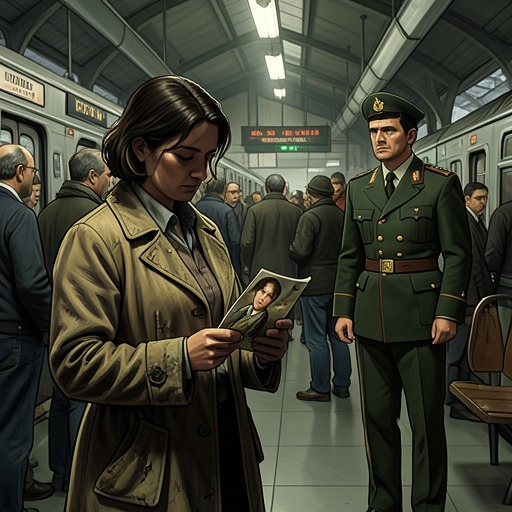
The Children’s home occupies several old houses, with children visible at the windows when the boy arrives. After leaving the station, he and Yury reach it in a military driver’s vehicle, passing through a city crowded with military convoys, soldiers, and people on the sidewalks. The journey from the station to the home places the institution within a landscape of movement and upheaval, even as its buildings become a place where children are gathered and kept.
The boy and Yury wait for an hour in the lobby. Yury reads a newspaper while the boy tries to appear indifferent. When the principal comes to them, she takes the folder containing the boy’s documents, completes paperwork, and rests a hand on his shoulder. He shakes it off. The gesture establishes his suspicion of institutional authority before he has settled into the home, and his parting from Yury makes the admission personal as well as administrative. Yury jokes, straightens the boy’s forage cap, and tightens the string around the books inscribed by Red Army sniper Mitka and Red Army instructor Gavrila. They embrace, while the principal stands by.
Crowding and Institutional Discipline
The home holds five hundred children, divided into groups for lessons in small, poorly equipped classrooms. Desks and blackboards are scarce, and the children’s experiences of war are visible in their different needs and ways of behaving. One boy repeatedly asks for his father; another child has lost her fingers in an explosion, and a boy with serious injuries depends on others to feed him. Several children are partly paralyzed. The classroom is not presented as a single, orderly community: fear and uncertainty shape how its inhabitants look at and respond to one another.
The boy’s inability to speak makes him a target for older, stronger pupils, who mistake his silence for intellectual disability, insult him, and sometimes beat him. He sleeps badly in a crowded dormitory and worries that defending himself could injure someone and cost him his chance of returning to Gavrila. The home therefore provides shelter without resolving his sense of danger. Its shared rooms bring children together, but do not make them feel secure with one another.
Institutional rules also collide with the boy’s chosen identity. The principal wants him to give up his uniform and wear civilian clothes supplied to the children by the International Red Cross. He refuses and sleeps with the uniform under his mattress. After staff take it from him by force, he runs into the street and appeals in writing to four Soviet soldiers. He presents himself as the son of an officer at the front and accuses the principal and nurses of hostility to the Red Army and of mistreating him. The soldiers follow him back; their disruptive intervention frightens the staff, who thereafter leave him alone. His protest does not persuade the institution to recognize his account as true, but it changes how freely its employees challenge him.
His resistance extends to lessons in his mother tongue. When teachers ignore his refusal, he writes on the blackboard that Russian is his language and links it to a society without exploitation or teachers persecuting pupils. This declaration turns a classroom into a place where he can assert an allegiance of his own. Outside lessons, he slips out daily to buy Pravda with money from Gavrila, reading reports of military victories and looking at new pictures of Stalin. These habits sustain his expectation that the war will end and that he will return to his absent companions.
The Silent One and Life Beyond the Rules
The Children’s home is also where the boy gradually becomes friendly with The Silent One, an older, stronger child who acts as though he cannot speak. The other children know that The Silent One can speak but has chosen not to, and even a beating fails to make him answer them. At first the boy avoids him: because the boy himself cannot speak, he fears that friendship with someone who has voluntarily stopped speaking will make others suspect that his silence is a choice too.
Their relationship changes when The Silent One comes to the boy’s rescue in a corridor, knocking down a pupil who is attacking him. The next day, the boy takes The Silent One’s side in a schoolyard scuffle. They begin by exchanging written notes and then communicate through signs, making a small private language within an institution where the boy’s silence has been used to mark him as an outsider. They sit together at the back of a classroom and leave the home together on expeditions around the city. The Silent One accompanies the boy to the railway station, where they make friends with departing Soviet soldiers, and across a park still closed because of land mines. At night they sneak out of the dormitory to roam nearby squares and courtyards and harass unsuspecting passersby; The Silent One, being taller and stronger, takes the active role in these escapades.
The pair’s adventures do not make the home disappear from their lives: they return to it, and it remains their point of departure. Two weeks after the boy has been injured in an incident outside the institution, The Silent One wakes him at dawn and leads him to a derelict hut near the railway crossing. The boy does not know what his companion intends. After the subsequent railway disaster, they return to the home before the other children wake. The episode connects their secret life beyond the institution to the anxieties and consequences that reach back into it. In the days that follow, the disaster dominates school talk, while newspapers print lists of casualties and police search for suspected saboteurs.
Departure and Aftermath
The home becomes the setting for the boy’s eventual reunion with his birth parents. A teacher summons him to the principal’s office, where the principal and a member of the Social Commission wait. The commissioner, who had earlier questioned the boy about his parents, is present again; voices from an adjoining room precede the arrival of a man and a woman. The boy’s departure is not simply another administrative transfer: his parents come to take him away, ending the period in which the institution has been his assigned home.
Before leaving, he and his parents go to say goodbye to The Silent One. The Silent One looks at them suspiciously, shakes his head, and refuses to greet them. Outside, the father carries some of the boy’s books as the family moves through streets crowded with people returning to homes and arguing with wartime occupants. The boy feels his parents’ hands on his shoulders and hair, but their care is also overwhelming to him. The departure thus gives him a family without immediately resolving his difficulty in receiving protection or adjusting to a changed household.
After he moves in with his parents, the boy continues to leave secretly to meet The Silent One. One day The Silent One fails to appear; staff at the home later tell the boy that his friend has been transferred to another city. The institution consequently remains a point of attachment even after it is no longer his residence. The boy visits frequently, hoping to find a letter from Gavrila or Mitka, but none arrives. When news comes in May that the war is over, the home and its absent comrades still belong to an unfinished transition: the boy learns that not all armies will return home soon, and that Germany’s occupation may keep Gavrila and Mitka away for years.
Narrative Significance
The Children’s home brings together several kinds of postwar separation: children are divided from parents, the boy is separated from his comrades, and companions can themselves be moved elsewhere without warning. Its scale and crowded classrooms give the boy’s individual vulnerability a social setting, while his uniform, newspaper reading, and written declarations show how he tries to preserve a sense of identity within institutional routines. Neither the home’s rules nor the soldiers’ intervention settles the truth of his claims; instead, the episode reveals how power and protection can depend on the adults or authorities a child manages to enlist.
The home also frames a movement from imposed company toward chosen attachments and then back toward family. The boy’s bond with The Silent One grows through shared silence, signs, and mutual defense, while his eventual reunion with his parents takes him out of the place where that bond formed. Yet the transfer of The Silent One and the continued absence of Gavrila and Mitka prevent departure from functioning as a clean conclusion. The Children’s home is a temporary refuge, but its strongest narrative effect is to make the boy’s fragile connections visible: some begin there, some are lost there, and others remain beyond its walls.