Cuckoos
The Painted BirdCuckoos occupy both the practical and the fantastical sides of the bird lore associated with Lekh: their first call of the season prompts everyday calculations and predictions, while their way of raising young becomes the basis for a story of noblemen trapped in bird form. The two accounts turn the bird into an omen and a figure of human transformation.
Seasonal Omens
The cuckoo’s first call of the year was treated as a signal requiring an immediate response. A man who heard it was supposed to jangle the coins in his pockets and count his money, thereby securing at least the same amount for the rest of the year. The custom makes the bird’s voice a prompt for an attempt to influence future fortune through a small, specific action.
The call also guided thieves. They were advised to remember when they first heard the cuckoo: if it sounded before the trees had leaves, they should abandon their plans, since the robbery would fail. The bird’s seasonal timing thus served as a warning, with the spring landscape determining whether an intended crime should proceed.
Lekh’s Story of the Cuckoos
Lekh had a particular affection for cuckoos and interpreted them not simply as birds but as people who had been changed into birds. In his account, they were noblemen who appealed to God in vain to restore them to human form. Their cries could therefore be imagined as petitions, giving the familiar bird call a human history and an unresolved longing.
He found further evidence of their noble ancestry in their treatment of their young. Cuckoos, he said, did not undertake their offspring’s upbringing themselves; they hired wagtails to feed and care for them. While the wagtails performed that work, the cuckoos continued to fly through the forest, calling on the Lord to change them back into gentlemen. The contrast between delegated care and their continued wandering is central to Lekh’s explanation: what might otherwise seem like a bird’s behavior becomes a sign of former rank and present exile.
Forest Setting and Meaning
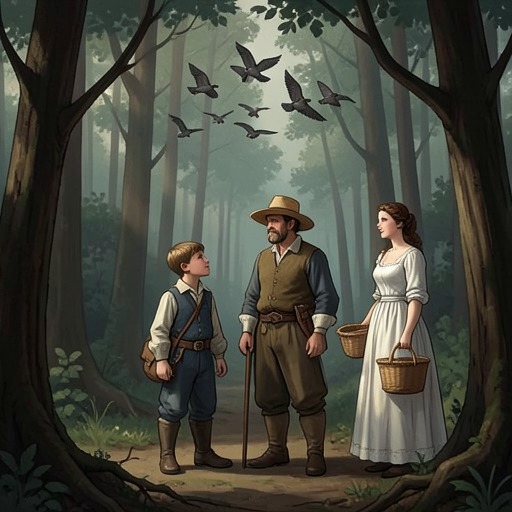
Lekh’s accounts belong to a world in which birds are watched for signs and their behavior is made to carry human meaning. In the surrounding forest, the trees form a dense, forbidding landscape, and perching flocks take flight when the travelers pass. The setting gives the bird lore a tangible natural world, while Lekh’s explanations transform that world into a place populated by omens, supernatural forces, and imagined histories.
The cuckoo’s place in this lore rests on a productive contrast. Its seasonal voice has practical consequences in folk belief, affecting how people count money or judge the prospects of a robbery; Lekh’s story, by contrast, makes the bird a figure of lost identity and frustrated return. Neither account offers detached natural observation: each reads the cuckoo as a bearer of meaning, whether for human fortune or for the imagined fate of transformed noblemen.