Folk magic and superstition
The Painted BirdFolk magic and superstition in The Painted Bird provide a working explanation for dangers that otherwise seem invisible or uncontrollable. Through Marta, Olga the Wise One, and Lekh, the boy encounters beliefs that connect illness and death to spirits, eyes, animals, and ritual mistakes. These ideas are not presented as a single doctrine: they differ from one practitioner to another, but each gives fear a recognizable cause and prescribes actions meant to avert harm. Their importance lies both in what villagers believe and in how those beliefs organize care, caution, expertise, and social standing.
Marta: bodies, illness, and protection
Marta’s household teaches the boy to see the body as vulnerable to forces that cannot necessarily be observed. She attributes the tangled locks in her uncombed hair, which she calls elflocks, to evil forces nesting and twisting them, and connects this process with the loss of her faculties. The account makes her appearance part of a larger belief about spiritual influence: what might be treated as a physical condition is, in Marta’s explanation, also a sign of unseen beings at work.
A snake kept in a fenced rock garden offers a contrasting model of bodily change. After remaining hidden for a long time, it sheds its old skin and emerges with a new one. Marta preserves the discarded skin, believing it has medicinal value, though she tells the boy he is too young to understand its properties. She extends the image beyond animal life: she explains that the human soul leaves its body, travels to God, and is then destined either for heaven or for punishment in hell. The snake’s renewal thus becomes a way to imagine death and what might follow it, without making human survival as simple as an animal’s change of skin.
Marta also treats illness as something that can approach through ordinary surroundings or through contact, and she warns the boy against looking directly into eyes she regards as dangerous. If he accidentally meets her eyes or an animal’s, she instructs him to spit three times and cross himself. When bread dough turns sour, she blames a spell cast by the boy and withholds bread as punishment. He tries to avoid her gaze by moving around the hut with his eyes closed, while she burns goose down over coals and spreads the smoke through the room as she performs incantations. She declares the spell lifted, and the next baking succeeds. The episode links a domestic mishap to a ritual sequence, while showing how the belief imposes real duties and risks on the child.
Her methods for managing pain follow the same logic of repeated, material procedure. She chops raw meat, puts it in an earthenware jar, adds water drawn from a well just before sunrise, and buries the jar in a corner of the hut. She says the treatment eases her aches for several days, until the meat decomposes, and repeats it when the pain returns. Her conduct is not passive resignation: she continually attempts to bargain with sickness through a practice whose benefit she describes as temporary. Her fear of losing years of life also shapes everyday manners; she avoids drinking in the boy’s presence because she believes that allowing him to count her teeth would shorten her life. He responds by trying to eat and drink without showing his own teeth.
Olga the Wise One: healing, danger, and village authority
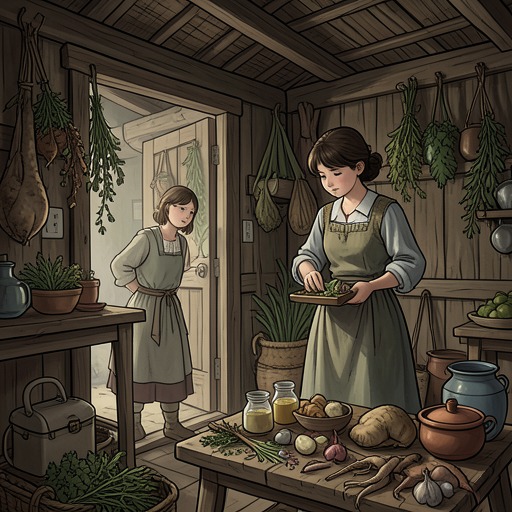
With Olga the Wise One, the boy encounters a broader repertoire of healing and protection. She teaches him household work and has him assist in preparing powders, then takes him to huts where sick villagers are waiting. Her treatments can involve close attention to a patient, spoken formulas, gestures, and prepared substances. The boy is made to help according to her instructions, so folk practice appears not only as private belief but as work transmitted through an apprentice-like relationship.
Olga’s account of the boy’s identity intensifies the danger attached to his appearance. She calls him the Black One and tells him that an evil spirit lives within him, recognizable, in her view, by his dark eyes. She believes those eyes can cast a spell, but also remove one: to help another person, he must look at the afflicted person, animal, or crop while keeping his mind focused only on the illness. The same supposed capacity can therefore be either harmful or therapeutic. Olga’s explanation makes the boy a potential source of danger and a possible instrument of healing, while leaving him dependent on her instructions for how to control it.
Her supernatural account includes phantoms that interfere with people and can take animal forms, as well as ghosts and vampires with distinct origins and habits. Olga suspects the boy may be a vampire and gives him a bitter elixir with garlicked charcoal each morning, intending to restrain the spirit she believes inhabits him. This belief has consequences beyond the hut: villagers cross themselves when he appears, pregnant women flee, and some peasants set dogs on him. Olga’s presence offers protection. Her authority does not erase the fear surrounding him, but it gives him a safer place and makes her household a refuge from village hostility.
Olga’s standing also rests on practical services to the community. Villagers ask her to protect cattle’s eyes from malicious spells and to advise them on animals and their sale. She teaches people to spit three times when buying a pig and to give a heifer specially prepared bread containing a sanctified herb before mating. Before a horse or cow is purchased, she pours water over it, observes its reaction, and gives a verdict that can determine both the price and whether the sale proceeds. These customs show superstition embedded in economic decisions: her ritual knowledge carries public weight because villagers use it to manage uncertainty about livestock, health, and future loss.
Birds, signs, and seasonal knowledge
Lekh’s beliefs make birds a source of messages about the natural and spiritual world. He teaches the boy to watch their behavior and draw conclusions from it. Mixed flocks flying against a red sunset are, in his interpretation, associated with evil spirits; gatherings of crows, rooks, and jackdaws are attributed to an evil influence that foments hostility among birds. Other signs forecast weather and harvest conditions: long-winged white crows indicate a cloudburst, while wild geese flying low in spring presage a rainy summer and poor harvest. These interpretations turn observation into a system of warning, joining attention to animal behavior with fears about spiritual forces.
Lekh also places migration within a sacred calendar. He says Storks arrive on St. Joseph’s day and remain until St. Bartholomew’s day, when frogs are driven into the mud and the birds can no longer locate them. Storks nesting on a house bring good luck. Lekh’s specialized work building nests gives this belief a practical and economic dimension: he constructs a framework from a harrow, angles it toward the west against prevailing winds, fixes it with nails, and places red cloth to attract the birds. His skill is costly, and only wealthy farmers can afford it. Belief in good fortune thus intersects with craft and unequal access to a service that Lekh alone in the area knows how to provide.
Survival practices and the limits of protection
The boy also remembers Olga’s advice about surviving without human help: learn about plants and animals, including poisonous and medicinal ones, and keep fire. The portable stove she calls a Comet is made from a one-quart preserve can perforated with small holes and fitted with a wire handle. Swinging it draws air through the holes and keeps fuel burning. Different fuels and degrees of heat suit different foods; damp moss can preserve a low glow overnight and produce smoke that repels snakes and insects, while dry resinous material helps restore heat in wet weather. Here practical knowledge and inherited instruction meet: the Comet is not a supernatural charm, but its value belongs to the same world of learned procedures by which a vulnerable person tries to anticipate danger.
The limits of such knowledge become clear when warmer weather brings an epidemic. Olga and the boy go from hut to hut, and he tries to drive sickness out by looking at patients as she has taught him. The disease overwhelms their efforts, and people die. The episode does not erase the role of folk practice in daily life; instead, it exposes the difference between a ritual’s promise of agency and its ability to overcome every threat. Across Marta’s remedies, Olga’s cures and protections, and Lekh’s reading of birds, superstition makes a perilous world legible and actionable, but it cannot guarantee that the world will obey.