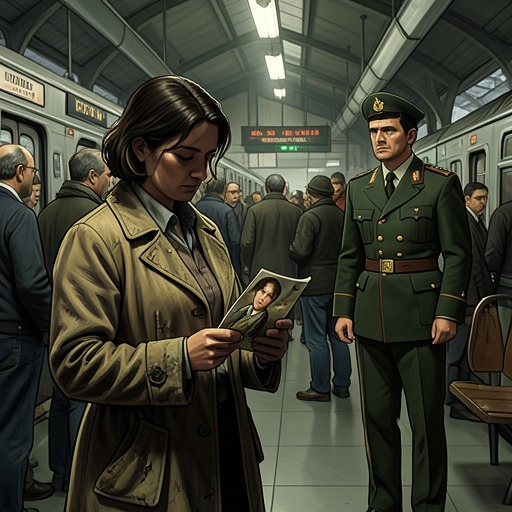
German occupation forces
The Painted BirdThe German occupation forces are a military authority whose demands and punishments penetrate the isolated villages of Eastern Europe. Their presence is felt less through a continuous occupation narrative than through recurring pressures: crops and supplies must be delivered, villagers face reprisals for refusing or assisting the wrong group, and Jews and Roma are hunted and transported to their deaths. This power reshapes ordinary exchanges and local loyalties, making shelter itself a dangerous act.
Requisitions and Village Dependence
The villages are already impoverished and remote, with poor roads, few bridges, and little access to urban services. The German occupation forces deepen this hardship by requiring peasants to hand over a large share of their meager harvests. That obligation competes with the demands of Partisans, who also seek food and assistance. Refusal can bring a punitive raid that leaves a settlement in ruins, so a village’s limited produce becomes a matter of survival as well as a measure of its exposure to armed power.
At one village far from both the railway and the river, detachments of German soldiers arrive three times a year to collect foodstuffs and materials owed to the army. The regularity of these visits gives the occupation a practical rhythm: villagers must anticipate the levy, while the threat behind it makes the obligation more than an ordinary exchange. The crops are scarce, but the cost of withholding them may be greater still.
The boy’s presence makes this pressure personal. Dark-haired and olive-skinned, he is taken for a Jewish or Roma child; the narrative explains that harboring either group can expose individuals and whole communities to severe German penalties. A blacksmith who keeps him receives him more favorably than some villagers would, but fears that the Germans may discover the child and punish the village. When German troops search the settlement and question its residents about Partisan visits, the blacksmith hides The boy in a potato cellar while offering the commanders timely deliveries and additional grain. Shelter, concealment, and promised food become linked forms of protection, none of them secure.
Enforcement and Rival Armed Powers
Occupation rule operates alongside, and against, the authority of rival Partisans. White partisans seek to fight both the Germans and the Russians, while Red partisans support the Red Army; the factions also differ over property and land reform. Each demands assistance from villages. The German occupation forces, in turn, question peasants about Partisan activity and shoot villagers as an example. The blacksmith’s attempt to placate commanders by promising deliveries shows how local leaders try to bargain within this coercive system, but cannot remove the threat to those they shelter.
The village is therefore caught among competing armed demands rather than governed by a single stable authority. Partisan factions sometimes attack one another there, turning the settlement into a battlefield and leaving residents to contend with the aftermath. German searches add another danger: information about whom the villagers have helped can invite retaliation. The occupation’s leverage is not limited to the collection of supplies; it makes association and silence consequential, and forces communities to weigh immediate survival against the safety of neighbors and dependents.
Racial Persecution and the Railway
The railway carries military traffic, but it also becomes a route for the deportation of Jews and Roma. Villagers learn from station workers that locked cattle cars hold people captured and sent toward death. Accounts circulating locally describe the subsequent stripping of prisoners’ possessions and their separation at a concentration camp; the narrative also notes that killing outstrips the capacity of the camp’s facilities. These are not distant abstractions for The boy, whose appearance has already made him vulnerable to the same racial classifications.
The villagers’ response to the transports sharpens the moral contrast between the occupation’s victims and those who watch. Peasants gather beside the track and wave at trains, while people confined inside sometimes respond from the small windows. The scene places public sociability beside the knowledge that the passengers are being carried to their deaths. The railway thus links the local world to a larger machinery of persecution, while the villagers’ gestures reveal how prejudice can turn mass violence into something they regard as deserved rather than as a reason to intervene.
People sometimes escape or are thrown from the trains, but the countryside offers little reliable refuge. The account describes villagers searching along the railway after several transports pass at night and finding a badly injured child. Rather than provide care, the group takes his clothes and leaves him on the track, where a German patrol will find him. The episode shows the occupation’s racial terror extending beyond the camps: the passengers’ danger continues after they leave the train, and local people can reinforce rather than interrupt it.
Material Traces and Historical Context
The transports leave traces that persist after the trains have gone. On later walks beside the line, villagers encounter ashes and fragments of possessions. The boy secretly touches some of the ash and fears that the dead will remain with him as ghosts. Paper records and family photographs also lie along the embankment, remnants of individual lives carried through the same landscape. The narrative moves from military infrastructure to personal objects, making the scale of persecution legible through what remains in the villagers’ path.
The author’s later defense of the novel sets such scenes against survivor testimony and official wartime documents. He cites accounts of village destruction and camp records documenting the murder of children and the killing of Jewish and Roma prisoners. He also reports that some former school friends considered the novel less brutal than what they and their relatives had endured. This context distinguishes the novel’s scenes from the historical materials invoked in its defense, while rejecting the claim that its violence was simply invented or exaggerated. The German occupation forces are consequently presented not only as an immediate threat in the villages, but as part of a wider system whose effects reach households, roads, railways, and the memory of those who witness its aftermath.