Lekh
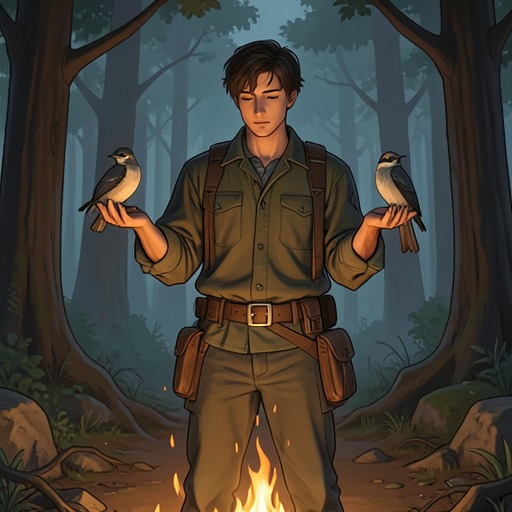
The Painted BirdLekh is a solitary bird catcher whose intimate knowledge of birds sustains his livelihood but also enables a cruel spectacle: he paints captive birds in conspicuous colors and releases them among flocks that reject them. He takes in the boy because the child is small enough to set snares in places Lekh cannot reach. When Stupid Ludmila disappears from their meetings, Lekh’s longing turns into a repeated practice of exposing painted birds to attack, while his anger reaches the boy as well.
Identity and Background
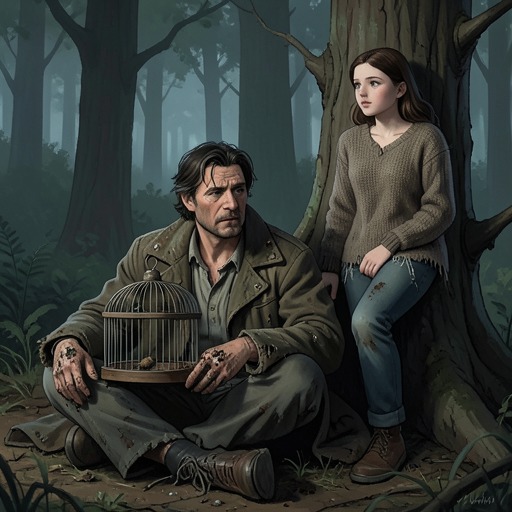
Lekh works alone and has no family. His hut is crowded with cages, and the boy’s sleeping place is a narrow space at the bottom of one of them. The arrangement reflects the practical terms on which Lekh takes him in: the boy is very small, thin, and light, so he can reach slender tree branches, dense nettles and thistles, and waterlogged patches in bogs and swamps. The boy’s usefulness, rather than a stated family bond, is the basis of their household.
The villagers explain Lekh’s pimpled, freckled face through a belief about people who steal eggs from swallows’ nests. Lekh offers a different account, connecting it to an act from his youth and to his father, a village scribe who wanted him to become a priest. Lekh instead feels drawn to forests and birds. He leaves his father’s hut and wanders from village to village and forest to forest, eventually making bird-catching his occupation. His life thus begins in a choice against the settled future his father intended for him, and continues in a solitude that he never replaces with a family of his own.
Work and Knowledge of Birds
Lekh sells birds in neighboring villages, where peasants barter food and other necessities for them. His trade brings him milk, butter, sour cream, cheeses, bread, hunter’s sausage, vodka, fruit, and cloth. Carrying caged birds from place to place, he promotes their beauty and singing. The birds are both living subjects of his study and goods on which his survival depends.
His knowledge is unusually attentive. He studies the habits of quail and larks, imitates the calls of cuckoos, magpies, and owls, and observes bird courtship, nesting, and flight. He notices the landrail’s jealousy around an abandoned nest, the swallow’s sorrow after boys destroy its nesting place, the hawk’s flight, the stork’s patience while hunting frogs, and the nightingale’s song. That attention does not make him protective: the same close observation supports his skill in trapping and handling birds.
At dawn, Lekh and the boy approach nests; later, they collect the birds caught in snares set the previous day. Lekh takes each frightened bird from its trap and places it in a large shoulder bag, sometimes trying to soothe it and sometimes threatening it. Birds from a flock circle overhead as their captured companions are carried away. When they persist, Lekh uses a sling to bring one down, without stopping to search for it. His routine places capture, sale, and the birds’ efforts to remain together in the same landscape.
Lekh also teaches the boy to interpret birds as signs. He treats large, mixed flocks at a red sunset as a sign of evil spirits, and assemblies of crows, rooks, and jackdaws as the work of an Evil one sowing hostility among birds. He reads long-winged white crows as a warning of a cloudburst and low-flying wild geese in spring as a prediction of rainy weather and a poor harvest. The beliefs combine close watching with supernatural explanations; in Lekh’s world, birds are at once creatures to study, omens to read, and objects to control.
Stupid Ludmila and the Painted Birds
A woman known locally as Stupid Ludmila meets Lekh in a distant forest clearing known only to the two of them. The boy follows Lekh on these journeys, carrying the bag of captured birds. After one meeting, he sees the couple part reluctantly; Lekh repeatedly looks back at her as he walks away. At home, when the birds are asleep in their cages, Lekh becomes restless and speaks about Ludmila, his body trembling as he closes his eyes. The meetings are a major source of hope and excitement in his otherwise solitary life.
When days pass without Ludmila appearing, Lekh becomes silent and angry. He selects a strong captive bird, ties it to his wrist, mixes paints, and covers its head, wings, and breast with bright colors. In the forest, he has the boy hold the bird until its calls draw a flock of its own kind. At Lekh’s signal the boy releases it. The bird tries to rejoin the flock, but its unfamiliar appearance draws attacks, and it eventually falls from the sky. Lekh examines the result; the boy is made a participant in the act, first as the handler and then as the person who releases the bird.
The pattern intensifies when Ludmila does not return. Lekh paints more birds in increasingly vivid colors and releases them to be attacked by their own kind. In one instance, he paints a raven red, green, and blue before releasing it toward a flock gathered above the hut. The flock attacks, and the painted bird falls to the ground still alive but unable to fly. The scene makes the central contradiction of Lekh’s work stark: he understands how birds live and gather, yet deliberately alters one bird’s appearance and sends it back into that community, where its difference makes it vulnerable.
Anger, Withdrawal, and the Boy
As the absences continue, Lekh grows thinner and spends more time in the hut, drinking homemade vodka and singing songs about Ludmila. He draws a woman’s figure in the dirt with a long stick. When he has no more birds to paint, he wanders through the fields with vodka beneath his jacket, singing so that his voice carries across the bogs and into the forests. The boy stays nearby, worried that something might happen to Lekh in the swamps. These details show grief becoming a condition of daily life, rather than a single outburst.
Villagers laugh at Lekh and say Ludmila has bewitched him. He responds with curses and threats to send birds against them. Once he turns on the boy, strikes him in the face, and blames the child’s presence for frightening Ludmila away, invoking the boy’s Gypsy eyes. After lying ill for two days, Lekh gets up, packs a knapsack and a loaf of bread, and goes into the forest. He orders the boy to continue setting snares and catching birds. The order leaves the boy with the work even as Lekh departs, preserving the practical arrangement that has defined their relationship while breaking their shared routine.
In the weeks that follow, the boy’s snares catch mostly cobwebs. Storks and swallows have flown away, the forest is becoming deserted, and the birds remaining in the cages are still. The evidence provided does not establish what ultimately happens to Lekh after he enters the forest. His departure therefore marks a rupture rather than a resolved fate: the boy is left carrying out Lekh’s instructions amid a landscape in which the birds on which their work depended are disappearing.