Lekh and Stupid Ludmila
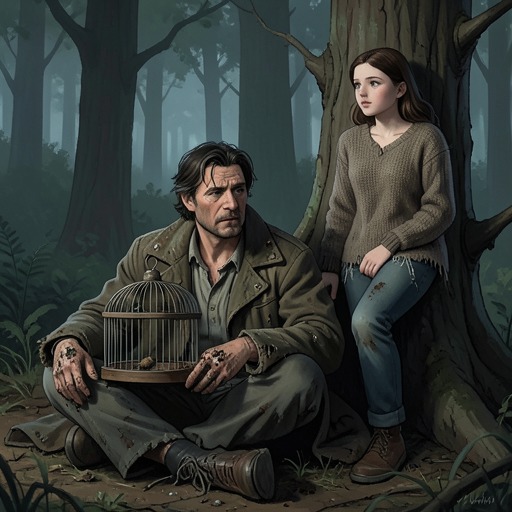
The Painted BirdLekh and Stupid Ludmila’s relationship is a passionate attachment shaped by the forest, by separation, and ultimately by village violence. Lekh regards her as his great love and imagines her as a vivid, free creature beyond ordinary human conventions. Their meetings offer a fleeting image of mutual closeness, while her repeated absences lead him into brooding acts involving painted birds. When Stupid Ludmila is killed by a group of village women, Lekh’s return comes too late to save her; his grief closes a relationship the surrounding community has treated as a source of disorder.
A Love Set Apart from Village Life
Lekh’s attachment to Stupid Ludmila persists despite her relationships with multiple men. The narrator presents her as living in the forests and as a woman whose desires do not conform to the expectations of village marriage. Yet this apparent distance from conventional domestic life does not lessen her importance to Lekh: she remains the subject of tender songs he invents for her.
In those songs, Lekh figures her as a strange-colored bird flying toward distant worlds, quick and free, more brilliant than other creatures. His image places her within a natural realm of abundance, wildness, decay, death, and renewal, set against the human world. The contrast is not simply between a faithful and an unfaithful lover. Lekh’s idealization makes Stupid Ludmila seem to embody a freedom that the village cannot easily accommodate, even as their relationship unfolds within the constraints and dangers of that human community.
Their Meetings in the Clearing
The narrator accompanies Lekh toward a clearing at noon, where Lekh hopes to meet her. He announces himself with an owl call; Stupid Ludmila then rises above the tall grass, with bluebottles and poppies in her hair. Lekh runs toward her, and the pair sway together amid the grasses. The description links their closeness to the surrounding landscape, as though the two might grow from a shared root.
The narrator watches from the edge of the clearing, hidden behind fern leaves. His birds, disturbed by the sudden stillness, flutter and chirp inside his bag. At the center of the scene, Lekh and Stupid Ludmila express affection through touch and gradually withdraw into the grass, which partly hides them from the birds overhead. The concealed setting gives their meetings a quality apart from village observation, though the narrator is present as a witness.
Afterward, Lekh tells the narrator that Stupid Ludmila spoke to him about her life and suffering. The account gives their intimacy a confiding dimension: their time together is not presented only as physical attraction, but also as an occasion for her to disclose personal experiences. That part of the relationship reaches the reader through Lekh’s report rather than through the narrator’s direct hearing of her stories.
Absence and the Painted Birds
Stupid Ludmila sometimes fails to appear for days. During these absences Lekh becomes silently enraged, staring at the caged birds and muttering to himself. He eventually selects the strongest bird, ties it to his wrist, and prepares paints from different materials. He covers its head, wings, and breast with bright colors until it resembles a bouquet of wildflowers.
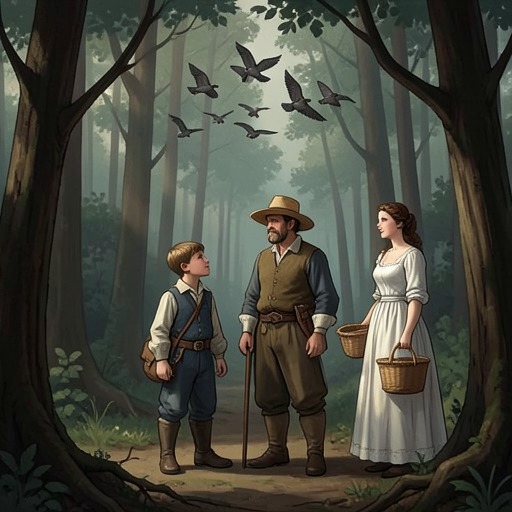
Her continued absence changes the pattern. Lekh paints more birds in increasingly gaudy colors and releases them, knowing that their own kind will attack them. In one striking instance, he paints a raven red, green, and blue, then frees it when a flock gathers above the hut. The flock turns on the conspicuously different bird, which falls to the ground badly injured. The scene makes the painted bird a grim counterpart to the relationship: an outsider made conspicuous and exposed to collective hostility. That parallel is an interpretive echo, not an explanation supplied by Lekh; the narrative shows his response to Stupid Ludmila’s disappearance through what he does to the birds.
The birds also connect the lovers’ story to the narrator’s position as an observer. He watches the meetings from cover, while the birds in his bag react to the stillness around the couple. Later, Lekh’s chosen birds become part of the visible aftermath of his waiting and frustration. The recurring contrast between cages, flight, and painted plumage gives the relationship an imagery of freedom that is repeatedly shadowed by danger.
Return, Violence, and Loss
Stupid Ludmila eventually returns to the cabin leading a large dog. She asks repeatedly where Lekh is. Told that he left days earlier and that the narrator does not know his whereabouts, she alternates between crying and laughing. She finds Lekh’s old cap, presses it to her cheeks, then throws it down and tramples it. After drinking vodka left beneath the bed, she orders the narrator to accompany her to the pasture; when he tries to escape, she sets the dog on him.
At the pasture, a group of village women approaches carrying rakes and shovels. Several younger women lead the group, while shepherds hold on to the struggling Stupid Ludmila. Her dog strains against its leash. The narrator remains at a safe distance by the cemetery wall and only then notices Lekh running across the pasture. His arrival makes plain that he has returned to the scene, but it does not prevent the women from killing her in a collective assault.
Afterward, the women leave for the village. Lekh rises injured and disoriented, then throws himself onto Stupid Ludmila’s body. He touches her, crosses himself, and tries to speak through swollen lips. The scene ends not with reunion or reconciliation but with his grief beside the dead woman. The contrast between the tenderness of their meetings in the clearing and the violence of her death gives their love its tragic shape: the forest offered them a private space, but could not shield them from the community beyond it.
Narrative Significance
The relationship brings together two recurring images in the narrative: the freedom Lekh associates with birds and the danger faced by creatures marked as different. His songs transform Stupid Ludmila into a bird of distant worlds; his painted birds, by contrast, are conspicuous and vulnerable among their own kind. The movement from loving image to destructive imitation registers the distress that follows her absence without reducing her to a symbol alone.
The narrator’s role is also important. He witnesses the lovers’ meetings from the margins and later becomes involved when Stupid Ludmila returns and demands that he accompany her. His shifting position—from concealed observer to the person she addresses, and then to a witness at a safe distance—links the private relationship to the wider village conflict. Lekh and Stupid Ludmila’s bond is therefore both intimate and exposed: its most tender moments occur away from the village, while its ending is imposed by a group acting in public.