Postwar Rules for Placing Missing Children
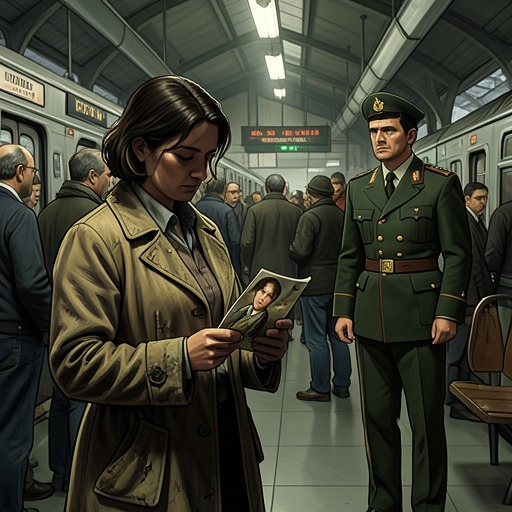
The Painted BirdPostwar Rules for Placing Missing Children provide an administrative answer to a crisis created by wartime separation: children whose families cannot be located are to be sent to special centers and kept there while officials determine whether their parents are still alive. In The Painted Bird, the procedure moves The boy from the improvised protection of a Red Army regiment into a state-run institution. It offers a route toward family identification, but also removes him from the relationships and identity he has formed during the war, making placement both a promise of reunion and a new separation.
A system built from wartime separation
The need for the rules is established by the circumstances of The boy’s displacement. In the first weeks of the Second World War, his parents send their six-year-old son from a large Eastern European city to a distant village, paying a man to find temporary foster parents. His father’s prewar anti-Nazi activities have forced the parents into hiding; they hope sending the child away will protect him until they can reunite. But population transfers and wartime confusion sever their contact with the intermediary. The arrangement intended to keep The boy safe instead leaves his family unable to find him.
That loss unfolds in a landscape where shelter is precarious and survival often depends on individual adults. The boy’s foster mother dies within two months of his arrival, leaving him to wander between villages, sometimes taken in and sometimes driven away. Later, Lekh takes him on partly because his small, light frame lets him set bird snares in places an adult cannot reach. Such episodes do not constitute the postwar procedure; they show the informal, contingent arrangements on which a separated child depends before any institution can claim responsibility for him.
The danger is also political. Because of his dark features, The boy is taken for a Jewish or Romani stray, and under German occupation, harboring either could expose a household or community to severe punishment. German requisitions and the threat of punitive raids further narrow the villagers’ choices. The missing-child rules belong to the period after the war, but the conditions that make them necessary are inseparable from a conflict in which ordinary family arrangements, shelter, and movement have been violently disrupted.
Transfer from the regiment
As the war ends, Gavrila tells The boy that the country has been liberated from the Germans and that regulations require lost children to be delivered to special centers. There they will remain until it is established whether their parents are alive. The explanation makes the transfer a matter of official procedure rather than a personal choice by the regiment. Gavrila and Mitka have discussed the boy’s future, but, as Gavrila makes clear, they have found no alternative consistent with the rules.
Gavrila nevertheless gives the separation a personal condition and a future possibility: if no relative claims The boy within three months after the war ends, he will take care of him and send him to a school where he can learn to speak again. The promise does not cancel the required transfer. It gives The boy a reason to endure it, while marking the regiment as the home and source of care he is being asked to leave.
The boy travels with Sergeant Yury to the center in the industrial city where he lived before the war. Before departure, Gavrila assembles a personal file from the information the child has provided: his name, former address, remembered details about his parents, hometown, relatives, and friends. The file turns fragments of memory into information that officials can use to search for family. Its usefulness depends on what a displaced child can remember and communicate, and on whether that information can be connected to living people.
The orphanage and the child’s response
At the destination, a military driver takes Yury and The boy to an orphanage housed in several old buildings on a side street. The principal receives the folder, signs papers, and takes responsibility for the handover. The formal exchange is swift, but The boy resists even its smallest gesture: when she puts a hand on his shoulder, he shakes it off. He has come to understand the uniform’s epaulets as signs of authority and protection, and does not accept the principal’s touch as a substitute for the relationships he is leaving.
Yury tries to make the parting easier by joking, straightening The boy’s forage cap, and tightening the string around the books inscribed by Mitka and Gavrila. They embrace as equals, while the principal stands by. The boy holds the red star Gavrila gave him and invests it with hope. The handover thus has two registers: the institution records a child received, while the child carries forward tokens of a particular military community and the possibility that it may still take him back.
The scale and condition of the orphanage complicate the promise of safekeeping. Five hundred children are divided into groups and taught in small, crowded classrooms with too few desks and blackboards. Some children have impairments from war injuries; many are distressed or fearful. The boy, unable to speak, is mistaken by older children for a moron and sometimes bullied. He fears that he may seriously injure someone while defending himself and thereby lose the prospect of returning to Gavrila. The center keeps him within an administrative system, but its crowded and unsettled daily life does not itself restore security or belonging.
Records, inquiry, and identification
The rules’ search for living relatives becomes a direct test of The boy’s willingness to cooperate. At a medical examination and interview with a social commission, an older member studies his papers and asks where his parents planned to go. The man appears to believe he knew them before the war. The boy pretends not to understand, then writes that his parents are dead, killed by a bomb. His denial protects him, in the moment, from a question that threatens the identity he has built around his separation and his hope of returning to the regiment. It also shows that records alone cannot compel a child to supply the truth that would make a search successful.
The inquiry eventually produces a possible family match. The principal and the commission member bring a man and a woman into the room; The boy recognizes a striking resemblance but holds back, uncertain whether to acknowledge them. The woman bends over him in tears, while the man asks him in Russian to unbutton his uniform so they can check for a birthmark on his chest. The boy knows the mark is there and hesitates, understanding that revealing it would remove doubt that he is their son. He slowly unbuttons the uniform. The scene reaches the moment of verification, showing the system’s intended purpose—reconnecting a missing child with his family—while leaving the act of recognition dependent on the child’s own decision to disclose what the records cannot establish.