Racialized identity and persecution of dark-featured people
The Painted BirdRacialized identity and persecution of dark-featured people in The Painted Bird concern the conversion of visible traits—especially black hair and dark eyes—into presumed ethnic identity and grounds for danger. The unnamed boy narrator’s appearance is repeatedly interpreted by villagers as evidence that he is Roma or Jewish, regardless of what he knows about his family or how he understands himself. Under Nazi rule, that imposed classification takes on an immediate threat: he may be denounced, discovered, or killed. The novel links private terror to the wider persecution of Jews and Roma, while showing how local prejudice helps make that violence seem ordinary or deserved.
Appearance as an imposed identity
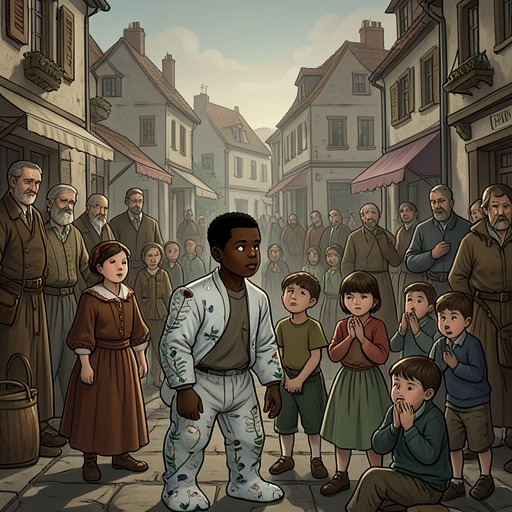
The narrator’s black hair and eyes make him conspicuous in villages where people treat dark features as proof of an identity they fear and despise. When mushroom gathering brings peasants from neighboring villages into the woods, his master shaves his hair to reduce the chance that others will recognize him as Roma and report him to the Germans. The narrator wears a large, old cap over half his face and stays near his master, aware that his usefulness may be what protects him for the moment. Concealment can alter what others see, but it does not remove his sense that he is being watched and classified.
The villagers’ treatment of Jews also supplies the terms through which they identify the narrator. When news spreads that locked trains are carrying Jews and Roma to their deaths, peasants explain the killings as divine punishment for supposed religious crimes. Their antisemitic beliefs turn the victims’ persecution into a story of deserved retribution, rather than an atrocity demanding resistance or aid. The narrator hears those ideas against the knowledge that his own dark features could place him in the same category. The boundary between the targets of persecution is not a stable distinction in the villagers’ eyes: they collapse Jewish and Roma identities into a single stigmatized appearance.
The railway and the danger of recognition
The trains passing through the forest make the stakes of that classification visible. Villagers wave to the trains, while people confined inside sometimes raise their arms at the windows; the two groups do not understand the gesture in the same way. The narrator also learns from station workers and peasants that the transports carry Jewish and Roma people to a concentration camp, where they are stripped of possessions and sorted, and where many are killed. These details are part of the narrator’s account of what villagers hear and witness; the narrative presents their knowledge alongside their failure to help those being transported.
After several trains pass at night, the mushroom gatherers search along the tracks and find a badly injured child who has fallen from a train. The villagers do not take him in. One removes his shoes; others leave his belongings behind and place his body on the track, where a German patrol will find it. The episode turns the narrator’s fear of being identified into a concrete moral crisis. He feels sorrow for the child, but also relief that the child is dead: if the Germans discover a Jewish foundling sheltered in the village, they may search the houses and uncover the narrator in the concealed cellar. His calculation shows how persecution forces the endangered to measure compassion against the risk of bringing violence down on themselves and others.
Fear, shame, and identification with persecutors
The narrator’s anxious questions reach beyond immediate concealment. He wonders whether God’s punishment is reserved for people with black hair and eyes, contrasts his remembered fair-haired, blue-eyed father with his dark mother, and asks what would happen to children born dark to fair-haired parents. These questions do not establish his ancestry; they show how persecution makes appearance seem like destiny and leaves him unable to rely on family resemblance as protection. He imagines a world in which only fair-haired, blue-eyed people remain, then recognizes that even this imagined standard could not secure the future of children whose features do not match it.
A separate encounter with a German officer reveals another consequence of racialized fear. Faced with the officer’s polished uniform, physical authority, and death’s-head insignia, the narrator feels shame about his own face and envies the power embodied by the man who may decide whether he lives. His response is not evidence that the officer’s violence is justified; it shows how completely the social hierarchy has entered the child’s view of himself. The persecuted boy can begin to regard the appearance that makes him a target as a personal defect, while seeing the symbols of the oppressor’s power as an ideal of invulnerability.
Later, watching Kalmyk cavalrymen commit violence against villagers, the narrator makes an even more painful association: because his hair and eyes resemble theirs, he believes he belongs with them and has been denied mercy by the same physical traits. The passage depicts this as the child’s frightened interpretation, not as an actual kinship or moral equivalence. His appearance has become a trap in which he is made to identify himself with men he fears, just as villagers have treated outward resemblance as proof of a person’s nature.
Historical scale and narrative significance
The book’s concluding reflections place its fictional episodes beside survivor testimony and wartime documents. The author cites an account of a village destroyed by German forces and Kalmyk troops, records from concentration-camp commanders about the killing of children considered too young to work, and a Jewish attendant’s diary describing the daily deaths of Roma, including many children. These materials do not make the narrator’s experiences identical to any individual testimony; they establish that the novel’s concern with the persecution of dark-featured people belongs to a larger historical record of mass violence against Jews and Roma.
The concept recurs through linked acts of classification: a master shaves the narrator’s hair to make him less recognizable; villagers use a hostile label to threaten him; the child on the railway is treated as a danger to the community rather than as someone needing help; and the narrator turns his own appearance into a source of shame and dread. The movement between public violence and private self-perception is central. The danger does not end at the edge of a train or a camp: it enters the child’s understanding of his family, his body, and his prospects for survival. By showing both the immediate threat of being recognized and the damage caused by internalizing the persecutors’ categories, the novel presents racialized appearance as a condition imposed by others, but one that can come to govern how the threatened person sees himself.