Rainbow
The Painted BirdRainbow is an eccentric, sociable villager whose elaborate talk about rainbows stands in stark contrast to the violence he commits against a Jewish girl brought into the village. The boy narrator first knows him as a neighbor and teller of curious natural explanations; watching from a knothole in the barn, he then sees Rainbow assault the girl. Afterward Rainbow recasts the episode as something the girl did to him, a self-serving story that sits against the narrator’s witnessed account.
Identity and Place in the Village
Rainbow is well liked even though some villagers consider him odd. His nickname comes from his special interest in heavenly signs, particularly rainbows, which can hold his attention for hours when he entertains neighbors in the evenings. The unnamed boy narrator listens from a dark corner and learns Rainbow’s fanciful account of how rainbows work: each is a hollow, arched stalk with one end dipping into a river or lake, drawing up water and distributing it over the countryside. Fish and other creatures travel with that water, Rainbow explains, accounting for similar fish in widely separated bodies of water. The explanation gives him a distinctive place in village conversation: he does not merely notice rainbows but turns them into an entire theory of the world.
That talk is also the source of gentle ridicule. Neighbors say that people who stare too much at rainbows cannot see an ass directly in front of them. The joke marks Rainbow as dreamy or impractical without making him a social outcast; he remains welcome among the people he entertains. The contrast between his fanciful account of water being fairly distributed across the countryside and the unequal, brutal treatment the girl receives becomes especially sharp once she enters his household.
Rainbow’s domestic circumstances are also established. His hut adjoins his master’s, and his barn shares a wall with the barn where the boy sleeps. Rainbow’s wife has died; although he is still young, he has not decided to take another mate. An old woman cooks for him and looks after his children while he works in the fields. He sometimes gets drunk for recreation. These details place the assault not in an isolated stranger’s shelter but within the everyday life of a familiar neighbor, close to the boy’s sleeping place and the routines of the village.
The Girl at His Hut
After the village headman and elders decide that the Jewish girl will be sent to the German post the following day, Rainbow takes her by the arm and leads her to his hut. The decision to send her onward is presented as compliance with official regulations; Rainbow instead keeps her overnight. The episode does not establish that he intends to protect her. His choice brings her into the barn where the boy can see what happens, and the narrator’s account gives no basis for treating the act of taking her there as a rescue.
The boy wakes to noises and cries and, frightened, finds a knothole through which he can look into the barn. On its cleaned threshing floor the girl lies on sacks beside an oil lamp set on an old chopping block. Rainbow sits near her head. He pulls at her dress, and when she tries to get away, he pins her long hair beneath his knee and holds her face between his knees. He tears away the other strap and then removes the dress as she tries to rise and hold on to it. The lamp throws shadows across her naked body. Rainbow strokes her with his large hands, obscuring her face from the boy’s view, while her sobs are intermittently broken by cries. He removes his boots and breeches but keeps on his rough shirt.
The account makes the girl’s resistance unmistakable. When Rainbow renews his efforts, he appeals loudly to the Virgin Mary and strains to tear himself away from her. The girl hits his face, scratches him, and bites his hands. Rainbow licks blood from his lip, strikes her, and then attacks her with further blows and bites. Her sustained scream eventually stops when her throat dries and then begins again. He continues beating her until he is exhausted. Whatever Rainbow’s appeal to the Virgin Mary signifies to him, it does not alter the actions the boy has witnessed: the girl is trying to escape and defend herself while Rainbow uses force against her.
Intervention and Aftermath
Rainbow and the girl lie motionless and silent, one on top of the other. The scene shifts from the boy’s isolated view through the knothole to the arrival of help: Rainbow calls for assistance, first bringing barking dogs and then alarmed men carrying axes and knives. They open the barn door and stare at the pair without understanding what they see. Rainbow explains the situation in a hoarse voice. The men close the door again, prevent others from entering, and send for a witch-midwife who is believed to know how to handle such matters.
The old woman kneels beside the pair and does something with the help of others. The boy cannot see what they do; he hears only the girl’s final piercing shriek, followed by silence, and the barn goes dark. At dawn, he looks through the knothole again. A human shape lies stretched out by the wall, covered from head to foot with a horse blanket. The narrative presents the girl as dead by this point, though the boy does not witness the intervention itself and cannot report what was done to her.
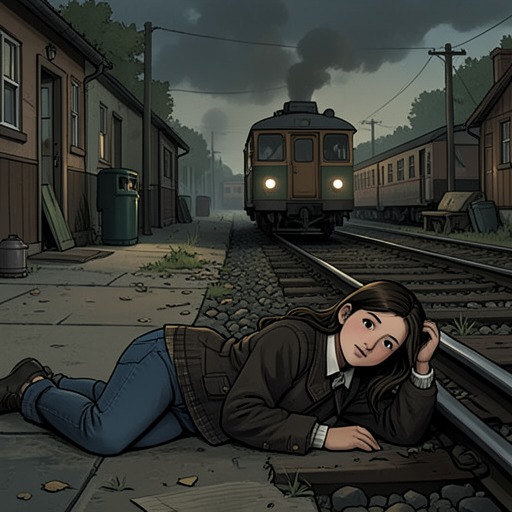
The boy has to take the cows to pasture while the village is still asleep. When he returns at dusk, he hears peasants discussing the previous night. They say Rainbow took the body back to the railroad track, where a patrol was expected to pass in the morning. The handling of the body and its placement at the track extend the consequences beyond the barn, while leaving the boy’s knowledge of the precise actions and decisions limited to what he saw through the boards and later overheard.
Rainbow’s Story and Narrative Significance
For several weeks the episode remains a lively subject of village conversation. Rainbow himself tells people about it after drinking, claiming that the Jewish girl had drawn him in and would not let him go. His version reverses the relation of force shown in the boy’s account: the girl, whom the narrator saw trying to escape and striking back, becomes the supposed source of Rainbow’s predicament. The villagers’ continuing discussion preserves the event as public gossip, but Rainbow’s retelling makes it a story in which he evades responsibility.
Rainbow’s characterization is built around this collision between social familiarity and witnessed violence. He is a neighbor who entertains people with an imaginative theory of rainbows, a widower with children, and a man whose actions in the barn are brutal. The boy’s position as a hidden observer matters: he hears Rainbow’s later explanation, but the earlier scene has already shown him the girl’s attempts to resist. By setting the convivial storyteller beside the man in the barn, the narrative makes Rainbow’s charm and local acceptance no guarantee of safety. His tale of the girl’s supposed power cannot erase what the boy saw.