Rats
The Painted BirdRats in the abandoned bunker are first glimpsed by sound and smell, then revealed as a vast, restless mass whose struggle to escape becomes fatal to The carpenter. The boy’s two encounters with them frame the animals not as a single pursuer but as a collective force: they fill the bunker’s depths, react to disturbances and light, and transform the opening above them into a deadly threshold.
Discovery in the bunker
After leaving a train and making his way through the forest, The boy comes upon a deserted military bunker beside an overgrown cobblestone road. Its reinforced-concrete walls and scattered remains of ammunition crates and metal suggest a site long abandoned. At first there is silence. The boy throws a stone at the closed door; only a brief echo answers. The rats remain unseen until he reaches an opening on the mound’s uppermost level.
The opening gives him evidence in stages. A foul odor rises from below, accompanied by muffled squeaking. When he drops an old helmet through the gap, the squeaks multiply. He throws earth, pieces of metal hoops, and concrete into the hole, and the sounds grow louder. These reactions establish that animals are crowded inside before he can see them. The gradual disclosure makes the opening itself a source of suspense: it conceals the scale of what is living below.
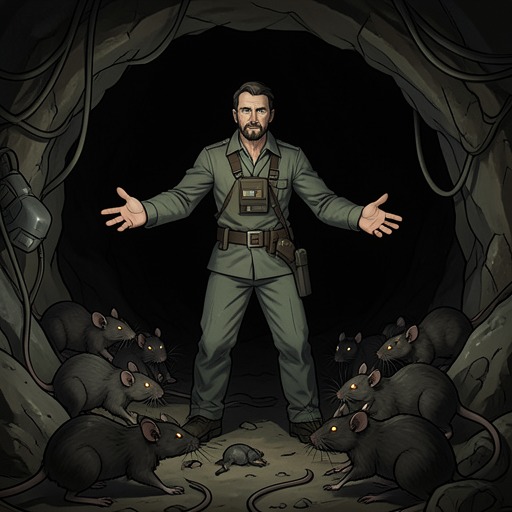
To see into the bunker, The boy catches sunlight with a piece of smooth sheet metal and reflects the beam down through the opening. Several feet beneath him is a churning mass of Rats. Their wet backs and hairless tails become visible in the light, while countless eyes glint across the surface. The animals repeatedly leap at the smooth inner wall, fail to gain a hold, and fall back onto the bodies below. The apparent sea is not water but a tightly packed, moving population with no clear path out.
A struggle within the swarm
The Rats’ attempts to escape are accompanied by fighting among themselves. The boy sees them attack and consume one another, while each animal competes to reach the top of the mass and make another attempt at the wall. The struggle has no single leader or coordinated direction: individual efforts to get clear continually press through the same crowded space. The movement that brings some animals upward also leaves others beneath them.
The sight makes the bunker’s enclosure central to the scene. The smooth walls defeat the Rats’ repeated leaps, and the depth of the opening puts The boy above a mass whose members cannot simply disperse. Their competition intensifies as they seek both higher ground and food. Blood draws further fighting, so that the attempt to survive within the swarm increases the disorder rather than providing an exit. Their behavior is presented through what The boy observes, not through any explanation of how they came to be trapped there.
After watching, The boy covers the opening with a tin panel and continues through the forest. The Rats do not emerge in this first encounter, and the evidence gives no account of what happens to them after the opening is covered. The panel temporarily separates the forest path from the unseen animals below, but it also marks the opening as a danger The boy will encounter again.
The carpenter at the opening
Later, The carpenter brings The boy back to the bunker. The boy is tied with a strong string and knows that, unless he escapes quickly, The carpenter may kill him and throw him into the depths. On reaching the opening, The carpenter pushes the tin panel aside. The odor rises again, and the Rats squeak in the light. The carpenter leans over, but at first cannot see into the darkness because his eyes have not adjusted.
The boy moves to the opposite side of the opening, which now lies between him and The carpenter. He pulls the string taut and makes a sudden effort to escape. The movement draws The carpenter forward; he falls into the bunker, and the string eventually snaps against the rough edge. The fall turns the place The boy had inspected into the setting of an immediate struggle for survival. The Rats, previously observed from above, are now directly around a human body.
The boy reflects daylight into the enclosure again. The Rats crowd over The carpenter, and the mass moves more violently as they gather around him. Unable to pull himself away at first, The boy watches from the edge. The account emphasizes the changing surface of the swarm and the repeated rising and sinking of what has fallen among it; it does not suggest that the animals pursue The boy out of the bunker.
Narrative function and limits
The Rats are pivotal because their presence makes the bunker both a concealed habitat and a trap. In the first scene, The boy’s curiosity produces knowledge of their numbers and behavior; in the later scene, the same opening becomes part of his escape from The carpenter. The tin panel, the reflected sunlight, and the string connect the two encounters through concrete objects and repeated actions, while the change in who stands at the opening reverses the danger facing The boy.
The animals’ collective motion also shapes the scene’s gradual shift from uncertainty to visible threat. Squeaks first signal a hidden presence; reflected light then reveals the mass, and the return to the bunker shows what happens when someone falls within its reach. Their struggle against the walls and their competition within the swarm remain the only behavior described. The account does not identify their origin, explain how they entered the bunker, or establish whether any escape. Their significance rests instead on the specific role they play in these encounters: The boy sees what they can do, and later survives the fall that exposes The carpenter to them.