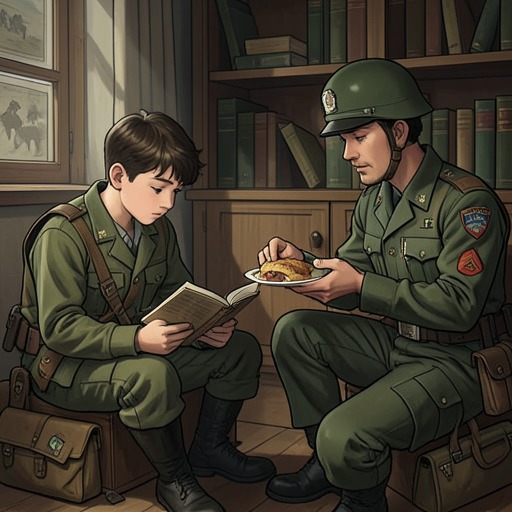
Red Army camp
The Painted BirdThe Red Army camp is a provisional refuge in the final phase of the war: a guarded military settlement where the narrator finds friends and instruction, but cannot remain. Its tents and working perimeter give the soldiers a routine, yet the nearby village remains a source of danger, and military regulations ultimately require the narrator to leave for a center for lost children.
Setting and Layout
The camp appears through practical landmarks rather than a full description of its grounds. The narrator sleeps in a tent with Red Army sniper Mitka; outside are the guard line, a field kitchen, bushes, an adjoining field, and the route toward the village. The officers’ headquarters is another point of reference, reached by a motorcycle during a night emergency. Mechanics test engines nearby. Together, these details suggest a working encampment organized around shelter, food, security, and military equipment, rather than a settled home.
The perimeter is both a defense and a boundary the characters can cross. Soldiers take their turns on guard, and Red Army sniper Mitka and the narrator slip past them before dawn when they leave the camp. They pass the field kitchen, cross a field, and head toward the bushes. On returning, they get back in unnoticed. The scene makes the camp’s security feel real but not absolute: it depends on watches and routine, and a person who knows the grounds can move through its edges without being seen.
Military Routine and Relations with the Village
The camp’s relationship with the nearby village is tense and governed by orders. After soldiers attending a village feast are attacked by local peasants, four are reported killed and others wounded. The deputy commander hears a report, orders the wounded taken to hospital, and the incident enters the evening report. The soldiers then receive instructions forbidding contact with the hostile local population and prohibiting actions that might worsen relations with the Red Army. The camp is therefore not simply separated from civilian life: events outside its boundary directly change the rules within it.
The order does not erase the human response to the attack. Red Army sniper Mitka is present as the bodies are brought in and taken away; afterward, he whispers to himself and sits in brooding silence. As days pass, the regiment resumes familiar activities: the soldiers sing again and prepare for a field-theater visit. The contrast between the formal return to routine and Mitka’s continuing distress shows how the camp’s collective schedule can recover faster than an individual’s sense of loss. The military setting offers structure, but does not make violence or grief disappear.
Red Army sniper Mitka’s Departure and Return
The camp also provides the staging ground for Red Army sniper Mitka’s private response to the deaths. Before dawn, he wakes the narrator and prepares quietly while the other men sleep. He retrieves his rifle from behind the bed, disguises its absence by restoring the empty case to its place, and takes the telescope, a small tripod, ammunition, and field glasses. The careful handling of equipment turns the tent into a place of secrecy: an ordinary shared sleeping space becomes the starting point for an unauthorized journey beyond the guard line.
After the excursion, Red Army sniper Mitka buries the spent cartridges under moss and removes signs of their presence before returning. Later, he cleans the rifle and sight and puts them back in their sheaths. By evening he has resumed his mild manner and sings with the other soldiers, while funeral bells can be heard from the village. The return to camp restores the appearance of ordinary regimental life, but the bells keep the nearby consequences audible. The episode presents the camp as a place where private action can remain hidden inside public routine.
The Narrator’s Departure
For the narrator, the camp becomes a place of attachment as well as temporary protection. He struggles with the prospect of leaving Red Army instructor Gavrila, Red Army sniper Mitka, and his other friends. Red Army instructor Gavrila explains that the war is ending, the narrator’s country has been liberated from the Germans, and regulations require lost children to be sent to special centers while officials determine whether their parents are alive. The transfer is presented as an administrative procedure, but for the boy it means separation from the people who have become his closest companions.
Red Army instructor Gavrila offers a possible future beyond the camp: if no relatives claim the narrator within three months after the end of the war, he will care for him and send him to a school where he can learn to speak again. Until then, Gavrila urges him to be brave and to read Pravda every day. This promise gives the camp’s farewell a qualified hope, not a resolution. The place has sheltered the narrator within a circle of military friendship, but its purpose and regulations prevent that circle from becoming permanent family. Its significance lies in this tension between temporary belonging and the official process that carries him away.