Soviet collectivist ideology
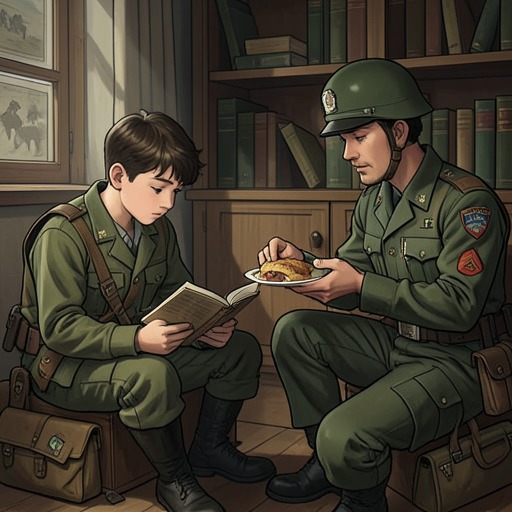
The Painted BirdSoviet collectivist ideology is the framework Gavrila teaches the boy narrator for understanding history, social purpose, and individual worth. It promises a rational alternative to religious consolation: people make their own destinies, but the Communist Party claims the knowledge to interpret their actions and direct them toward collective goals. The teaching gives the boy hope and a place in a larger pattern; at the same time, its demand that individuals submit to collective judgment makes that promised belonging a source of anxiety.
Replacing Providence with Human Agency
Gavrila presents the world as independent of God and rejects religious belief as an explanation for how life unfolds. In this account, priests invented God to deceive people who did not understand the natural order or trust their own powers. The boy is taught to discard not only God but also the supernatural beings and threats that had populated his earlier understanding of the world. Providence gives way to human responsibility: people, rather than divine intervention, determine the course of their lives.
That argument does not reduce human action to isolated choice. Gavrila tells the boy that every person matters because individual deeds contribute to a pattern larger than any one person can see. The image is a woman’s needlework: stitches that seem random by themselves become part of a floral design visible in the finished cloth. The metaphor reconciles personal action with a collective result, but it also introduces a problem of perspective. The individual makes a stitch without knowing the full pattern; knowledge belongs to those positioned to discern the design.
Leaders and the Historical Pattern
In Gavrila’s account, people who possess superior knowledge and wisdom can emerge from the nameless mass and become leaders. Because waiting for divine help cannot improve earthly conditions, such figures guide people’s thoughts and deeds, directing many separate actions as a weaver directs colored threads. Leadership is thus presented as a practical answer to the absence of providence: history can be shaped by human beings who understand its pattern and act on behalf of others.
The doctrine is embodied in the portraits displayed throughout the regimental library, field hospital, recreation hall, mess tents, and soldiers’ quarters. The boy has seen images of many great men, most dead, but one living leader’s portraits are larger and brighter. Gavrila identifies Joseph Stalin as the figure directing the Red Army’s advance and promising a society without rich and poor, exploiters and exploited, persecution of the dark by the fair, or people condemned to gas chambers. The boy is told that soldiers and officers owe him their education, rank, and homes; the library’s books, the army doctors’ care, and the boy’s own recovery are also attributed to his leadership. The teaching makes collective liberation and personal gratitude converge in a single figure.
The Party as Interpreter and Motor
For Gavrila, the Communist Party turns the broad historical pattern into organized work. Its members are selected from the population, specially trained, and assigned tasks; they are expected to endure hardship, even death, when the cause of the working people requires it. The Party occupies the social summit from which separate actions become legible as parts of a definite design. It does not merely explain events after they occur: its members are said to shape and direct them toward new aims. The Party’s ability to see farther than even the best sniper becomes a claim to exceptional political understanding.
Gavrila compares the Party’s function to an engine leading a train, with Joseph Stalin at the throttle. The image binds direction to movement: the masses are the train, while the Party supplies the force and route that carry them toward better conditions. This model offers an answer to confusion and uncertainty, because the Party is supposed to know the right destination and identify shortcuts to improving people’s lives. Yet it concentrates the authority to define both the destination and the route in the institution that claims to represent the collective.
The Party’s meetings enact that authority through reciprocal appraisal. Gavrila returns hoarse and exhausted from long, tempestuous gatherings where members criticize one another and themselves, offer praise, and identify shortcomings. Members are expected to watch for harmful activity among people influenced by priests and landlords. The Party’s strength, as explained to the boy, depends on removing those who obstruct progress, like a jammed or crooked wheel. Self-criticism is therefore both a method of correction and a discipline that hardens members through scrutiny.
The Collective and the Judged Individual
The boy is especially struck by the Party member’s ordinary appearance. A member may dress, work, and fight like any other soldier, yet the Party card carried close to the heart changes how the boy sees him. The card makes hidden affiliation visible as a source of authority: other people fall silent when its bearer speaks or choose their words more carefully when he listens. Political standing is not marked by a different uniform but by the knowledge and judgment the boy believes membership confers.
Gavrila teaches that a person’s worth is determined not by self-assessment but by the collective. The group decides what will make someone more useful and what will diminish that usefulness; a person becomes, in effect, the composite of what others say about him. Because inner character cannot be known with certainty, the possibility of an enemy concealed within a person remains open. Friends and enemies alike must therefore keep watch. Evaluation extends across professional ability, family origin, collective achievement, and Party success, and the individual may be compared with people who could replace him or be replaced by him. The result is a shifting identity, measured from several angles without a guaranteed final verdict.
Purpose, Conformity, and the Boy’s Anxiety
The doctrine’s promise of direction unsettles the boy as he tries to imagine his own future under the collective’s gaze. He wonders whether the group might decide that he should become a deep-water diver because his near-drowning under the ice had made him seem qualified, even though water terrifies him. In that imagined assignment, a painful experience would be converted into evidence of suitability, while his own fear and preference would count for less than the collective’s judgment. The example gives the ideology’s abstract hierarchy a bodily consequence: service and useful placement may override what the individual knows about himself.
Gavrila’s teaching describes life as a choice among paths, including dead ends, swamps, traps, and snares, but says that only the Party knows the proper route and destination. Happiness and usefulness, the boy learns, mean joining the march of working people and keeping one’s assigned place in the column. Moving too far toward the head risks separation from the masses and decadence; lagging behind is also a failure, while a stumble can slow everyone and those who fall may be trampled. The marching image turns social belonging into coordinated motion, but leaves little room for a person to choose a pace or destination independently. The boy absorbs the lessons carefully, writing questions on his slate and listening to conversations and meetings, yet the more he learns, the more complex and precarious the system appears. Its central tension remains unresolved: collective organization promises meaningful action and protection from arbitrary paths, while making the individual’s identity, ambitions, and place subject to other people’s judgment.