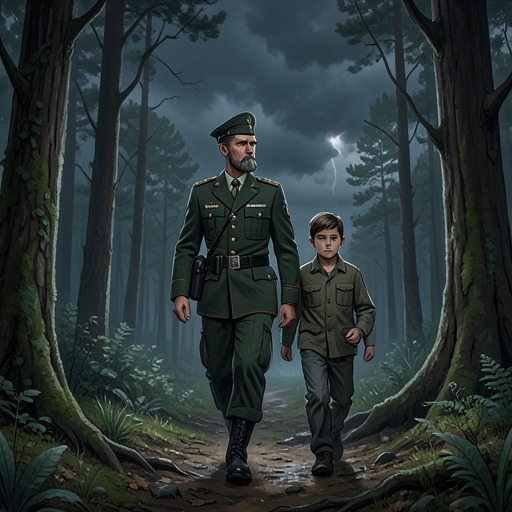
The Narrator Is Beaten by a Farmer at the Market
The Painted BirdThe narrator’s assault at a local marketplace turns an accidental mishap into a public punishment, exposing how quickly a vulnerable child can become a target. The crowd’s laughter and the farmer’s violence make the narrator’s exclusion visible; the Silent One’s intervention, by contrast, establishes a practical bond of care that continues after the immediate danger has passed.
Setting and Vulnerability
The scene takes place at a weekly market where peasants from neighboring villages sell produce and handmade goods. The narrator and the Silent One have learned to obtain small amounts of food there: an apple, a bunch of carrots, or a glass of cream, secured through smiles directed at the women selling their wares. Their method is opportunistic but modest, and the market’s abundance offers no assurance of safety. Farmers call out their goods, women try on colorful clothes, and livestock jostles through the crowded space. The two boys move among people whose attention can quickly turn from ordinary bargaining to hostility.
The assault follows a moment of distraction. Looking at a militiaman’s gleaming bicycle, the narrator stumbles against a tall dairy table and knocks it over. Milk, cream, and buttermilk spill across the market. Nothing in the account suggests a deliberate act: a brief lapse is enough to provoke a farmer, who hits the narrator before he can run. The farmer then lifts him by the scruff of his neck, continues beating him, pushes through the gathering onlookers, and puts him into an empty sauerkraut barrel, which he kicks into a garbage heap. The disproportion between the accidental spill and the punishment is central to the scene. The market’s ordinary commerce gives way to an improvised spectacle of humiliation.
The crowd does not protect the child. Its laughter accompanies the beating, and people mock the Silent One when he tries to reach him, dismissing the narrator as a stray Gypsy child. The episode therefore repeats the social logic of the narrator’s earlier encounters: an identity imposed on him makes him conspicuous, while the people around him treat his vulnerability as a reason for contempt rather than assistance. The market is not merely a setting for a private quarrel; the onlookers help make the violence public by watching, laughing, and obstructing rescue.
The Assault and Rescue
For a moment, the narrator cannot make sense of what has happened. Disoriented by the attack and the barrel’s movement, he struggles to breathe and feels his face swelling. The farmer’s punishment has reduced him to an object to be handled and discarded. The barrel intensifies that loss of control: the narrator is trapped inside it while the crowd remains outside, able to watch and laugh.
The Silent One finds him pale and shaking, and tries to pull him free. When fear of further attacks makes a direct escape difficult, he rolls the barrel toward a water fountain with the narrator still inside. Village boys run alongside, trying to trip him and take the barrel away; the Silent One wards them off with a club. His intervention is physical and persistent, carried out while other people make rescue harder. At the fountain, the narrator crawls out soaked in water and blood, with splinters in his back and hands. The Silent One puts a shoulder under him, and the two make the painful walk back to the orphanage.
At the orphanage, a doctor treats the narrator’s cut mouth and cheek. The Silent One waits outside the room rather than leaving after bringing him to safety. When the doctor has gone, he studies the narrator’s injured face for a long time. The account gives no speech to explain this attention; it is conveyed through his waiting and looking. In a narrative shaped by the narrator’s repeated exposure to abandonment and hostility, those actions make care legible without requiring verbal reassurance.
Aftermath and Narrative Significance
The marketplace episode sits against the narrator’s memories of people transported toward death. In earlier scenes, villagers watched trains carrying Jewish and Romani prisoners pass through the forest; some waved at the trains, while later the narrator encountered evidence of people who had fallen or been thrown from them. He had also held human ash in his hand and imagined the dead continuing to watch the living. These experiences form part of the emotional context for his thoughts about the power to decide whether unknown people live or die. The market assault brings that large, impersonal power down to a local scale: here, a farmer’s anger and a crowd’s complicity determine what happens to one child in their midst.
The contrast is not that the farmer and the perpetrators of mass violence are equivalent, but that the episode continues the book’s attention to how power operates through ordinary people and immediate acts. The narrator is exposed to the farmer’s force and the crowd’s indifference; the Silent One uses what agency he has to carry him out of danger. The scene thus places cruelty and protection side by side without allowing the rescue to erase the humiliation or the injury.
Two weeks later, the Silent One wakes the narrator at dawn. Dust covers him, his shirt clings to his perspiring body, and he signals for the boy to follow. The narrator gathers that the older boy has been out all night, but does not know what he intends. This summons follows the market assault and the Silent One’s sustained care, while opening onto a new episode whose purpose is not yet clear. The sequence ends not with an explanation, but with a changed relation: after bringing the narrator back from the market, the Silent One now leads him somewhere in silence.