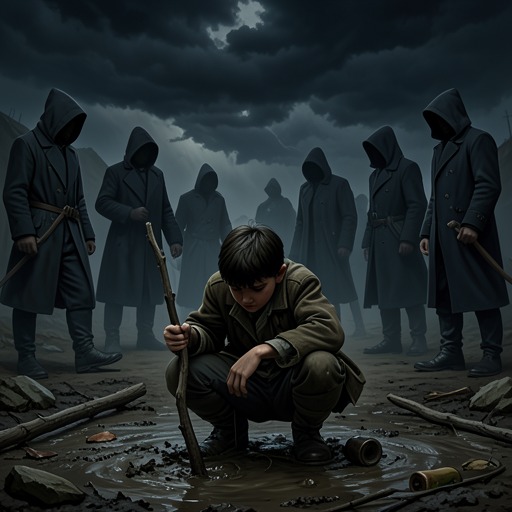
The Narrator Regains Speech After a Skiing Accident
The Painted BirdThe narrator’s recovery of speech follows a dangerous descent in a blizzard and ends a period in which his voice had been absent. The change arrives not through a stated medical explanation but in an ordinary room, when a telephone keeps ringing and someone on the other end wants to talk. The narrative makes speech return as effort, sound, and astonished repetition: first a strained attempt at syllables, then sentences and songs spoken aloud.
Mountain Isolation and the Accident
The episode begins in the mountains because the narrator is too thin and not growing. Doctors recommend mountain air and exercise, while his teachers consider the city unsuitable for him. His father takes work in the western hills, and when the first snows come the boy is sent to live with an old ski instructor in the Mountain shelter. His parents see him only once a week. This arrangement places the accident within a period of separation from family and ordinary city life, rather than presenting it as an isolated mishap.
The instructor provides a daily routine: they rise early, and the instructor kneels to pray while the narrator watches. The boy interprets this adult’s faith as a failure to accept that people are alone and cannot rely on assistance. His bleak conviction that each person stands apart gives the surrounding landscape a double meaning. The narrator spends his days skiing long trails through deserted hills, where hostels have burned and the former valley inhabitants have been sent away; new settlers are only beginning to arrive. The physical emptiness of the mountains echoes his sense of human separation.
The blizzard abruptly turns that setting from a place for exercise into a source of danger. Snow swirls across the peaks and ridges, and the narrator loses sight of the instructor. He starts down the steep slope alone, trying to reach the shelter quickly. His skis bounce over hardened, icy snow, and the speed takes his breath away. When a deep gully comes into view, he is already too late to turn. The account establishes the immediate sequence and peril but does not describe the collision, the extent of his injuries, or a medical explanation for his later recovery of speech.
The Telephone and the Return of Speech
The next scene is set in April, in a room filled with sunshine. The narrator moves his head and finds that it no longer seems to hurt; as he starts to lift himself on his hands, the telephone rings. The nurse has already left, but the ringing continues insistently. The contrast is striking: after the mountain’s blinding storm and the danger of the gully, the turning point takes place in a quiet interior, through a routine device and a voice carried along a wire.
The narrator pulls himself out of bed and walks to the table to answer. He hears a man speaking impatiently. The man’s identity and words are not supplied, and the importance of the call lies less in its content than in the fact that someone at the other end wants to speak with him. That contact awakens an overpowering desire in the narrator to answer. The sequence moves from hearing another person to wanting a voice of his own, without claiming that the caller knows anything about his condition.
Speaking does not happen effortlessly. The narrator opens his mouth and strains; sounds crawl up his throat, and he concentrates on arranging them into syllables and words. He distinctly hears them emerge one after another, compared in the account to peas falling from a split pod. The comparison gives the return a physical rhythm: language is not merely recovered as an abstract ability but released in separate sounds that he can hear. He puts the receiver aside, scarcely believing what has happened, and begins to recite words, sentences, and snatches of Red Army sniper Mitka’s songs.
Voice, Memory, and the Ending
Once speech begins, it gathers momentum. The narrator talks loudly and continuously, first like the peasants and then like city people, as fast as he can. His attention is fixed on the sounds and their weight of meaning, and he repeatedly convinces himself that speech now belongs to him and will not escape through the balcony door. This is both a declaration of change and an expression of its precariousness: he has regained the ability to speak, but the scene shows him testing and reaffirming that ability rather than treating it as an unremarkable fact.
The remembered songs connect this new voice to material carried from earlier experience. The narrator describes the voice lost in a faraway village church as having found him again and filled the room. The image does not explain how or why speech returns; it gives the event an emotional shape, joining present utterance to a distant past. In the final movement, the room becomes full of speech as the narrator moves between remembered registers and tests words at increasing speed.
The episode’s structure makes the recovery legible through contrast: a storm that erases the instructor from view is followed by a voice arriving over a telephone line; a silent or absent voice becomes a stream of audible language. Yet the narrative leaves the physical consequences of the ski accident and the cause of the speechlessness unspecified. Its emphasis falls instead on the experience of speaking again: the strain in the throat, the sequence of sounds, the remembered songs, and the narrator’s insistence that the voice will stay. Speech returns not as a general explanation of what has happened to him, but as an event he can hear himself perform.