The Narrator and Mitka the Cuckoo
The Painted BirdThe relationship between The Narrator and Mitka the Cuckoo gives the boy practical care, cultural instruction, and an ideal to imitate during his time with the Red Army regiment. Red Army sniper Mitka does not merely protect him from immediate hardship: through everyday gestures and stories of his military past, he helps shape what the boy thinks an adult life might be. The boy’s growing admiration makes Mitka both a caregiver and a figure of aspiration, while Mitka’s injury keeps that ideal connected to the bodily cost of war.
A Protective Relationship in the Regiment
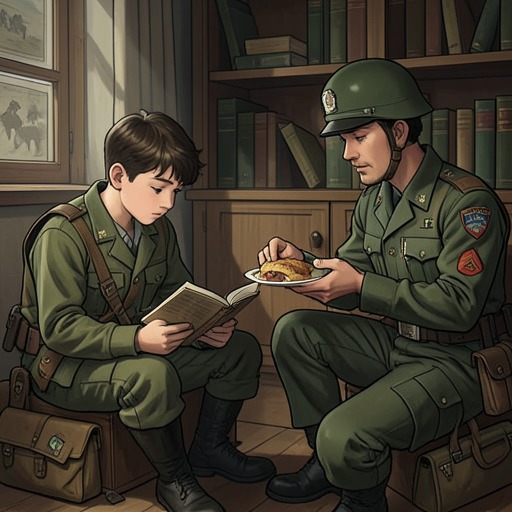
Two men look after the boy for much of his time with the regiment: Red Army instructor Gavrila and Red Army sniper Mitka. Mitka’s care becomes especially tangible after the boy enters the regimental hospital. The boy gains weight because Mitka sets aside the best pieces of meat from the soldiers’ large cooking pot and skims fat from the soup for him. When the boy faces painful injections and medical examinations, Mitka helps him endure them; after overeating makes him ill, Mitka stays beside him for two days, supporting him while he vomits and wiping his face with a wet cloth.
These acts make the relationship more than a formal bond between an adult soldier and a child attached to the regiment. Mitka attends to the boy repeatedly, through feeding, treatment, and the less dramatic work of staying with him when he is unwell. For a child who has lived amid suspicion and violence, such steady care offers a sharply different experience of adult attention. The evidence does not present Mitka as a substitute parent, but it does show that he assumes responsibility for the boy’s comfort and courage in specific, sustained ways.
Instruction Beyond Military Life
The boy’s education in the regiment has more than one source. Gavrila teaches him to read and explains the role of the Party, while Mitka introduces him to poetry and songs, accompanying his singing on the guitar. The distinction between their forms of instruction is clear: one offers literacy and political explanation; the other enlarges the boy’s imaginative and cultural world. Mitka also takes him to the regimental cinema and explains the films, and brings him to watch truck mechanics at work and sharpshooters training.
The boy’s time with Mitka thus combines companionship with guided observation. The cinema and the workshops expose him to activities beyond his own immediate survival, while poetry and song give him forms of expression he has not previously been shown. The boy does not describe these experiences as lessons in a classroom; their force comes from Mitka sharing them with him. Across these outings and performances, the soldier makes knowledge accessible through participation and explanation, rather than through authority alone.
A Hero the Boy Wants to Emulate
Mitka’s standing in the regiment intensifies the boy’s attachment. He is widely liked and respected, has a distinguished service record, and holds the Hero of the Soviet Union award, the highest military honor. His achievements have appeared in newspapers, books, and newsreels; the regiment takes pride in him, and correspondents interview him. Soldiers recount missions in which he operated behind enemy lines, parachuted in alone, and used his skill as a sniper against officers and couriers of the German Army.
The boy listens closely to these accounts while sitting beside Mitka and leaning against his arm. He imagines that, if the war lasts until he is old enough to serve, he too might become a sharpshooter and a hero whose name working people discuss at their meals. That aspiration shows how closely the boy’s future-facing ambitions have become bound to Mitka’s example. His admiration is not abstract: it grows from proximity, from hearing Mitka’s voice and stories, and from the boy’s wish to belong to the community that honors him.
Mitka’s rifle concentrates that public legend into a particular object. He takes it from its case when soldiers ask to see it, and they examine its polished stock and telescopic sight with reverence. For the boy, the weapon belongs to the same world as the stories of skill and danger that surround its owner. Yet Mitka’s response to the admiration is not uncomplicated. His face darkens, and he touches the stiff, painful side of his body, where fragments of a bullet remain. That injury ended his career as a sniper a year earlier and continues to trouble him. His earlier nickname, Mitka the Cuckoo, has given way to Mitka the Master. The contrast between the rifle’s prestige and the injury it recalls prevents the boy’s image of heroism from being entirely triumphant.
Admiration, Protection, and the World Outside the Camp
The boy’s perception of Mitka also carries a moral contrast. He admires a man who, in his view, works toward a safer world through skill and action rather than prayer. Against Mitka, the boy sees the German officer who had seemed powerful in earlier episodes of his life as comparatively insignificant. This comparison belongs to the boy’s understanding of Mitka, not to a claim that the violence of war has ended: Mitka’s own injury and the regiment’s continuing military life make clear that danger remains close.
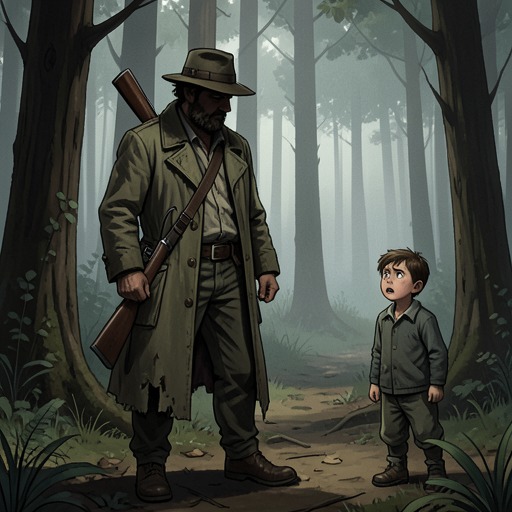
The relationship is set against the boy’s earlier exposure to the persecution of Jews and Roma. In the village, he hears that people are being transported in locked trains, sees peasants greet those trains, and encounters their suspicion toward him because of his dark features. After a child is thrown from a train, villagers find him beside the tracks and strip his belongings; later, the boy secretly handles ash left by burned victims. These episodes establish the hostility and human dispossession surrounding the child before the regiment’s care for him. They do not make Mitka’s protection a simple answer to that history, but they sharpen the contrast between a community that treats vulnerable people as objects of fear or profit and a soldier who feeds, assists, teaches, and stays with the boy.
Mitka’s concern is not confined to the boy. When several soldiers who have secretly gone to a village fail to return, Mitka grows anxious as the hour of inspection approaches. He paces in the tent and watches his watch, worried about friends he regards as especially close. The scene shows his attachment to others and places his care for the boy within a broader capacity for loyalty. For The Narrator, Mitka is therefore not only the celebrated marksman he hopes to resemble: he is also a man whose attentiveness is expressed through meals, illness, shared culture, and concern for comrades. Their relationship joins protection to example, while the injury that curtailed Mitka’s former role leaves the boy’s admiration shadowed by the cost of the ideal he wants to follow.