The Narrator’s Inability to Speak
The Painted BirdThe Narrator’s Inability to Speak is a lasting condition that begins in the aftermath of a village crowd’s violence and changes how he survives, communicates, and understands himself. Its significance lies not only in the loss of spoken language, but in the gap between the narrator’s vivid inner life and the suspicion with which other people interpret his silence. For much of the story, he cannot make his voice answer the world; when it returns, speech arrives as an overwhelming recovery of agency.
Onset amid violence
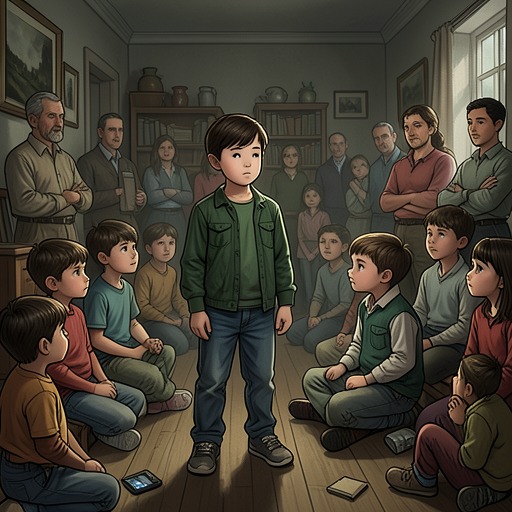
The loss follows the narrator’s fall during a church Mass. As he carries the Missal, its weight overwhelms him, and he tumbles down the altar steps. The crowd’s response turns his accident into a charge of monstrosity: villagers call him a vampire and drag him outside. Although he wants to plead for mercy, he finds that no sound comes from his throat. The failure is present before the ordeal reaches its physical climax; it is not simply that the villagers refuse to listen.
The peasants take him to a manure pit, convinced that his interruption of the Mass foretells evil for the village. When he struggles, they press hands over his mouth and nose. They swing him by his hands and feet and throw him into the pit. He fights through the filth, repeatedly pushing off its bottom to reach the surface, and finally catches a creeper at the edge and pulls himself out. After vomiting and crawling away into the forest, he tries once more to cry out and discovers that he still has no voice. The sequence joins bodily danger to communicative helplessness: the crowd can name and punish him, while he cannot answer its accusations or call for help.
Silence as an inward experience
The narrator does not describe the silence as an absence he can calmly accept. At first he refuses to believe that his voice is gone and tries again, while the forest around him supplies only the buzzing of flies. His last cry, made as the Missal fell, remains audible in memory. He imagines that voice wandering through the church, striking its walls and stained glass, moving from altar to pulpit and balcony among the organ music and the congregation’s singing. That image gives the lost voice a trajectory of its own: it continues to exist in the remembered church even as the narrator can no longer summon it from his body.
He recalls the mutes he had seen before. Their faces, twitching limbs, and dribbling mouths had seemed strange to other people, who looked at them with suspicion. This memory makes his own condition newly frightening: he recognizes the social image into which he may now be placed. The narrative thus presents muteness as a lived vulnerability as well as a bodily change. The narrator fears not only his inability to speak, but also the way silence can make a person appear alien to those who expect speech.
Suspicion, adaptation, and agency
At Makar’s farm, the narrator’s silence is treated as something that may conceal a trick. Makar suspects that he is pretending to be mute so that he will not betray his Gypsy speech. At night, Makar sometimes rushes into the tiny attic and tries to force a scream from him. The narrator wakes shaking, opens his mouth, and produces no sound; Makar watches and eventually gives up repeating the test. His silence is therefore repeatedly examined by someone who distrusts it, rather than accepted as an unexplained condition.
The narrator nevertheless finds ways to communicate and act. At the orphanage, when the staff try to take his Soviet uniform, he escapes into the street and approaches four Soviet soldiers. He signals that he is mute, then writes a message claiming to be the son of an officer at the front and accusing the principal and nurses of beating him because of his uniform. The soldiers respond to the written appeal by confronting the staff, after which the staff leave him alone. His account is calculated, not merely a passive record of helplessness: without speech, he uses writing to influence what others do.
He also writes on the blackboard that Russian is his language and the speech of a land without exploitation, rejecting the teachers’ attempt to make him learn his mother tongue. The episode makes his silence compatible with forceful self-presentation. He cannot voice the claim aloud, but chalk allows him to define his allegiance and resist the orphanage’s authority. The distinction is important: the condition constrains his means of expression without extinguishing his ability to form purposes or act on them.
Learning, belonging, and the return of speech
In the regiment, Gavrila spends time with the narrator in the field library and teaches him to read. The narrator is already over eleven, and Gavrila presents literacy as part of growing up among Russian boys who can read, write, and, when necessary, fight. The narrator studies industriously and imitates the soldiers, unwilling to be treated as a child. Books enlarge the world available to him: their pages reveal what people think and plan, knowledge ordinary observation does not provide. His access to language therefore expands through reading even while spoken language remains unavailable.
The narrator’s muteness also shapes his bond with Mitka. During a secret mission, he feels proud to have been chosen to accompany a Hero of the Soviet Union, and he silently longs to repeat the curses Mitka uses on the march. Later, when the narrator is sent to the orphanage, he clings to the uniform that connects him to the soldiers and shakes off the principal’s hand from his shoulder. His gestures, written claims, and possessions carry meanings that he cannot yet speak aloud. Silence does not separate him from every form of belonging, but it makes those ties dependent on signs and objects rather than conversation.
The condition ends in a hospital room after an April morning when the narrator can move without apparent pain. A ringing telephone brings an impatient voice from the other end of the line, and he feels an overpowering desire to speak. He strains, forms syllables and words, then sets the receiver aside in disbelief and tries out speech again through sentences and snatches of Mitka’s songs. The voice he had imagined lost beneath the church roof fills the room instead. His return to speech is not represented as a quiet restoration: he speaks loudly and incessantly, testing the sounds and their meaning, as if repetition could assure him that the voice will not escape again. The ending turns speech into a recovered possession and a source of immediate joy, without erasing the years in which the narrator had to make himself understood otherwise.