The Narrator’s Religious Crisis
The Painted BirdThe Narrator’s Religious Crisis is a struggle to make suffering intelligible: prayer first appears to offer a precise, countable route from humiliation to justice, but the loss of his voice and Gavrila’s lessons unsettle that faith. The narrator’s movement away from divine providence does not leave a vacuum for long. Political instruction supplies a new framework in which people, rather than God, shape history, and organized human purpose replaces the imagined heavenly order.
Prayer as an Explanation of Suffering
While Garbos persecutes him, the narrator hears a priest explain that certain prayers earn between one hundred and three hundred days of indulgence. He takes the teaching literally and causally: more prayer means a better life, while fewer prayers mean more pain. This scheme appears to explain the inequalities he sees between the strong and weak, the free and enslaved, the rich and poor, and the healthy and sick. Misfortune is no longer arbitrary; in his understanding, it reflects a person’s failure to accumulate enough spiritual credit.
The narrator imagines that every person has a heavenly bin in which earned days are stored. Some bins bulge; others remain nearly empty, and unused ones await people who have not yet discovered prayer. The harvest image makes the promise tangible: indulgences can pile up like sacks of wheat, and a sufficiently full bin might have to be replaced with one as large as the church. In this vision, divine justice is an accounting system that can be learned and used.
He asks the priest to show him the Prayer book, selects the prayers marked with the highest indulgence totals, and memorizes them after the priest reads them repeatedly. He expects this concentrated effort to transform him from a vulnerable creature who could be crushed into an unapproachable bull. Prayer gives him not only hope but a practical objective: each spare moment can add to the account that, he believes, will end punishment and humiliation.
A Devotion Tested by Violence and Silence
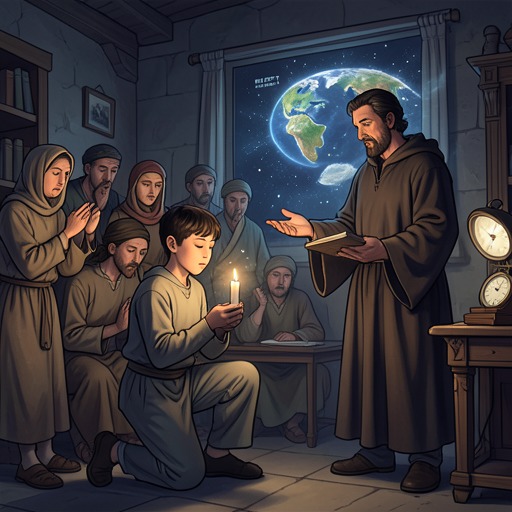
The narrator’s praying becomes continuous, from dawn to dusk. He pictures his accumulated prayers rising like sparrows from a small boy with black hair and black eyes, and imagines saints noticing them as they approach the heavenly throne. The image gives private suffering a destination and an audience. Even as Garbos beats him, the narrator continues to pray: pain passes, he reasons, whereas the days of indulgence will remain in his bin forever.
Garbos misreads the murmuring as a possible Gypsy spell. The narrator conceals his actual purpose, fearing that Garbos might forbid him to pray or somehow interfere with the heavenly account. When a prayer delays his answer to Garbos, the delay is taken as impudence and brings further beatings. The narrator’s days thus alternate between prayer and violence, while he treats each assault as evidence of how much ground he must make up for lost years rather than as proof that his system has failed.
After escaping into the forest, the narrator discovers that he can no longer speak. He tries to cry out, but his tongue moves without producing a voice; the forest is broken only by the flies around him. The last cry he remembers came beneath the falling missal, and he imagines his voice wandering alone through the church, striking its walls and colored windows before drifting between altar, pulpit, and balcony. With the loss of speech comes a new uncertainty about the forces governing his life. He reasons that his vast reserve of indulgences should have left God no cause to punish him so terribly, and begins to suspect that powers other than God may reach those God has abandoned.
The Collapse of the Heavenly Account
Gavrila’s instruction gives the narrator a sharply different explanation of the world: God does not exist, and the natural order has no divine author. In this account, priests invented God to deceive people who were superstitious and unable to trust their own powers. The narrator is taught that people themselves determine the course of their lives, and that individual actions contribute to a larger pattern, much as separate stitches form a design in a tablecloth or bedcover.
This teaching makes the narrator reconsider the thousands of days of indulgence he believes he earned. He wonders whether his prayers are circling through an empty heaven like birds whose nests have been destroyed, or struggling to escape somewhere as his lost voice does. Their language now seems meaningless to him, and he feels cheated. Yet the change is not presented as simple, settled certainty: he also finds it difficult to believe that priests knowingly deceive their congregations. He considers what the churches would mean if their rites were only instruments of intimidation, and what priests themselves might face if they discovered that no God waited above the church domes. His abandoned faith leaves questions as well as an alternative answer.
From Providence to Political Purpose
Gavrila’s lessons eventually give the narrator a new confidence. The good once expected from God is recast as something people can promote through deliberate action. Members of the Communist Party, as Gavrila describes them, are selected and trained for particular tasks and prepared to endure hardship or death for working people. From their position at the social summit, they can see individual acts as parts of a meaningful historical pattern and direct them toward chosen aims.
The political image is as ordered as the narrator’s former vision of heavenly bins, but its agents are human: the Party is an engine leading people toward better goals, and Joseph Stalin is its engineer. Party meetings add a disciplinary method to this promise of direction. Members evaluate one another, criticize themselves and their comrades, praise work, and identify shortcomings; constant watchfulness is meant to forestall harmful influence. The narrator’s earlier hope that a higher power would recognize his prayers and secure his future gives way to confidence in trained people who claim to understand and shape events.
The crisis therefore marks more than a rejection of prayer. It exposes how urgently the narrator needs a pattern capable of explaining pain and assigning meaning to individual action. His first system makes suffering the consequence of insufficient spiritual accumulation; the next makes history intelligible through collective labor, leadership, and political discipline. His doubts about priests and the fate of his prayers remain part of that transition, even as the promise of human agency begins to occupy the place once held by divine providence.