The Narrator’s Separation from His Family
The Painted BirdThe Narrator’s Separation from His Family is not presented as a single departure but as a long condition of wartime displacement, in which the narrator loses contact with his birth parents and builds a new sense of belonging among Red Army soldiers. The postwar search reunites him with his parents, yet the reunion is also a painful break from the regiment and the future he had pictured there.
Identity and Wartime Displacement
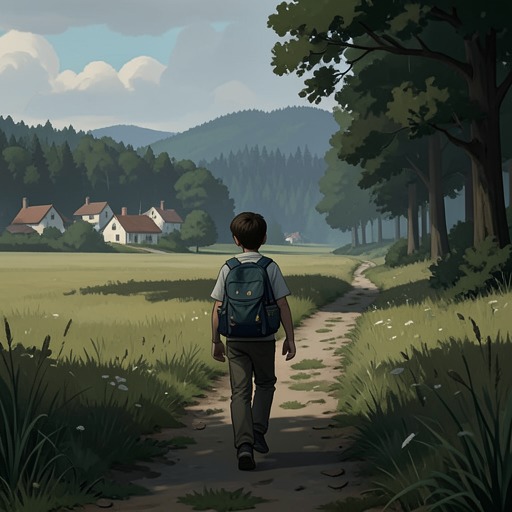
The narrator is separated from the people he remembers as his parents during the war. The supplied account does not describe the moment they became separated, or establish one particular event as its cause. Instead, it shows the consequences accumulating: he is a child living under other people’s protection, without the security of knowing where his family is or whether they remain alive. By the time the war is ending, he is twelve and is treated as a lost child whose identity and family connections must be reconstructed.
The danger surrounding that displacement is made concrete in the episodes he witnesses. During mushroom season, his master fears that the narrator’s dark appearance will lead others to identify him as Roma and report him to the Germans; he shaves the boy’s black hair and gives him a large cap to cover part of his face. Villagers still direct hostility toward him. These details do not explain how he became separated from his parents, but they show how precarious a child’s safety could be when his appearance exposed him to suspicion and persecution.
Railway scenes deepen that context without making another child’s fate the narrator’s own. The villagers hear that locked trains carry Jews and Roma toward death, and they line the tracks to wave at the passing trains. Later, while searching near the railway, they find a small boy who has fallen from one of them. The villagers take his clothes and leave him beside the track. The episode places the narrator’s own lost-child status within a world where children can be deprived of family, protection, and even recognition. His later reunion is therefore not a simple return to an undisturbed home life; it occurs against the background of widespread wartime loss.
A New Attachment in the Red Army
As the war ends, the narrator has formed strong ties with Red Army mentor Gavrila, Red Army sniper Mitka, and the other soldiers in the regiment. Gavrila explains that the country has been liberated from the Germans and that regulations require lost children to be sent to special centers until it is established whether their parents are alive. The rule gives the separation an official, postwar form: the narrator must leave the people who have cared for him so that his original family can be sought.
Gavrila promises that if no relatives claim him within three months after the war ends, he will take responsibility for the boy and send him to a school where he can learn to speak again. The promise offers a possible future, but it remains conditional on the search failing. Gavrila also urges the narrator to be brave, remember what he has learned, and read Pravda every day. His care thus combines affection with preparation for a life beyond the regiment, even as the narrator struggles to accept that departure.
The narrator is given a bag of gifts from the soldiers and books from Gavrila and Red Army sniper Mitka. A regimental tailor has made him a Red Army uniform, and he finds in its pocket a small wooden pistol bearing pictures of Joseph Stalin on one side and Lenin on the other. These objects give the parting a tangible weight: the boy is not simply transferred between institutions but leaves with tokens of the people and ideals that have become his chosen home. Before the journey, Gavrila checks that his belongings are complete and that his personal file contains the name and former residence he has supplied, along with what he remembers about his parents, hometown, relatives, and friends.
The Search and Reunion
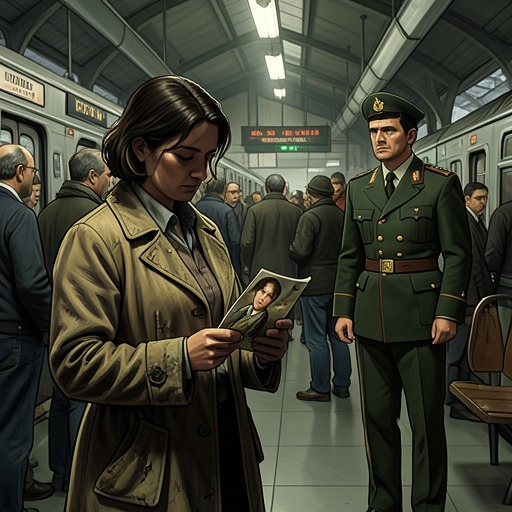
The narrator travels with Sergeant Yury to the city where the center for lost children is located. It is the country’s largest industrial city and the place where he lived before the war. The two-day train journey passes bombed towns, deserted villages, abandoned military vehicles, and stations where ragged people ask for food and cigarettes. The landscape makes clear that the search is taking place in a devastated postwar world, while the destination also brings the narrator back to the setting of his earlier family life.
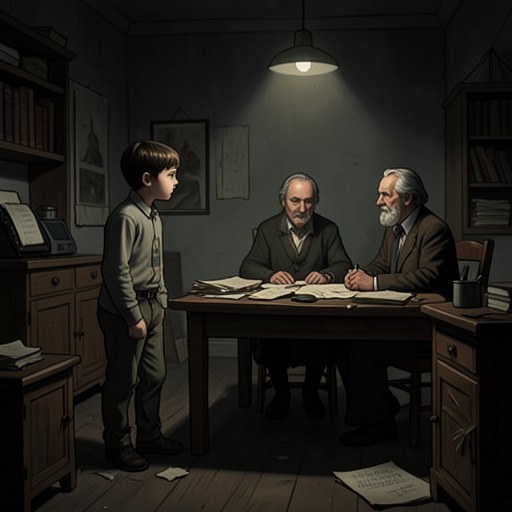
At the center, the principal summons him to her office with a member of the Social Commission who believes he knew the narrator’s parents before the war. The adults seem nervous, and the narrator hears voices in the adjoining room before a man and woman are brought in. He finds them familiar and sees a striking resemblance, but recognition does not immediately settle his response. He considers whether to admit that he recognizes them or pretend otherwise. His hesitation registers the distance that separation has created: these are his parents, yet reunion is also an unfamiliar encounter with people from a life he has not shared for years.
The man asks the narrator to unbutton his uniform so they can check for a birthmark on the left side of his chest. The narrator knows it is there and pauses, aware that showing it will establish their relationship beyond doubt. He finally opens the uniform, partly because he feels sorry for the woman, who is crying. The visible mark confirms that the adults are his parents; they embrace and kiss him. The identification resolves the practical question of who he is, but it does not erase his divided feelings.
The Cost of Return
Gavrila has often told the narrator that parents have a right to their children. The narrator understands that, at twelve, he is not grown and cannot decide the matter as an independent adult; even if his parents did not wish to take him, he believes it would be their duty. He studies them as people who seem frail and unwell rather than threatening. The reunion therefore brings relief and obligation together, rather than an uncomplicated return to intimacy.
He knows he could run away, board a crowded train, and make himself difficult to trace. Yet he wants Gavrila to find him, and concludes that running would defeat that hope. At the same time, he recognizes what going with his parents means: an end to his dreams of becoming an inventor of devices that change people’s color and of living in the world of Gavrila and Red Army sniper Mitka, where, as he imagines it, tomorrow has already arrived. The family separation ends through identification and reunion, but the narrator’s attachment to the regiment remains a real loss. The episode makes belonging more complicated than biological recognition: the search restores his family connection while exposing how deeply wartime care and companionship have reshaped his sense of home.