The Nazi Genocide of the Romani People
The Painted BirdThe Nazi Genocide of the Romani People is presented in The Painted Bird as part of a system of deportation and mass killing that also targeted Jews. The novel places the machinery of persecution beside the conduct of people who watched it pass, profited from its traces, or used its racial logic against a vulnerable child. Its afterword then answers accusations that the book exaggerated wartime cruelty by citing survivor testimony and camp records, distinguishing the novel’s scenes from the documents invoked to corroborate the historical violence.
Deportation and the railway
The unnamed boy narrator first encounters the deportations through a new kind of train moving along the railway in the forest. Earlier trains carried freight under the surveillance of armed German soldiers; now locked cattle cars carried captured Jews and Romani people toward their deaths. The narrator hears that each car held about two hundred people, including men, women, children, and babies. The details of sorting and killing at the camps reach the village through railway workers and peasants who had been employed in camp construction, so the book separates what the boy sees from what villagers report.
The trains turn the railway into a public scene of persecution. Peasants line the tracks and wave cheerfully to the railway workers and guards. People inside the cars, visible only through small high windows, respond with desperate gestures; those outside mistake the spectacle for something less terrible, or choose to behave as though it were. The train’s passage is thus both transport and a test of the surrounding community: the victims are visible, but visibility does not produce aid. The contrast between the villagers’ greeting and the captives’ signals makes ordinary public behavior part of the scene’s moral indictment.
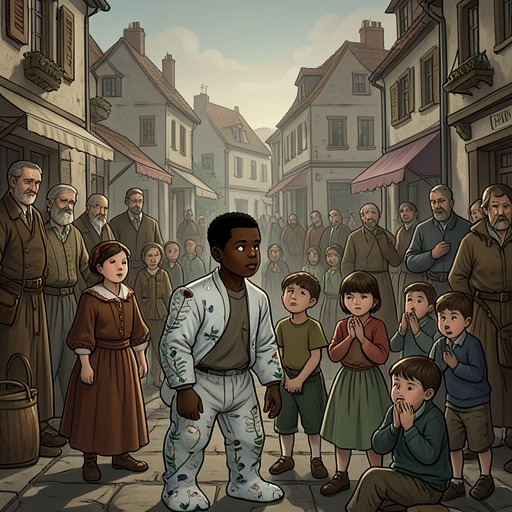
The narrator also encounters what the trains leave behind. When villagers search the trackside after several trains have passed, they find an unidentified child, about five years old, who appears to have fallen from a car. The people gathered around him recoil from his dark eyes and cross themselves. After he dies, they take his clothes and leave his body where a German patrol will find it. The episode does not establish the child’s identity, but its placement among accounts of the deportations shows how racial fear and self-interest shape the villagers’ response even to a helpless child.
Persecution carried into village life
The danger of being marked by appearance is not confined to the railway. As talk of the camps spreads, villagers turn their hostility toward the unnamed boy narrator, whom they identify as Romani. They threaten him with burning and treat his dark hair and eyes as signs that he belongs among the people being persecuted. Some shepherds try to drag him toward a fire; he resists and escapes. The scene makes persecution immediate for him: the distant system of deportation becomes a local threat, enforced by people who repeat its racial categories and invoke religious approval.
In the boy’s nighttime fears, these categories become an anxious question about family and survival. He remembers his father as fair-haired and blue-eyed, while his mother was dark, and wonders what distinguishes a Romani person from a Jew when both are treated as doomed because of their appearance. He imagines a postwar world populated only by fair-haired, blue-eyed people, then asks what would happen to children born dark to such parents. The passage does not offer an abstract explanation of racial classification; it shows a child trying to understand why appearance can determine who is hunted and whether even family lineage can protect anyone.
The villagers’ response to the deportations reveals a related mechanism of persecution. They interpret the killing of Jews as divine punishment and cast the Germans as instruments of justice. This religious explanation does not describe Romani persecution in the same terms, but it helps establish the moral climate in which the boy is threatened: violence against people designated as outsiders can be accepted, rationalized, or repeated by those around them. The book therefore distinguishes the targets of the Nazi genocide while showing how antisemitic belief and anti-Roma hostility coexist in the same village world.
That world is not uniformly defined by explicit denunciation. In another episode, a farmer tells the boy to flee because German forces are preparing a raid after learning that a Jew has been hidden in a village. The community knows the man and remembers his family’s local standing, describing him as a decent person despite his Jewish identity. The warning gives the boy a chance to escape, but it also shows the precarity of such acceptance: a known neighbor can remain at risk when German forces search for someone hidden from them.
Remains, memory, and documentary evidence
The aftermath of the trains persists along the tracks. The villagers encounter ashes and other remains, sometimes covering them with dirt because they fear contamination. The unnamed boy narrator secretly handles some of the human ash and cannot treat it as ordinary fuel residue. He fears that the dead may remain present in memory, following the living and bringing illness or madness. His response registers the limits of the villagers’ attempts to dispose of the evidence: the remains can be buried or scattered, but witnessing them changes the witness.
The railway also yields personal documents and photographs—passports, diaries, calendars, papers, and images of parents with children, young people, and newlyweds. These objects place particular lives beside the anonymous movement of the trains. Their presence does not undo the victims’ disappearance, but it gives the deportation a human scale that the villagers’ talk of punishment and the trains’ impersonal passage try to erase.
In the book’s afterword, the author counters claims that The Painted Bird’s violence was invented or exaggerated by referring to materials beyond the novel’s fictional scenes. One cited survivor account describes German forces and Kalmyk cavalrymen destroying a village punished for sheltering an enemy of the Reich. Other cited camp records include a commander’s statement that children judged too young to work were killed, a report of nearly one hundred thousand garments belonging to Jewish children prepared for shipment within forty-seven days, and a Jewish attendant’s diary recording that more than half of roughly one hundred Romani people killed in a camp each day were children. These are presented as documentary testimony cited by the author, not as events witnessed by the narrator.
Together, the narrative and the afterword make two different kinds of claim. The railway episodes portray the experience of persecution and the responses of bystanders; the cited testimony and records argue that the book’s brutality has historical counterparts. The distinction matters: the novel’s scenes should not be mistaken for a complete historical record, while its documentary frame insists that literary extremity cannot be dismissed simply because it is difficult to read. The Romani victims named in the camp testimony, and the boy threatened in the village, remain at the center of that challenge to denial and minimization.