The boy
The Painted BirdThe boy is a six-year-old child separated from his parents by the opening weeks of World War II. Sent from a large city in Eastern Europe to a distant village for safety, he enters a childhood defined by displacement: the adults’ attempt to protect him cannot keep him from being left alone among strangers, waiting for a reunion that war has made uncertain.
Identity and Wartime Separation
In the fall of 1939, the boy’s parents entrusted him to a man traveling eastward, who agreed for a substantial payment to find temporary foster parents. They believed sending him away offered the best chance of keeping him alive. Because of his father’s prewar anti-Nazi activities, his parents had to hide to avoid forced labor in Germany or imprisonment in a concentration camp; they hoped they would eventually find their son again.
The plan broke down amid occupation and the repeated movement of populations. His parents lost contact with the man who had placed him in the village and had to confront the possibility that they might never find their child. Their separation is therefore not presented as a chosen abandonment: it begins as an effort to save him, then becomes a consequence of wartime confusion that none of them can readily undo.
Displacement and Exposure
The boy’s first foster mother died within two months of his arrival. With her death, the child was left to wander from village to village, sometimes receiving shelter and sometimes being chased away. Over the following four years, he lived among communities whose appearance and speech differed sharply from his own. The local peasants were described as fair-skinned, blond, and blue- or gray-eyed; he was olive-skinned, dark-haired, and black-eyed. He also spoke the language of the educated class, which the eastern peasants could barely understand.
These visible and linguistic differences made him legible to villagers as an outsider and a suspected Gypsy or Jewish stray. Under German occupation, harboring Jews or Roma could expose individuals and communities to severe punishment. His danger thus arose not only from having no stable home, but also from the way others interpreted his appearance and the risks attached to sheltering a child like him.
Marta’s Hut and the Waiting Child
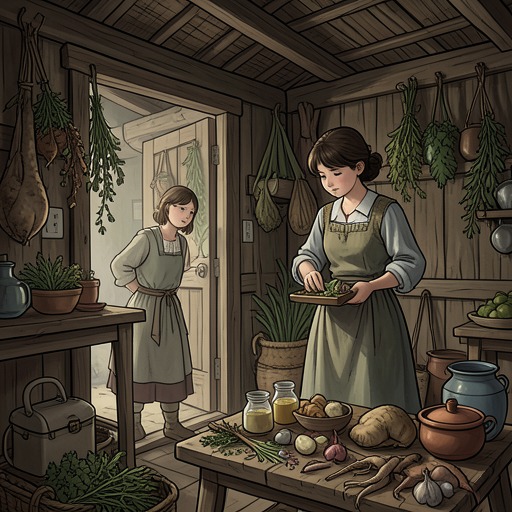
For a time, the boy lived in Marta’s hut, still expecting his parents to come for him at any moment. He cried, but crying did not bring them back, and Marta paid no attention to his sniveling. The contrast between his urgent expectation and her indifference establishes the small, immediate scale of his abandonment: the hoped-for reunion remains vivid to him, while the adult beside him offers little comfort.
Marta is introduced through a markedly physical portrait. Old and bent, she hobbled with a gnarled stick; her uncombed hair had formed thick braids she called elflocks, which she believed housed evil forces that slowly induced senility. Her withered body trembled, and the diseased joints of her bony fingers never stopped quivering. The boy’s first refuge is therefore neither a return to family nor a secure home, but a hut shared with a frail, distant woman whose presence cannot answer his longing for his parents.
Narrative Significance
The boy’s early story turns the promise of protection inside out. His parents send him away to save him, but the death of his foster mother and the loss of contact leave him exposed to repeated transfers and uncertain shelter. The account places his private waiting alongside the larger pressures of occupation and persecution, showing how a decision made for survival can become the beginning of prolonged separation.
His outsider status is established through concrete distinctions—skin, hair, eyes, and language—rather than through any choice of his own. Those differences shape how villagers identify him and whether sheltering him is dangerous. At Marta’s hut, the narrative narrows from this broad wartime vulnerability to the child’s unanswered expectation: he remains a boy waiting for his parents, even as events have already made their return uncertain.