The boy and Lekh
The Painted BirdThe boy and Lekh are bound first by usefulness and shared labor: Lekh takes in a boy whose small, light body can reach trapping places inaccessible to an adult, while the boy becomes his apprentice in the woods and his witness at home. The relationship offers proximity to an intensely knowledgeable bird catcher, but not equal companionship. The boy lives in a narrow space at the bottom of a cage, helps capture birds, and is eventually struck when Lekh turns his frustration against him. Their bond therefore joins instruction and dependence to confinement and violence.
Work, Shelter, and Dependence
Lekh works alone and has no family. He makes his living selling birds in neighboring villages, bartering them for food and other necessities. He takes the boy in because the boy is very small, thin, and light: he can place snares on slender branches, in dense nettles and thistles, and on waterlogged islands in bogs and swamps where Lekh cannot go. The boy’s role begins as practical labor, shaped by his body and the difficult terrain rather than by any stated promise of care.
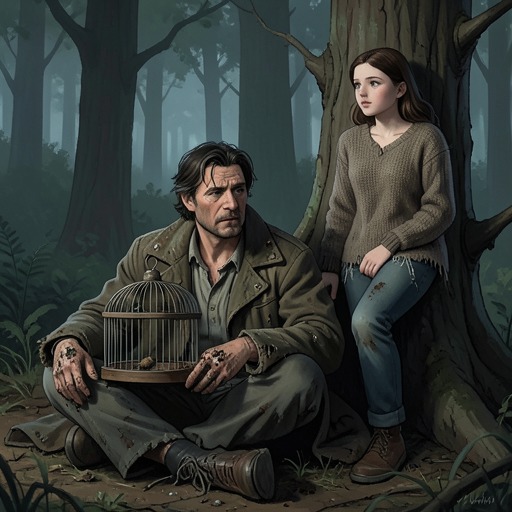
The shelter Lekh provides is as closely connected to his work as the boy’s task is. He settles in a hut he built himself, occupies one corner, and fills the others with birdcages. At the very bottom of one cage, a narrow space is found for the boy. This arrangement makes their unequal closeness tangible: they share a home, but the boy is fitted into the same crowded world of capture that defines Lekh’s trade. The hut gives him a place beside Lekh while also placing him, quite literally, among the possessions Lekh keeps captive.
Apprenticeship in the Woods
The boy listens avidly as Lekh talks about birds, learning both detailed observations and the beliefs Lekh attaches to them. Lekh explains when storks arrive and depart, what their nesting places mean for a household, and how weather and harvest might be foretold from birds’ flight. His account of the natural world mixes close attention to animal behavior with folk explanations of luck and danger. For the boy, listening is part of the relationship: Lekh’s knowledge gives their time together an instructional dimension, even though the lessons are not separate from the work of catching birds.
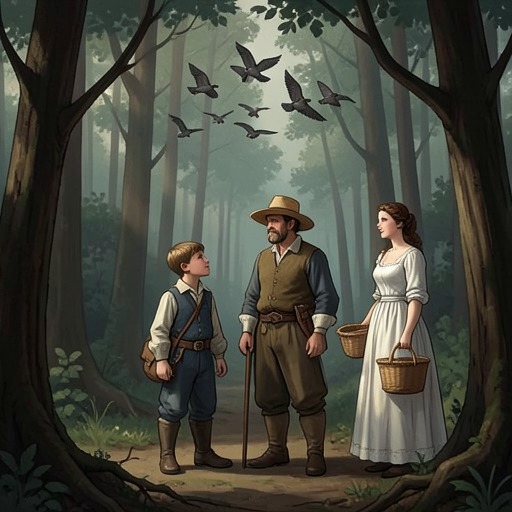
At dawn, when the birds are asleep, Lekh leads the way toward their nests, with the boy following behind. Later they return to the snares they set the day before. Lekh removes the trapped birds, soothing or threatening them, then puts them into a large bag. Their friends and family circle above, and when they persist, Lekh uses a sling and a sharp stone to knock a bird from the sky. The boy participates in this routine and carries the bag of struggling captives. His work makes him a close observer of Lekh’s skill, but also a participant in the violence that skill enables.
Stupid Ludmila and the Painted Birds
Lekh and the boy’s shared routine is repeatedly redirected by Lekh’s meetings with Stupid Ludmila, who waits for him in a distant forest clearing known only to them. The boy follows with the bag of captured birds and waits while the two cling to each other and exchange words he does not understand. Afterward, Lekh walks home tired and withdrawn, repeatedly looking back toward her; in the evening he brightens and speaks of her with visible excitement. The boy is present at the edge of this intimacy, close enough to witness its effects but not included in its language.
When days pass without Stupid Ludmila appearing, Lekh’s silent rage settles on the birds. He chooses the strongest one, paints its wings, head, and breast in vivid colors, and takes it into the forest with the boy. The boy holds the bird lightly until its calls draw a flock of its own kind; when Lekh signals, he releases it. The brilliant bird tries to rejoin the flock, but its companions attack and drive it away. Lekh examines the blows on the dead bird, while blood runs through its painted feathers and stains his hands. The boy is not merely watching this cruelty: he is required to help stage it.
The pattern continues when Stupid Ludmila does not return. Lekh paints successive birds in brighter colors and sends them into the same deadly encounter. In one especially stark instance, he paints a raven red, green, and blue. When it joins the flock, the ravens attack from all sides; the wounded bird falls to the soil with its eyes pecked out and can no longer lift itself. The boy’s part in these episodes makes their partnership morally uneasy: Lekh’s instruction and authority enlist him in an act that turns the bird’s desire to rejoin its kind into a trap.
Blame, Violence, and Separation
As Lekh grows thin, he spends more time in the hut drinking homemade vodka and singing about Stupid Ludmila. He draws the outline of a long-haired woman on the dirt floor, then, when no birds remain to paint, wanders the fields with vodka under his jacket. The boy sometimes rambles nearby, afraid that something may happen to Lekh in the swamps. These moments show the boy continuing to attend to the man even as Lekh’s grief and anger increasingly dominate their shared life.
People in the villages laugh at Lekh and say that Stupid Ludmila has bewitched him. He curses them and threatens to send birds to peck out their eyes. Once, he rushes at the boy and strikes him in the face, blaming the boy’s presence for frightening Stupid Ludmila away and singling out his Gypsy eyes. The boy’s usefulness and proximity have not protected him from becoming the object of Lekh’s anger. The accusation also reveals how abruptly Lekh turns the boy’s visible difference into an explanation for a rejection that the boy did not cause.
After lying ill for two days, Lekh gets up, packs a knapsack, takes a loaf of bread, and goes into the forest. He orders the boy to keep setting snares and catching birds. The boy follows that instruction for weeks, but the traps mostly catch drifting cobwebs; the storks and swallows have flown away, and the birds in the hut sit puffed up, their wings graying and still. The order survives the relationship’s physical separation, but the work it commanded has lost its living purpose.
The Relationship’s Meaning
The boy and Lekh’s connection never resolves into uncomplicated mentorship or mutual affection. Lekh gives the boy access to his expertise and a place in his hut, while relying on the boy’s smallness to extend his reach in the forest. In return, the boy listens, follows, carries, and obeys. The same closeness that makes the boy an apprentice also exposes him to Lekh’s treatment of captives and to the violence of Lekh’s disappointment.
Their relationship is shaped by a recurring contrast between attraction and exclusion. Lekh studies the habits of birds and envies their power to fly, yet earns his living by trapping them; the boy helps him do so and watches the painted birds rejected by their own flocks. When Lekh’s longing for Stupid Ludmila overwhelms him, the boy is first a witness at the edge of their meetings and then a scapegoat for their absence. The final command to continue trapping, followed by weeks of empty snares and fading caged birds, leaves their bond suspended between dependence and abandonment rather than repaired or explained.