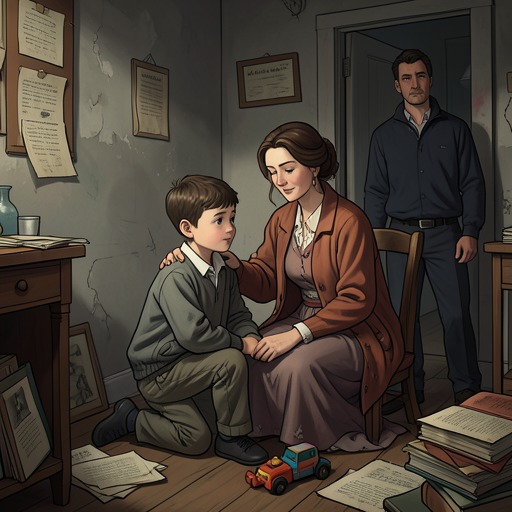
The boy and Olga the Wise One
The Painted BirdThe relationship between The boy and Olga the Wise One is a brief but formative bond in which shelter, labor, folk medicine, and fear are inseparable. Olga takes him from another peasant’s household and makes him her helper, but she also becomes his teacher: she explains how she understands his appearance, trains him in the practices of healing and survival, and intervenes when he falls ill. When the narrative later finds him without her, the practical knowledge she gave him has become one of the few resources he can carry forward.
A Household Formed by Need
Before he meets Olga, The boy is living in Marta’s hut and waiting for his parents to return. Crying does not change his circumstances. When Olga comes to the hut, she examines him and bargains with the owner; after the agreement, she leads him away. The narration makes the exchange starkly material: he has been bought. Their relationship begins not with a choice he makes, but with his transfer into another adult’s care.
Olga’s new home is a two-room dugout crowded with gathered plants, stones, animals, and pots of small creatures. The boy’s place in this household is defined by work. Olga shows him how things are done, and he must tend the fire, collect wood from the forest, clean the animals’ stalls, and help prepare the powders she makes by grinding and combining ingredients. Shelter comes with obligations, but the work also gives him a daily role and a close view of Olga’s knowledge.
Apprenticeship in Care and Folk Medicine
Olga takes the boy with her on visits to sick villagers. People cross themselves when they see the pair, then receive them politely; those seeking help wait inside their huts. Under Olga’s direction, the boy assists with treatments while she performs gestures and speaks formulas. The scenes establish their relationship as a practical apprenticeship: she gives instructions, and he is expected to participate, even though he is still a child.
Her work also means that she is sometimes called away at night to attend a birth or summoned to a neighboring village for several days. During these absences, the boy watches the hut, feeds its animals, and keeps the fire burning. Their arrangement therefore extends beyond lessons given face to face. Olga relies on him to maintain the household in her absence, and he learns to manage its basic needs while she is away. The relationship offers him a place and a function, though both depend on his service.
The Black One and Olga’s Explanations
Olga calls him the Black One and tells him that an evil spirit lives within him. In her account, his dark eyes mark him as bewitched: he may cast a spell without knowing it, especially when looking at people, animals, or crops. She also teaches that bewitched eyes can remove a spell. To do so, he must focus on the illness he is treating and keep his mind otherwise blank. These are Olga’s beliefs, presented as instruction rather than independently established facts; the boy learns a system that makes his appearance both a source of danger and a possible instrument of healing.
Olga’s teaching gives the boy a way to interpret a world in which sickness and misfortune are constant. She also tells him about Phantoms and other mysterious beings, extending her account of his supposed inner spirit into a larger supernatural order. Their shared conversations matter because the two understand one another despite Olga speaking in a strange dialect. In winter, when snow makes the village difficult to reach, they sit together in the warm hut as she tells him about the forces she believes surround them. The explanations do not simply reassure him: they make his difference legible to him through Olga’s language of spirits, spells, and risk.
A Cure That Becomes a Test of Trust
When the boy develops a severe fever, Olga looks into his eyes, touches his brow, and takes him to a remote field. There she puts him into a deep pit and covers him with earth up to his neck, smoothing and pressing the soil around him. She then lights three fires of peat nearby. The treatment is extreme, but the narration places it within the curative world Olga has taught him to inhabit: she acts quickly and decisively, while he must submit to a procedure whose purpose he cannot direct.
The boy loses awareness and imagines himself becoming a bird, rising with a flock of ravens. Olga later finds him among the birds, nearly frozen and injured, and digs him out. After several days his health returns. She explains that the cold earth drove the sickness away and that ghosts, changed into ravens, tasted his blood and spared his eyes because they recognized him as one of their own. The account links her physical intervention to the supernatural framework she has already given him. His recovery is real within the narrative; Olga’s explanation of its cause remains her interpretation.
Lessons Carried Beyond Olga’s Presence
Among Olga’s most durable gifts is the knowledge that a person alone needs familiarity with plants and animals, including medicinal herbs and poisons, and a reliable way to make fire. She gives the boy a Comet, a portable stove made from a one-quart can with small holes in its sides and a loop of wire for a handle. He learns how to keep its fuel smoldering, build its heat by swinging it, and choose different fuels for cooking. The device supplies warmth and cooked food, and its smoke can keep snakes and insects away. Olga’s practical instruction turns folk knowledge into means of staying alive.
The Comet is scarce in the region: cans are found along the military railway, and communities compete for them. Olga receives one in payment for treating a patient and gives it to the boy. He maintains it carefully, repairs the holes and dents, and keeps the wire wrapped around his wrist so he will not lose it. His pride and sense of security in the stove show how fully her teaching has become part of his own survival. Later, when Olga is far away and he is without the Comet, the loss of both her presence and the object’s protection sharpens the contrast between his time in her household and the exposure that follows. Their bond does not secure lasting safety, but its practical lessons continue to shape what he knows how to do alone.