The narrator’s father
The Painted BirdThe narrator’s father is revealed at the moment the narrator’s lost family becomes present again: he is the man who supports the crying woman, asks to see the birthmark that can establish their relationship, and later tries to make a home for his returned son. Yet reunion does not resolve the narrator’s sense of belonging. The father’s tenderness and physical frailty meet a child whose imagined future still lies with Gavrila and the Red Army, making him a figure of real protection that the narrator experiences, at first, as confinement.
Identity and Recognition
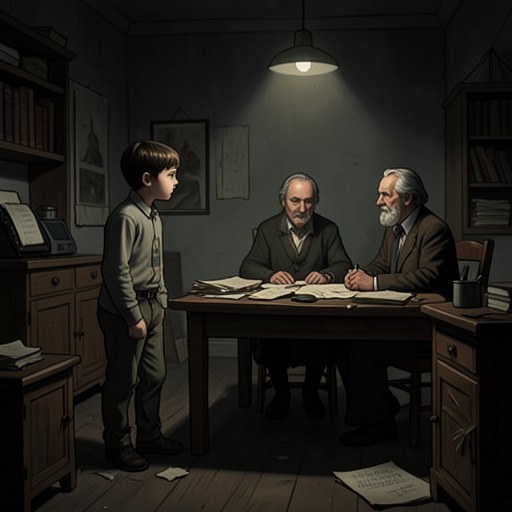
The father first appears as one half of a couple brought into the principal’s office by a member of the Social Commission. The meeting is arranged after the commission member believes he may have known the narrator’s parents before the war. The man and woman seem familiar to the narrator, but resemblance alone cannot settle what their appearance means. The father’s identity becomes legible through the specific evidence of the birthmark: he asks the boy to unbutton his uniform so that the mark on the left side of his chest can be checked.
Before the mark is exposed, the father is already presented through a mixture of composure and emotion. He adjusts his spectacles on his damp nose and speaks to the narrator in Russian, whose fluency and beauty the boy compares with Gavrila’s. The mother bends toward the narrator in tears, and the father supports her on his arm; he too shakes with sobs, but quickly masters them enough to address the boy. The scene makes recognition both intimate and verifiable: the family resemblance suggests an answer, while the birthmark supplies the confirmation.
Reunion and the Boy’s Resistance
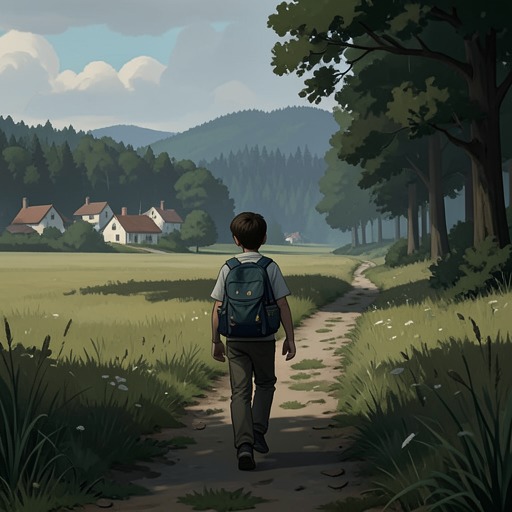
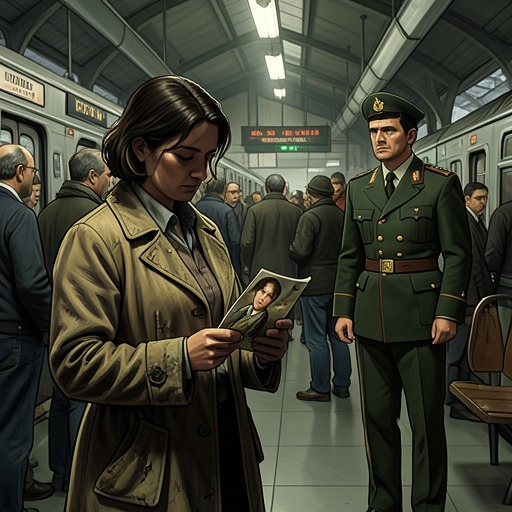
Once the birthmark is visible, the parents embrace and kiss the narrator, but his recognition does not become uncomplicated acceptance. He considers whether to run away, imagining that he could board one of the crowded trains and remain untraceable. He also believes that, at twelve, he is not grown enough to refuse his parents’ claim to him. The father therefore enters the story not as a rescuer whose arrival instantly restores a family, but as the adult whose right and duty to take the child away collide with the boy’s desire to choose his own future.
The narrator connects that future to Gavrila and Mitka and to a dream of inventing fuses that could change people’s color. He fears that returning to his parents will end this imagined life in the land of his Red Army companions, where tomorrow already seems to have arrived. The father does not cause this conflict through any stated threat; rather, the care represented by the reunion itself closes off the narrator’s cherished possibility of remaining unattached. The boy’s image of his world shrinking to the cramped attic of a peasant shed gives the return home the emotional shape of a narrowing, even as it offers shelter.
A Household Built Amid Displacement
After the narrator leaves the orphanage with his parents, the father helps carry his books through a city crowded with people returning to homes occupied during the war. The family’s apartment has been borrowed only with great difficulty, after the parents learned that a boy matching their son’s description was at the local Children’s home and that a meeting could be arranged. Their reunion thus depends not on a settled domestic world waiting intact, but on hard-won space amid a wider postwar struggle over homes and return.
The apartment consists of one room and a kitchen, with a washroom on the stairs. It is stuffy and crowded, and the people living there repeatedly get in one another’s way. The father has a heart condition: when upset, he grows pale and perspiration covers his face, after which he swallows pills. This detail gives his frailty a practical presence in the household rather than leaving it as a general impression from the tearful reunion. It also sits beside the mother’s daily labor; she goes out at dawn to queue for food, then returns to cook and clean. The family’s protection is genuine, but it is exercised in circumstances of scarcity and close quarters.
The parents have also adopted a four-year-old boy, an orphan whose parents and older sister were killed. His former nurse saved him and handed him to the father during the family’s wanderings in the third year of the war. The parents love the child, and the narrator can see that affection, yet the new household intensifies his doubts about whether he belongs there. He wonders whether he would rather remain alone and wait for Gavrila to adopt him, because the family’s predictable life feels less appealing than wandering from village to village and town to town.
Care, Harm, and Narrative Significance
The narrator’s inability to settle into family life becomes concrete when the younger child interrupts his reading of newspaper reports about Red Army successes. The boy clutches his trousers and knocks over his books; the narrator grabs his arm and squeezes it hard enough to break a bone. The father calls a doctor. That response is the clearest action in the evidence through which he protects the child in his care, while the parents’ wordless looks at the narrator register the seriousness of what has happened without any reported confrontation. The younger boy later lies in bed with his arm in a cast, whimpering and looking at the narrator in terror. The father’s household offers safety, but the narrator’s conduct makes plain that protection alone cannot undo the violence and estrangement carried into it.
The father’s relationship with the narrator remains unsettled even after the boy is home. The narrator often slips away to meet the Silent One, and later learns that the Silent One has been transferred to another city. When the war ends in May, the narrator continues visiting the orphanage, hoping for a letter from Gavrila or Mitka; none comes. The father has brought his son back into a family, but the boy’s attention remains divided between that family and the absent figures who represent his wartime hopes. His significance lies in this unresolved contrast: he is loving, vulnerable, and materially responsible for the narrator, yet the return he makes possible feels to the child like the loss of a life he had chosen for himself.