The village vicar
The Painted BirdThe village vicar is a village priest whose encounters with The boy combine practical concern, religious instruction, and limits on what his authority can change. He notices evidence that Garbos has mistreated the child and brings him into the life of the church, but his mild intervention does not prevent further punishment. Later, his explanation of indulgences gives The boy a framework for interpreting inequality, while the vicar’s own illness unsettles the apparent promise that piety protects the faithful.
Pastoral Intervention and Its Limits
The village vicar first becomes important to The boy when he visits Garbos by dogcart. After blessing both of them, he notices the welts on The boy’s shoulders and neck and asks who caused them. Garbos says the child has been punished for laziness. The village vicar admonishes him mildly and instructs him to bring The boy to church the next day. The exchange establishes that the priest can recognize abuse and challenge its explanation, even if only briefly.
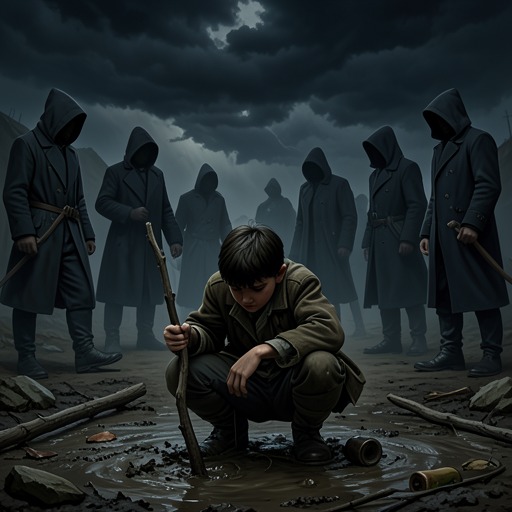
His intervention has an immediate but limited consequence. Once The village vicar has left, Garbos punishes The boy again, taking care to avoid visible parts of the body. The next morning, Garbos warns him not to disclose what happened and threatens to set Judas on him. The boy therefore goes to church hoping the priest will not notice the renewed abuse, rather than expecting that he can safely report it. The episode distinguishes the vicar’s concern from effective protection: he sees the marks and opens a path toward help, but Garbos retains control over the child’s daily circumstances.
At the church, The boy encounters another form of exclusion. A crowd of elderly women has gathered to pray and compete to kiss the priest’s sleeve. The boy keeps apart, but some women stare at him with disgust, label him a vampire or a foundling, and spit in his direction. The village vicar’s presence does not erase the village’s suspicion of the child. His role is thus neither simply that of a rescuer nor a representative of the crowd’s hostility; the scene places his personal attention within a religious community that can offer welcome and enact rejection at the same time.
Religious Instruction and the Child’s Understanding
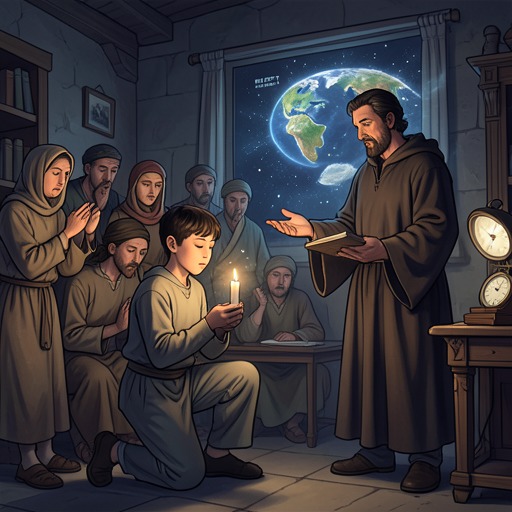
The village vicar treats The boy warmly when he notices him at church. He pats the child’s hair and asks about his parents, his home before the war, and the church his family attended. The questions expose how little The boy remembers of religious practice. Rather than assuming that he already understands, the vicar takes him to the organist, asks for the meaning of liturgical objects to be explained, and arranges for him to begin preparing to serve as an altar boy at morning Mass and vespers.
The boy begins attending church twice a week. He waits until the elderly women have reached their pews, then sits at the back near the holy water font. The water seems ordinary to him, while its supposed power is difficult to reconcile with its plain appearance. The Mass and the priest’s role at the altar are likewise unfamiliar. The boy reads the church’s sacred objects through a vocabulary of magic: its elaborate ceremony appears more splendid than the practices he has seen with Olga the Wise One, but no easier for him to understand. The vicar’s instruction gives him access to a new religious world; it does not instantly replace the interpretive habits formed by his earlier experiences.
Indulgences and the Order of the World
The village vicar’s explanation of indulgences becomes especially consequential because The boy overhears him speaking to an old man. The priest says that certain prayers can earn from one hundred to three hundred days of indulgence. When the peasant does not understand, the vicar explains at length. The boy concludes that saying more prayers earns more days and that the number also affects how well a person lives: more prayer means fewer troubles and less pain.
From this teaching, The boy builds a comprehensive account of unequal lives. He imagines that people who are strong, free, wealthy, or healthy have accumulated more days of indulgence, while the weak, enslaved, poor, or sick have fewer. In his vision, prayers are sorted and stored in individual bins in heavenly pastures; some bins bulge with accumulated days, while others are nearly empty. The vicar provides the religious terms, but it is The boy who turns them into a systematic explanation of social fortune. His image makes an abstract teaching tangible and offers a child subjected to hardship a rule by which apparently arbitrary differences might be understood.
Illness and the Limits of the Promise
The vicar later falls ill at the vicarage, apparently after catching cold in the chilly church. He lies feverish and speaks to himself or to God. The boy brings him eggs given by Garbos and sees the vicar attended by his older sister and a local wise woman, who lets his blood and applies leeches. Having just imagined that prayer and indulgence explain who is well and who is sick, The boy is astonished to find the priest ill despite what he assumes must be a lifetime of piety. The scene does not provide a theological resolution; it puts the child’s newly constructed rule beside an instance it cannot easily explain.
A new priest subsequently arrives. When he sees The boy returning with the basket, he asks where the child with his dark appearance came from. The organist whispers something to him; the priest gives The boy a blessing and walks away. Though this is not an encounter with The village vicar, it echoes the earlier pattern of religious authority meeting the child’s stigmatized appearance. Across these episodes, The village vicar’s significance lies in the mixed consequences of pastoral care: he notices suffering, offers instruction, and opens the church to The boy, but neither his presence nor religious teaching secures the child from abuse, stigma, or uncertainty.