Vampires
The Painted BirdVampires are among the most feared supernatural beings in the village’s folklore: their capacity to take human form makes them harder to recognize than other intangible threats. Belief in them turns the boy’s uncertain status into a source of danger, as Olga the Wise One suspects he may be one and the villagers respond to him with fear and avoidance.
Folklore and Characteristics
In the account of village belief, vampires are drawn to a possessed person. They are said to originate among people who died without baptism or were abandoned by their mothers. Their early years are spent in water or in the forests; at seven, they take human form and become vagabonds. This transformation gives them a means of entering ordinary human spaces while concealing what they are believed to be.
Their principal target is religious space. The folklore says that they seek opportunities to enter Catholic or Uniate churches, settle near the altars, and defile or damage sacred images and objects. They are also described as a threat to men who are asleep. These beliefs cast the vampire as both a hidden danger to people and an adversary of religious protection.
Olga the Wise One’s Suspicion
Olga the Wise One sometimes tells the boy that she suspects him of being a vampire. The account does not establish that he is one: her suspicion is part of the village’s supernatural interpretation of his presence, not proof that he transforms or carries out any of the actions attributed to vampires.
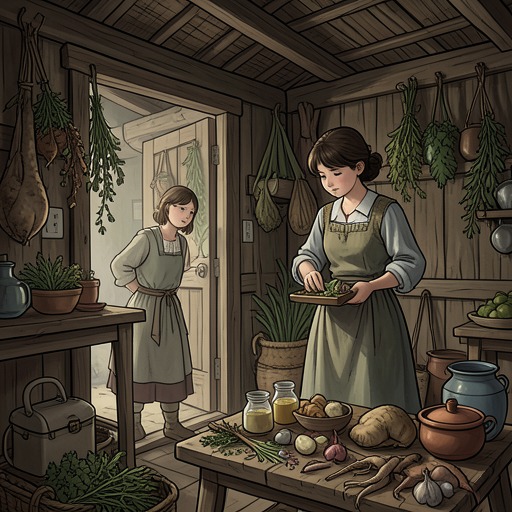
To restrain what she regards as his evil spirit and prevent its transformation into a ghost or phantom, Olga the Wise One gives him a bitter elixir each morning and has him eat a piece of garlicked charcoal. The routine makes folklore a practical regimen of care and control within her hut. Its purpose is preventive: Olga acts against a feared transformation, rather than responding to a witnessed one.
Village Fear and Protection
The suspicion extends beyond Olga the Wise One. When the boy tries to walk through the village alone, people turn away and make the sign of the cross; pregnant women run from him, and some peasants set dogs on him. He learns to flee quickly and to stay close to Olga the Wise One’s hut, where her standing in the village affords him protection. The vampire belief thus has concrete social consequences even though the boy’s supposed identity remains unverified: it isolates him outside the hut and makes his safety depend on Olga’s presence.