War Trauma and Violence Among Children
The Painted BirdWar Trauma and Violence Among Children is presented not as a wound that ends with the war, but as a force carried into childhood, family separation, and postwar institutions. The boy’s experience links early displacement to a later environment where frightened children struggle to live together and where violence has become part of ordinary life.
War’s Imprint on Childhood
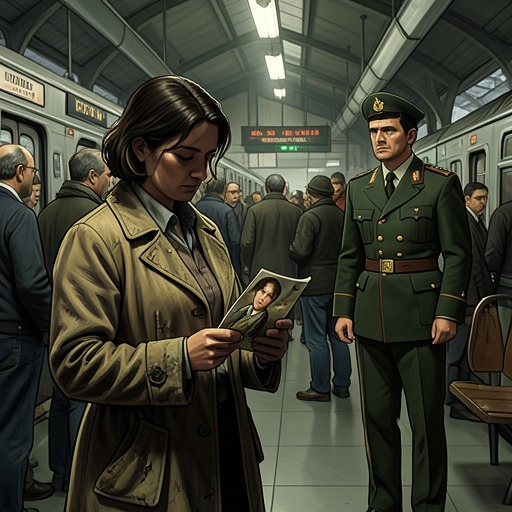
The boy is six when his parents send him from a large Eastern European city to a distant village in the first weeks of the war. They believe separation offers him a chance to survive: his father’s prewar anti-Nazi activity has put the parents at risk of forced labor or imprisonment, and they hope to reunite with their son later. But wartime population transfers sever their contact with the man who arranged the placement. Within two months of the boy’s arrival, his foster mother dies, leaving him to wander between villages, sometimes sheltered and sometimes driven away. The effort to protect him thus becomes the beginning of a prolonged separation that neither the child nor his parents can control.
The boy’s childhood is also shaped by the demands adults place on a dependent child. When Lekh takes him in, the boy’s small, light body makes him useful for setting snares in places Lekh cannot reach, including slender branches, dense nettles, and waterlogged ground. The detail connects vulnerability with a limited form of agency: the boy contributes labor and gains a place in Lekh’s household, but his security still depends on an adult’s needs and willingness to keep him.
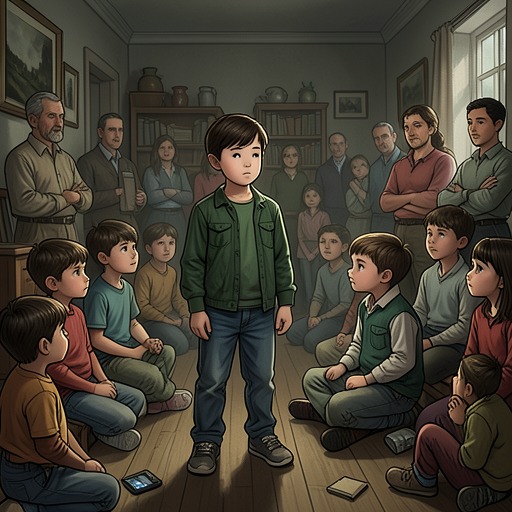
The consequences remain visible after the war, when the boy is among five hundred children living in an overcrowded orphanage. Many have disabilities or appear deeply withdrawn; the institution is short of desks and blackboards, while the children themselves meet one another with fear and mistrust. The boy cannot speak, and other pupils mistake his silence for evidence that he is intellectually impaired. They insult and sometimes beat him. He dreads the crowded dormitory and the classroom, not only because he may be attacked, but because he fears that in defending himself he might seriously injure someone and lose the possibility of returning to Gavrila. The orphanage therefore offers no simple contrast between wartime danger and postwar safety: the war’s effects persist in the children’s bodies, behavior, and expectations of one another.
Violence as a Peer System
At the orphanage, aggression is not confined to occasional fights; it organizes the children’s social world. The boys acquire names that describe their characteristic methods of attack: the Tank relies on his fists, the Cannon throws heavy objects, the Saber strikes with his arm, and the Airplane knocks opponents down. The Sniper attacks from a distance, while the Flamethrower uses burning matches to set clothing and belongings alight. Girls also have reputations shaped by violence: the Grenade injures opponents with a concealed nail, and the Partisan and Torpedo work together to trip and strike them. These labels turn repeated acts into recognizable roles, as if the children have formed a grim society with its own tactics and ranks.
The adults cannot reliably contain this system. Teachers and attendants sometimes keep away from fights because they fear the stronger pupils, and the consequences can be fatal or leave children badly hurt. The Cannon once attacked a girl after she refused to kiss him; she died hours later. In a separate incident, the Flamethrower set fire to three boys’ clothes and locked them in a classroom, sending two to the hospital with serious burns. Such episodes make clear that the orphanage’s violence is not harmless roughness: the children face genuine danger, while the adults charged with their care have little control over it.
Violence also reaches beyond ordinary clashes. The account records sexual violence against a nurse by a group of boys, while some girls speak of sexual demands made of them during the war and seek attention from men at night. The passage reports these experiences as part of the institution’s damaged social reality, not as isolated misconduct detached from history. At the same time, many children respond in the opposite way: they stand silently and listlessly, absorbed in private memories. Some are said to have survived ghettos or concentration camps; others appear to have endured exploitation by foster parents, while still others have no known family history and refuse to explain their past. The orphanage brings these different histories together without resolving them, leaving fear, aggression, withdrawal, and uncertainty to coexist among children who have already been exposed to profound instability.
Fear, Retaliation, and the Continuation of Violence
The orphanage’s danger shapes the boy’s reactions as well as his surroundings. During a scuffle, he finds that his hands seem beyond his control and remain caught in the conflict; afterward, he cannot easily calm himself, instead revisiting what happened until his agitation rises again. Yet when a group of boys approaches, he cannot make himself run. His legs feel heavy, and he stops to wait for them, despite remembering earlier successful escapes. The opposing responses—being unable to flee and fearing what he might do if attacked—show how the threat of violence constricts his choices even before a fight begins.
The boy interprets these confrontations through Mitka’s rule of revenge: every humiliation should be answered according to the pain it caused, and a person’s capacity to retaliate is bound up with self-respect and survival. The rule allows for differences in how an injury is experienced, but it turns the boy’s attention toward repayment rather than reconciliation. In a place where attacks recur and adult supervision is ineffective, this lesson gives violence an organizing logic. Fear is not simply endured; it is measured against an imagined response.
At night the boy sleeps in his uniform with a knife in one pocket and a wooden knuckle-duster in the other, anticipating practical jokes and attacks even while trying to rest. His association with The Silent One develops through this same climate of danger. The boy initially distrusts him because The Silent One chooses not to speak, while the boy himself cannot speak; their silence has different causes, but the boy worries others will mistake them for the same. When The Silent One intervenes against a boy who is beating him, the boy feels obliged to fight alongside him the following day. They become companions, first exchanging written notes and then communicating through signs. Their alliance offers mutual protection, but it also becomes a channel for aggression: on nighttime excursions they frighten couples, throw stones through open windows, and attack unsuspecting passersby, with the taller and stronger The Silent One acting as the striking force. The bond therefore does not release either boy from the orphanage’s violence; it gives their fear and force a shared direction.
Witnessing and the Afterlife of Violence
The novel links the orphanage’s peer violence to a wider wartime world in which children are exposed to organized persecution and to adults’ indifference. During mushroom-gathering season, the boy sees trains carrying Jews and Roma in locked cattle cars. Peasants line the tracks and wave to the trains, while desperate signals from inside pass through a scene they treat as ordinary spectacle. The contrast places the children’s later violence within a society where cruelty has been normalized and the vulnerable can be seen without being helped.
After several trains pass at night, villagers search the railway embankment and find a young boy who has fallen from one of them. They take his clothes and leave him by the track, where a German patrol will find him. Later, the narrator comes across human remains reduced to ash and imagines the dead continuing to watch and remember. The sequence makes witnessing itself consequential: violence does not end when its immediate victims disappear, but persists in what the boy has seen and fears he cannot leave behind.
The book’s afterword places such scenes beside survivor testimony and camp documents, including evidence that children were killed because they were considered too young to work. The author recalls that some former schoolmates judged the novel less severe than what they and their relatives had lived through. This distinction matters: the orphanage’s violence is not offered as a substitute for the historical record, but as part of a literary account of how war enters children’s lives and survives in their conduct, silence, and memory. In the afterword, the author explains that the discrepancy between lived facts and optimistic political accounts helped turn him from social science toward fiction, which he believed could present lives as they are truly lived.