
The Academy’s Rules and Their Breaches
The Pale Blue EyeThe Academy’s strict routines order cadet life, but repeated breaches expose a system that can punish disobedience more easily than prevent violence.
increasing Bearing strength in each event
 decreasing
Bearing strength in each eventdecreasingA Regulated Day

A Regulated Day
Life by command
Cadets move between reveille, recitation, drills, meals, parade, and tattoo. The daily schedule turns a large corps into a coordinated body.
Order’s limitation
The routine can conceal absence as readily as it can organize presence. Leroy Fry’s place is filled in formation, showing how efficiently the institution absorbs a missing individual.
A Night Outside
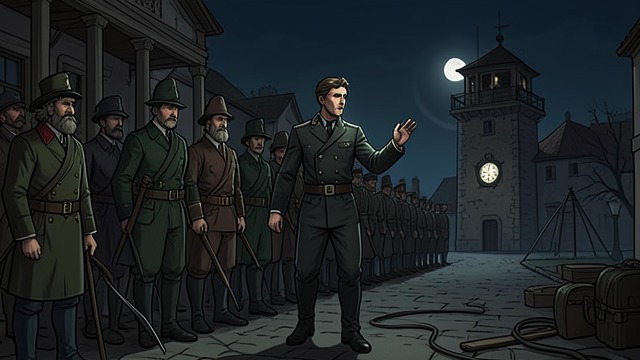
A Night Outside
Curfew crossed
Leroy Fry leaves barracks after tattoo, violating cadet regulations to attend a secret meeting. His departure is possible because nighttime movement is governed by routine and watchfulness, not complete control.
An opening exploited
The rules explain why Fry’s absence matters and why witnesses fear punishment. They also give the murderer a predictable setting in which a cadet can disappear without immediate notice.
A Spy Inside the Corps
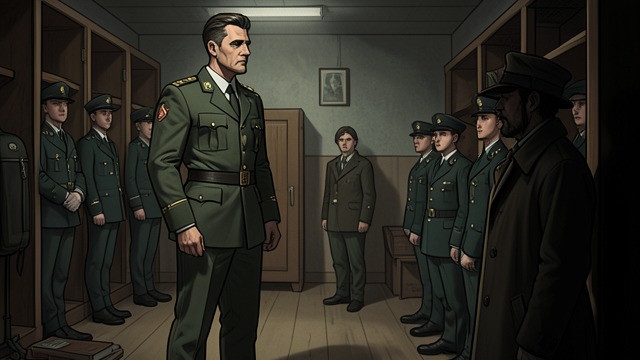
A Spy Inside the Corps
An irregular appointment
Landor recruits Poe to observe fellow cadets because a civilian cannot move freely among them. The choice violates the Academy’s ordinary boundary between military authority and outside investigation.
Rules bent for necessity
Thayer and Hitchcock reluctantly accept Poe’s role, provided he continues his duties. The arrangement reveals that the institution’s strict rules can be modified when its survival seems at stake.
Impersonating Authority

Impersonating Authority
A borrowed uniform
Poe disguises himself as Lieutenant le Rennet to attend a gathering at Marshmoor. His performance depends on a borrowed uniform, fabricated history, and the guests’ willingness to accept appearances.
The breach exposed
When his disguise fails, he risks punishment for impersonating an officer. The episode shows how theatrical skill can challenge formal rank while also putting the performer at institutional risk.
Rules After the Murders

Rules After the Murders
Paired guards
The Academy requires cadets to serve and move in pairs after Ballinger’s death. The policy addresses fear through tighter supervision and shared responsibility.
Security without certainty
The rule cannot recover Stoddard or identify the murderer. It demonstrates that discipline can reduce opportunity but cannot substitute for truthful testimony or trust.
October 1830
October 25, 1830
Late October 1830
December 5, 1830
After November 23, 1830
