Augustus Landor–Ethan Allen Hitchcock relationship
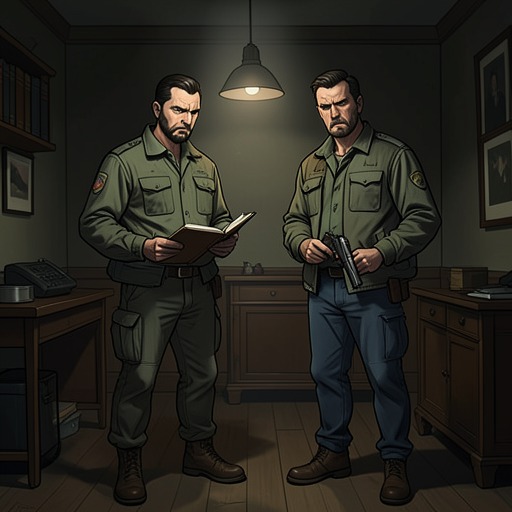
The Pale Blue EyeAugustus Landor and Ethan Allen Hitchcock’s relationship is a working alliance strained by distrust, divided authority, and a painful disagreement over Edgar Allan Poe’s role in the investigation. Hitchcock eventually removes Poe as Landor’s agent and gives Landor only three days to find the culprit before an outside investigator arrives. Landor takes the decision as a personal and professional repudiation; by the investigation’s end, however, both men offer apologies and part with a handshake. The reconciliation is real but limited: it comes as their association is ending, not as a promise of renewed friendship.
An Uneasy Investigative Alliance
Hitchcock’s position places him inside the Academy’s command structure, while Landor conducts inquiries with Poe’s help. The evidence does not describe the beginning of their working relationship, but it makes clear that Hitchcock has never welcomed Landor’s presence. Landor eventually says that he knows Hitchcock did not want him there and that the investigation was Colonel Thayer’s idea. Hitchcock does not deny it. Instead, he accepts that both he and Colonel Thayer must bear responsibility for what others may regard as a mistake in judgment.
That admission gives their cooperation a guarded quality. Landor is not simply acting with Hitchcock’s unreserved confidence: he is pursuing an assignment that Hitchcock opposed from the outset, under an authority that both men know may be judged from outside the Academy. Hitchcock predicts that the chief of engineers will send another investigator, empowered to see the case through, in about three days. The approaching replacement turns the investigation into a deadline as well as a professional test. Hitchcock leaves Landor room to continue, but makes that room temporary and conditional.
The Dispute Over Poe
The decisive break concerns Poe. Hitchcock tells Landor that he can no longer consent to Poe serving as his agent. Landor immediately objects that Poe has helped make substantial progress. Hitchcock does not dispute that contribution; he argues instead that Landor’s proximity to Poe has compromised his objectivity, and suggests that distance from him might improve Landor’s judgment. The conflict is therefore not presented as a simple disagreement about whether Poe is useful. It is about whether Landor can judge the investigation impartially while working so closely with him.
Landor recognizes the force of the accusation even as he resists it. He recalls a sudden sensation of shame at how little he had considered Poe’s physical safety while following his meetings with Lea and Artemus as if they were only elements in a story. That recognition makes Hitchcock’s order more than an administrative obstacle: it brings into view a responsibility Landor has not adequately faced. Nevertheless, Landor’s anger remains intense. He looks for an object to throw, finding nothing equal to his fury, and protests that he has been working without compensation. Hitchcock answers that the unpaid arrangement was Landor’s own request. The exchange lays bare their different measures of obligation: Landor invokes the labor he has given, while Hitchcock points to the terms Landor accepted.
Landor ultimately gives his word that Poe will no longer take part in the inquiry. Hitchcock then insists that Landor should have engaged an officer from the outset rather than a civilian. To Landor, the reprimand confirms an old grievance: Hitchcock never wanted him involved. The dispute thus joins a specific question about Poe’s appointment to a deeper conflict over who has the standing to investigate, who bears responsibility for the choice of methods, and whether Landor has ever truly possessed Hitchcock’s confidence.
Rupture and the Three-Day Limit
The confrontation changes how Landor understands their connection. He concludes that he and Hitchcock will never be friends, imagining the ordinary companionship they will not share: Madeira in Gouverneur Kemble’s study, chess, concerts, a walk to Fort Putnam, or newspapers over grapefruit. The list makes the rupture concrete by setting the ease of friendship against the strictly professional contact he expects from then on. Landor’s conclusion is not merely that they disagree; he believes neither will forgive the other.
Hitchcock makes the separation sharper by returning to the deadline. Landor has three days to find the perpetrator, after which he will be finished with the Academy. The ultimatum places the investigation’s urgency and the relationship’s breakdown side by side: Landor must continue working under the authority of a man he now expects never to forgive him, while knowing that the institution is preparing to replace him. His anger at Hitchcock is consequently bound up with the threatened end of his role, not confined to the order about Poe.
A Formal Apology and Final Parting
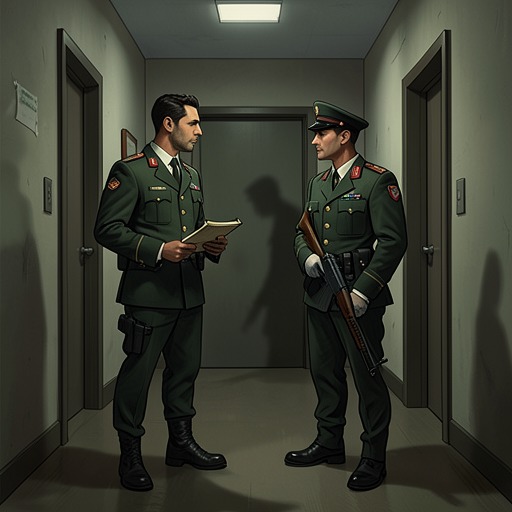
After the final crisis, Landor remains in the North Barracks guardroom through the night, briefs Hitchcock, and writes down nearly everything that has happened. Hitchcock receives Landor’s account with ceremony, folds it, and places it in a leather pouch to be forwarded to Colonel Thayer. His grave nod is the closest he comes to openly praising Landor. The gesture does not undo the earlier quarrel, but it recognizes the seriousness of Landor’s final work and gives their professional exchange a measured closing form.
Before leaving, Landor asks whether Dr. Marquis was responsible. The question precedes Hitchcock’s attempt to address their own conduct. Turning away, Hitchcock struggles to say that if the demands of the case have led him to impugn Landor’s integrity or competence in a moment of intemperance, he is sorry. Landor accepts the apology and says he is sorry too. Neither pushes the exchange further: it ends where continuing would, in Landor’s account, risk fatally embarrassing them. They nod, shake hands for the last time, and part.
What the Relationship Resolves—and Does Not
The final handshake qualifies Landor’s earlier certainty that the two men would never forgive each other. It permits an acknowledgment of mutual injury without restoring the friendship Landor had imagined losing. Hitchcock’s apology addresses his treatment of Landor’s integrity and competence; Landor’s reciprocal apology acknowledges his own part in the antagonism, though the account does not specify its terms. Their farewell is therefore a reconciliation of limited scope, expressed through apology and a final professional gesture rather than renewed companionship.
The contrast between the meeting’s beginning and its end is especially telling. Hitchcock’s earlier intervention narrows Landor’s authority, removes Poe from the inquiry, and imposes a deadline. At the end, Hitchcock receives Landor’s report and offers the recognition and apology that had been absent during their conflict. Neither gesture erases the other. Their relationship remains defined by the collision between institutional command and independent judgment, but its ending allows the two men to acknowledge one another before they separate.