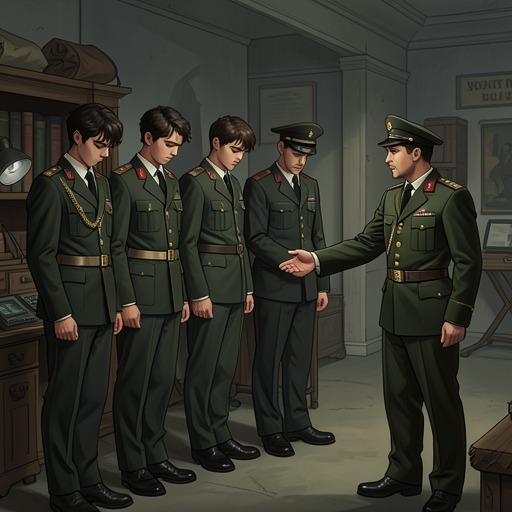
Cadets' Code of Silence Toward Fellow Cadets
The Pale Blue EyeThe Cadets' Code of Silence Toward Fellow Cadets is an informal obligation of solidarity that keeps cadets from betraying one another, even when silence frustrates an investigation. Its force emerges most clearly when Augustus Landor recounts that Leroy Fry and Randolph Ballinger disclosed details about an incident involving his daughter Mattie but refused to name their fellow cadets; that refusal left Julius Stoddard beyond Landor’s reach.
Nature of the Code
The evidence presents the code not as a written regulation but as a shared standard of conduct among cadets. Landor recalls that Fry and Ballinger both identified the hostess at the gathering and remembered what Mattie had been wearing. They gave him that information under duress, yet drew a firm boundary at betraying their companions. Their answer, repeated as though rehearsed, was: “I won't tell,” they'd said, as though they'd been drilled for the occasion. “I won't tell.”
The contrast matters: the two men were not wholly silent, but they treated naming their comrades as a different, forbidden act. Landor calls this their gentlemen's code. The account shows its practical force through their behavior rather than through any formal sanction or written rule.
Effect on Landor’s Investigation
The code cost Landor time and effort. He says the investigation would have been much easier if Fry and Ballinger had identified the others involved, but their refusal prevented him from tracing the evidence directly through their companions. When Edgar Allan Poe asks whether Ballinger confessed, Landor answers that both Ballinger and Fry did so under duress, then emphasizes that neither would betray his comrades.
The withheld names carry a concrete consequence: Landor concludes that only Julius Stoddard escaped his justice. Stoddard’s disappearance had been reported by Sylvanus Thayer to the chief of engineers, arriving amid the fallout from Ballinger’s death. The code thus operates not just as a private bond but as an obstacle with consequences for the investigation’s reach and outcome.
Institutional Pressure and Significance
The code plays out against the United States Military Academy’s precarious public standing. Sylvanus Thayer tells Landor that the young institution has not secured permanence and is forced to defend itself against critics, including charges of elitism and accusations that its regime is brutal. When Landor raises the danger that cadets might break down and take their own lives, Thayer says news of Fry’s death has already spread and stresses his concern that the investigation stay out of certain hands.
As scrutiny rises, the Academy’s leaders face demands for accountability: Landor recounts that the chief of engineers required an accounting of his inquiries, and Thayer reports Stoddard’s disappearance to that office. Within this climate, the code protects fellow cadets from exposure while making it harder to establish responsibility. Its dramatic significance lies in that tension: loyalty may preserve a bond among the cadets, but it also leaves Landor without the testimony that could have brought every participant within the reach of justice.