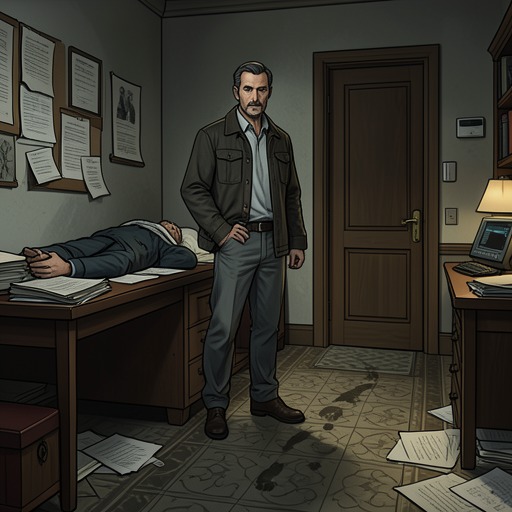
Don't be late, come soon.
The Pale Blue Eye“Don't be late, come soon.” is a reconstructed invitation, not a surviving complete message: the note that Leroy Fry carried when he died had been torn, leaving only fragments for Edgar Allan Poe and Augustus Landor to interpret. Poe’s reading turns the scraps into a summons that may have drawn Fry away from his barracks, but Landor’s later correction produces a different version and exposes how much of the message remains uncertain. The phrase matters both as a proposed clue to Fry’s final movements and as an example of deduction working against the limits of incomplete evidence.
The fragment and its first reading
Poe begins with the circumstances surrounding the note rather than with a deciphered sentence. Because it was handwritten, he considers it personal; because Fry had it with him at the time of his death, he reasons that it was capable of drawing him from his barracks that night. The remainder had been torn from Fry’s hand, which suggests to Poe that the missing portion may have identified the sender. The note’s primitive block capitals, in turn, look like an attempt to disguise that sender’s identity. These are clues about the document’s use and concealment, not proof of who wrote it or why.
From those observations, Poe proposes that the fragment could have been an invitation—or, less reassuringly, a trap. He then focuses on the one complete word he believes the third line preserves: “be.” Treating it as an imperative, he tests possible words beginning with l, but rejects them as poor fits for an invitation. If Fry was being summoned to a particular time and place, Poe argues, the line could be completed as “be late.” The oddness of asking a guest to arrive late prompts the next step: the phrase must be negative. Poe supplies “don't,” and the incomplete message becomes “Don't be late.”
Poe’s performance makes the deduction part of the scene. He pauses to heighten the effect of the word trap, holds out his hand as if displaying the missing letters, and paces around the bed while extending his reconstruction. His reasoning is presented as an unfolding demonstration, with each proposed completion made to seem inevitable after the previous one. Yet the theatrical confidence belongs to the interpreter; it does not restore the absent text.
Completing the summons
Poe treats the final line as a reinforcement of urgency. He considers whether “me” is a complete word or the end of a longer one, then proposes that Fry would be “coming” to the sender. From that reading, he supplies “soon,” yielding “Don't be late, come soon.” He even offers “come soonest” as a possible variant if the sender’s urgency were greater. The gesture of beckoning that accompanies his explanation makes the imagined summons vivid, but both the added wording and its degree of urgency remain deductions.
At this point, Augustus Landor praises Poe’s work, but the exchange does not end with that apparent solution. Landor picks up the scrap and examines a different possibility. He crosses out “their” and circles “there,” proposing “Meet me there” as an alternative reading. This change shifts the fragment from Poe’s direct injunction to a more explicit appointment: the sender would be asking Fry to meet at a place. Poe supplies the next missing word, “At,” and imagines that the original might have continued with a specific hour: “Meet me there at eleven P.M.”
That version creates a problem of its own. If the note named a precise time, Landor observes, asking Fry to come soon would be somewhat contradictory. Poe therefore allows that “Come see me” might fit better. The reconstructions do not settle into one definitive text: “Don't be late, come soon” is the phrase associated with Poe’s first solution, while the exchange immediately tests and alters the underlying reading.
Place, timing, and the remaining inference
Even after the appointment has taken shape, its location is unknown. Landor points out that the available letters, n and g, frequently occur at the ends of words, then asks Poe to think of a place on the Academy grounds whose name might end that way. Poe identifies a cove near North Landing, where Benny Havens brings his wares. Landor corrects the detail: Patsy brings them there. Poe says that anyone who has smuggled beer or whiskey knows the cove, marking it as a known but secluded meeting place rather than an obscure location beyond the cadets’ reach.
Landor then assembles the clues into a provisional appointment: the cove by the landing, eleven at night, and a request to meet. His reconstruction joins the location inferred from the letters to the time Poe had imagined and to the invitation inferred from the fragment. But the assembled message is explicitly a solution for the time being, not a transcription confirmed by the complete note. The cove, the hour, and the wording carry different degrees of certainty, and the missing text prevents those parts from becoming a single verified account.
Invitation, trap, and uncertainty
The surviving circumstances make an invitation plausible: Fry had the note, and Poe and Landor reason that it drew him from the barracks. They do not establish who sent it. Nor does the proposed wording decide whether the meeting was affectionate, dangerous, or both. Poe initially entertains the possibility of a trap, but after Landor connects the imagined appointment with the cove, Fry’s reported remark—“Necessary business”—and a wink lead Poe to suggest that the summons involved a woman. That is an interpretation of Fry’s manner as reported in the investigation, not confirmation of the sender’s identity or the meeting’s purpose.
The phrase therefore remains useful precisely because it is provisional. It gives the investigators a possible sequence—an invitation, a late-night meeting, and a secluded place—while every step depends on a fragment, a correction, or an inference. Poe’s “Don't be late, come soon” makes the damaged note sound complete; Landor’s alternative reading reminds the reader that fluency is not proof. The investigation can use the reconstructed message to frame questions about Fry’s last movements, but it cannot treat the proposed words as though the missing note had been recovered.