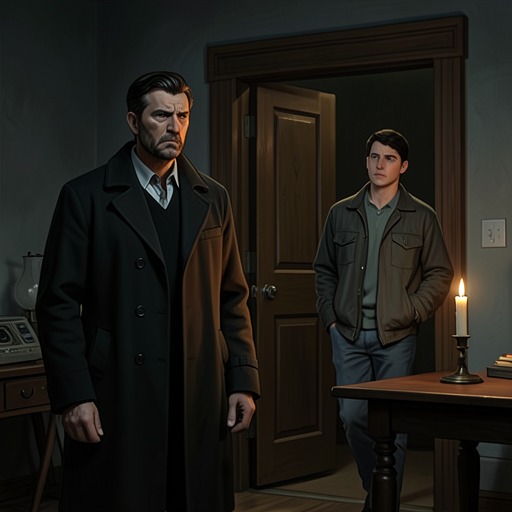
Edgar Allan Poe and John Allan's adoptive father-son relationship
The Pale Blue EyeEdgar Allan Poe and John Allan's adoptive father-son relationship joins the promise of a family to the bitterness of perceived rejection. John Allan took the orphaned Poe into his household, made him his heir, and undertook to raise him as a gentleman; years later, Poe described that upbringing as a sustained pattern of withheld support. The gap between those accounts makes the relationship more than a private grievance: it shapes Poe’s sense of thwarted ambition and exposes the instability of the story he tells about his own past.
Identity and Formation
John Allan’s role in Poe’s life began with an act of guardianship. As Poe later recounted to Augustus Landor, John Allan had been so affected by his orphaned state that he took responsibility for raising him and made him his heir. Poe presented this arrangement as an effort to form him into the gentleman his mother would have wished him to become. The account gives the relationship an explicit paternal ideal: a bereaved child was to receive a home, an inheritance, and a cultivated identity through his guardian.
That household also included John Allan’s wife, whom Poe described as a second mother. She remained in that role until her recent death, an event Poe mentioned alongside the history of his upbringing. His brief account therefore locates him between the mother he lost and the maternal care he later received in the Allan household. It does not establish that the bond with John Allan offered comparable emotional comfort; instead, Poe’s later complaints make the contrast between the family role and his experience of its support central to the relationship.
Support and Denial
At Benny Havens' tavern, Poe traced his resentment to what he said had begun when John Allan first took him in. He alleged that John Allan would not clothe or educate him in the manner expected of a gentleman and had denied him in countless large and small ways. In Poe’s telling, the injury was cumulative: not a single refusal, but repeated scrutiny and begrudging assistance that made his dependence feel humiliating.
Poe’s complaints concerned specific turning points in his prospects. When he needed help publishing his first volume of verse, he recalled John Allan refusing assistance on the ground that men of genius should not seek his aid. When Poe needed fifty dollars to pay for his Army replacement, he said John Allan hesitated so long that Sergeant Bully Graves continued to demand payment. These episodes connect literary ambition and military obligation to the same familial conflict: Poe portrayed John Allan as encouraging him to aspire, then withholding the means by which he might advance.
A recent letter from John Allan, in which he mentioned a possible visit if he could find a boat and a boatman who would not overcharge him, prompted Poe to return to the grievance. The letter indicates that communication between them continued, and that a visit was at least contemplated; it does not show that the visit took place or resolve the estrangement Poe described. Instead, even the prospect of renewed contact becomes the occasion for rehearsing old disputes about expense, dependence, and unequal generosity.
Conflicting Accounts of Poe’s Education
The exchange with Landor gives Poe’s account a pointed complication. Poe said that John Allan had left him so impoverished at the University of Virginia that he was forced to leave after only eight months. Landor answered that Poe had previously said he studied there for three years. Poe denied having said so, and Landor insisted that he had. The scene leaves the discrepancy visible rather than reconciling it: Poe’s account of deprivation is set beside an earlier version of his own history that Landor remembers differently.
Poe defended his version by arguing that John Allan had squeezed him financially from the moment he arrived. He then turned to the drink in his hand, joking that if John Allan had paid for it, he would demand it back in the form of urine. The coarse exaggeration converts a complaint about money into an image of support made conditional and reclaimed. Its comic force does not settle whether Poe’s account is accurate, but it shows how sharply he experienced even small expenses through the larger grievance of dependence.
Narrative Role and Significance
The relationship reaches the reader through contrasting forms of testimony. Poe’s earlier account to Miss Marquis presents John Allan as the guardian who made him an heir and raised him toward a gentlemanly ideal; his later conversation with Landor dwells on the failures of that promise. Neither account cancels the other. Together they establish a paternal bond in which provision and deprivation coexist, and in which the meaning of care is inseparable from money, education, and the prospect of advancement.
Landor’s correction about the University of Virginia makes the relationship especially important to the novel’s presentation of Poe. Poe speaks with conviction about the injuries he attributes to John Allan, yet the disagreement over eight months or three years warns that conviction alone cannot verify his recollection. The episode preserves the force of Poe’s grievance while making its narration uncertain. John Allan’s role consequently remains double: he is the man who took Poe in and named him heir, and the father figure whom Poe remembers as obstructing the very future he had been expected to prepare.