Edgar Allan Poe and Lea Marquis's Growing Attraction
The Pale Blue EyeEdgar Allan Poe and Lea Marquis's growing attraction takes shape through music, poetry, jealousy, and private confidences. Poe first approaches Lea while investigating her brother, Artemus Marquis, and insists that his interest is purely practical; yet his attention repeatedly slips beyond that explanation. Lea, in turn, responds with wit and unusual attentiveness, giving their acquaintance a warmth that makes the boundary between inquiry and courtship increasingly difficult for Poe to maintain.
First Encounters: Music, Poetry, and an Ideal
At a gathering hosted by the Marquis family, Lea performs on the pianoforte and sings sentimental songs. Poe notices that her naturally contralto voice is stretched by the keys, and observes that a song would have sounded more exquisite transposed down a fourth or fifth. Artemus has seated Poe beside him and repeatedly looks over to secure his admiration of his sister’s performance. Lea’s smiles, which Poe understands as meant for Artemus alone, reveal to him a close and reciprocated sibling bond. That intimacy matters to Poe not only as a family affection he feels he missed in his own upbringing, but also because he sees Lea’s regard as a way to understand her brother.
At the family’s urging, Poe recites his poem To Helen. Artemus praises him as a prodigy, but Lea’s response is more personal: she says she is thinking of Helen as a living girl, confined to a window niche, who might want to walk in the woods, speak with friends, or attend a ball. Poe answers by defending the immortal figure of his vision, whose immortality has been conferred by Eros. Lea gently counters that no woman may wish to be immortal; a good joke or a single caress might be enough. Her cheek reddens, and she turns the conversation elsewhere. The exchange establishes a telling difference in their imaginations: Poe elevates woman into poetic permanence, while Lea brings the ideal back toward embodied, social life and human touch.
Courtship Amid Suspicion
The possibility of courtship surfaces in a room already charged by Randolph Ballinger’s rivalry with Artemus. During talk about Leroy Fry’s death, Ballinger pointedly asks what woman could have promised to meet Fry, then invokes Lea’s supposed power to dazzle him. The implication provokes a hush. Artemus restrains Poe by putting a hand on his sleeve, then calmly tells Ballinger that he was closer to Fry than anyone present. Ballinger answers that he does not believe he was as close to Fry as Artemus. Their strained exchange gives way to hysterical laughter, and the company avoids raising Fry’s name again. The episode does not establish any past attachment between Lea and Fry; instead, it shows how quickly her name becomes a dangerous instrument in the men’s contest over loyalty and honor.
Later, Poe interprets Ballinger’s expression as jealousy at the prospect of his being alone with Lea. That reading gives Poe courage to address her directly, though he immediately reproaches himself for presuming to seek the attention of someone he considers so graceful. He also casts the request as useful to his inquiry: Lea’s esteem, he reasons, might offer a way to understand Artemus. His explanation preserves the language of investigation even as he recognizes the pleasure he would take in seeing her again.
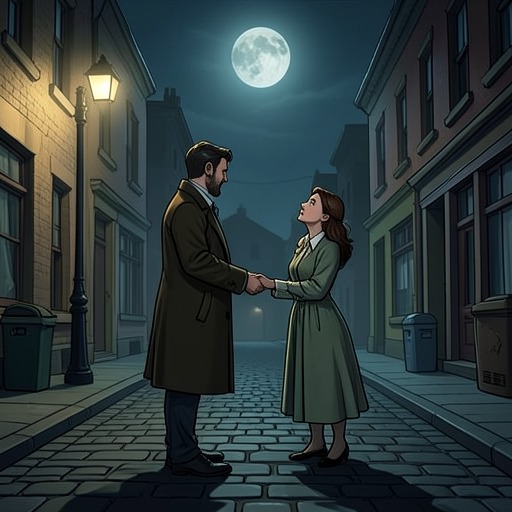
Lea answers his request with amused familiarity, asking whether he intends to meet at Flirtation Walk, Gee’s Point, or another secluded place favored by cadets. Poe says he had the cemetery in mind. Her astonishment gives way to a firm limit: she is engaged the following day, but can see him at four-thirty on Tuesday for fifteen minutes, and promises nothing beyond that. Poe is delighted by even this restricted appointment. Lea’s answer is not a declaration of love; its significance lies in the choice to grant him a meeting while keeping its terms explicitly her own.
Waiting and the West Point Cemetery
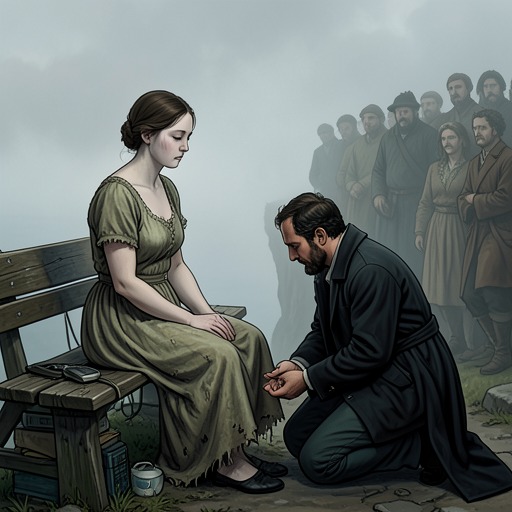
Poe waits for Lea at the West Point Cemetery, a small, secluded enclosure on a high riverbank about half a mile from the Academy. He describes its views across the Hudson and its quiet, tree-screened setting, but admits that his thoughts are occupied by the still-living woman he expects to meet. Four o’clock passes, then another ten minutes. At thirty-two minutes past four, his vigil is rewarded by the sound of silk and the glimpse of a pale yellow bonnet. The scene sets his romantic anticipation against a place devoted to the dead: even among graves, he is absorbed by Lea’s arrival.
A later appointment takes them to Mount Independence. Lea is reclining on a broad granite table beneath an arch and among cedar bushes when Poe arrives. Her smile and apparent enthusiasm replace the vexation he remembers from their previous encounter. She explains that she arranged to see him in order to thank him for helping her when she was in need. After learning that he had missed evening parade on her account and had been reported, she had told her father that Poe’s intervention had kept her from harm. Her action gives their connection a reciprocal form: Poe has helped her, and she responds by seeking him out and making his conduct known to her family.
Scent, Memory, and Growing Intimacy
During their conversation on Mount Independence, Poe becomes increasingly conscious of the scent of Lea’s clothes and asks whether it is rosewater or another fashionable fragrance. She tells him it is orrisroot. The answer silences him: orrisroot was his mother’s favorite scent, and he remembers smelling it on her clothes long after her death. What Poe intends as a passing remark becomes a disclosure when Lea’s curiosity draws out a fuller account of his mother, her artistic renown, her devotion to her family, and her death in the Richmond theater fire of 1811. The small sensory detail opens a door to grief. Lea’s attention makes a private memory speakable, while Poe’s willingness to continue marks a movement from polished self-presentation toward personal vulnerability.
Across these encounters, Poe’s attraction is unmistakable, but the evidence leaves Lea’s feelings less conclusive. She welcomes conversation, listens closely, arranges a meeting, thanks him, and speaks playfully about the prospect of a secluded rendezvous. Those gestures support warmth and interest without proving that she shares the intensity of his romantic investment. Poe’s narration tends to turn each opening into evidence of enchantment; the distinction between what Lea does and what he hopes it means is part of the relationship’s texture.
The Limits of Poe’s Idealization
Poe’s language about women is itself tested by Lea. In conversation with Artemus, he argues that spiritual charms matter more than physical beauty, and Artemus laughs before suggesting that Poe has not yet given himself to a woman. Artemus calls Poe’s innocence an endearing quality and says he counts himself among those who hold Poe dear. He then takes Poe’s hand, spreads his fingers, calls them beautiful and like a lady’s, and kisses them. This later intimacy is between Poe and Artemus, not Lea, and does not establish anything about Lea’s response. It does, however, place Poe’s developing courtship within a wider pattern of male affection, scrutiny, and rivalry, where women can become the focus of competing claims and where tenderness does not always fit the language of ordinary comradeship.
Lea’s early reply to To Helen remains a compact counterpoint to Poe’s romantic ideal: she imagines not an immortal figure preserved for poetry, but a woman who might want to leave her niche, move through the world, and receive a caress. Their attraction grows in the space between those visions. Poe is drawn to Lea’s beauty and attention, but also to the way she brings his abstractions back to lived experience; Lea offers kindness and chosen companionship, while maintaining the right to define when and how she meets him. The relationship’s significance lies in this unfinished negotiation between poetic idealization and human intimacy.