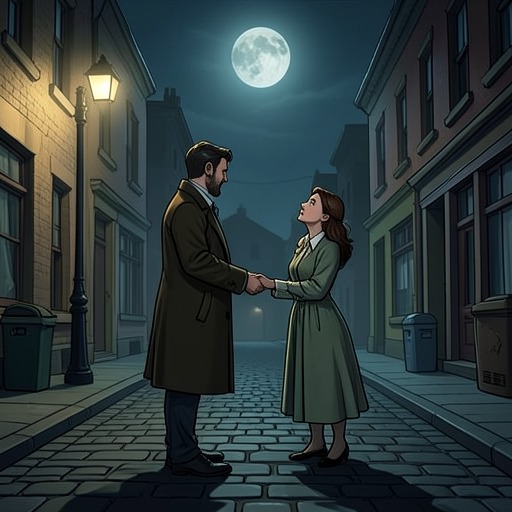
Edgar Allan Poe and Lea Marquis's romantic relationship
The Pale Blue EyeEdgar Allan Poe and Lea Marquis’s romantic relationship turns on a belated recognition: Lea names the love Poe has not allowed himself to acknowledge, and her confession releases his own from what he describes as confinement. Their courtship brings him an expansive, almost dreamlike happiness, but it is shadowed by the suspicions surrounding Leroy Fry’s death and by Poe’s steadfast inability to reconcile Lea’s goodness with the possibility of her brother’s violence.
Recognition and declaration
Poe later tells Augustus Landor that he had admired Lea and found her fascinating, but had never ventured to interpret his feelings as love. The change comes when Lea tells him how grateful she was to open her eyes and find him beside her. She says that, looking deeply into his face, she found something she had never expected to find: love. The scene gives Lea the first explicit declaration, while Poe’s account emphasizes that her words make him recognize what was already present in himself.
He describes the word as sacred and its effect as a release: Lea’s clemency has sprung the truth from its confined place. His acknowledgment is emphatic. Despite his earlier protests, he loves her. The sequence matters to the relationship’s development: affection and fascination precede his recognition, but Lea’s naming of love turns his private admiration into a consciously shared possibility. Her own heart, she adds, has been legible to him too; she assumes he must have seen the love she carried.
Poe’s narration gives this recognition an unusually heightened form. As he sits with Lea, the Hudson seems to produce music, and he imagines himself at the threshold of a dream whose farthest prospect ends in her. The imagery conveys the scale of his emotional change without presenting it as a practical resolution: the confession opens a future he can imagine, not a settled life together.
Courtship and assumed identities
A winter outing supplies a more playful scene of closeness. Poe initially refuses to go until he knows where he is being taken. His companion removes gloves, throws away a beaver-skin hat, and peels away a mustache; the figure disguised in an unconventional masculine costume is revealed as Lea. Poe’s joy at recognizing her is immediate, and he hurries into the sleigh, where the two embrace. The disguise makes their encounter a small performance of recognition: the person who had seemed strange and forbidding becomes, in an instant, the beloved woman he knows.
Lea reassures Poe that they will return in time for supper because her father and mother expect them both. That detail places their excursion within the family’s knowledge and gives the outing the shape of shared, welcomed time, rather than a secret escape. Later, when Poe wonders aloud who would accompany her, Lea answers that he would. Her answer makes the expectation reciprocal: she sees him not merely as a visitor to the family but as the person who belongs beside her.
Another scene of assumed identity gives the courtship a more theatrical cast. Poe removes his cloak and wraps it around Lea, while his uniform bears a single yellow bar on its shoulder. Lea presents him to Augustus Landor as a dear family friend, Lieutenant Henri le Rennet. Landor is struck by the uniform and by how well it fits Poe. In this episode, disguise enables Poe to appear within Lea’s family circle under another name; the relationship is thus associated not only with private declarations but also with the roles and appearances through which the two move among others.
Love amid suspicion
The Academy’s talk about Fry’s death exposes the dangerous social atmosphere surrounding the romance. At a gathering, the assembled cadets discuss the prevailing belief that Fry killed himself, while also repeating the notion that he had gone out that evening for an assignation. Randolph Ballinger turns the speculation toward Lea, asking Artemus whether she had dazzled Fry. The joke threatens her honor, and the room falls ominously silent as Poe prepares to demand an accounting. Artemus stops him with a hand on his sleeve and redirects Ballinger’s insinuation toward Artemus himself.
The exchange does not establish what happened between Lea and Fry; it shows how readily a dead cadet’s supposed appointment becomes material for public teasing, and how a woman’s reputation can be pulled into the men’s contest. Poe’s readiness to defend Lea sits beside Artemus’s intervention, which prevents the confrontation from becoming a direct challenge. Ballinger and Artemus then share laughter that Poe describes as hysterical rather than merry. Fry’s death and the social tension around it therefore press upon the circle in which Poe and Lea’s attachment is taking shape.
The strain becomes more personal when Poe tells Landor that he can no longer believe Artemus capable of the brutality under suspicion. He contrasts Lea’s light with the darkness attributed to her brother and finds their divergence nearly impossible to accept. His certainty is not evidence that Artemus is innocent; it is evidence of the emotional position from which Poe sees him. Love for Lea is entangled with kinship: Poe cannot easily imagine that someone sharing her family, features, and childhood could be morally opposed to her.
Innocence, intimacy, and trust
Artemus’s conversation with Poe offers another view of the young man who has fallen in love. After Poe gives an elevated account of the spiritual qualities he values in women, Artemus dryly suspects that Poe has not yet given himself to a woman. Poe blushes beneath the cover of darkness. Artemus calls his implacable innocence endearing and says that he counts himself among those who hold Poe dear. The moment situates Poe’s courtship within an acknowledged inexperience; it does not reduce his feelings for Lea to that inexperience, but helps explain the intensity and idealism of his account.
Artemus then takes Poe’s hand, spreads his fingers, admires their beauty, and compares them to a lady’s hands and a priest’s hands before kissing them. Poe registers the gesture as unexpected and shudders as he recounts it. This encounter complicates the surrounding language of male friendship and tenderness, but the evidence does not make it a declaration about Poe’s relationship with Lea. Rather, it shows the intimate, charged social world around him, where praise, affection, and physical contact can unsettle his expectations of comradeship.
Poe’s relationship with Lea is narrated retrospectively to Landor, and its most sustained scenes are filtered through Poe’s own romantic perception. His imagery makes love feel at once discovered and overwhelming, while the episodes of disguise and family expectation give that feeling a social setting. Yet the contrast between his happiness with Lea and his refusal to believe Artemus could be violent leaves the romance exposed to the larger mystery: intimacy gives Poe a powerful reason to trust Lea’s family, but does not resolve what that family may have done.