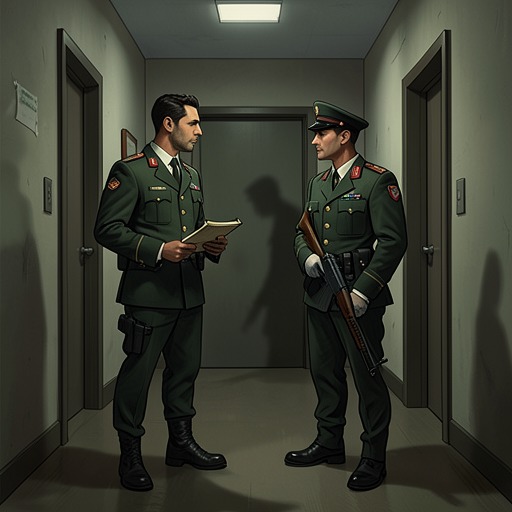
Edgar Allan Poe–Ethan Allen Hitchcock relationship
The Pale Blue EyeThe relationship between Edgar Allan Poe and Ethan Allen Hitchcock is defined by the tension between command discipline and the risks of an investigation that has already cost lives. As commandant, Hitchcock can treat Poe’s unauthorized conduct as an offense against the Academy and the Army; as the investigation’s danger grows, he also has to decide whether Poe can remain Augustus Landor’s agent. Their connection ends not in a negotiated reconciliation but in Poe’s deliberate disobedience, court-martial, and dismissal from the United States Army.
Command Authority and Poe’s Initiative
When Hitchcock confronts Poe after the young man’s unauthorized appearance in uniform, Poe is visibly diminished by the encounter. The narrator describes his shoulders shaking and his head drooping; Poe turns back toward Hitchcock and bows before taking responsibility. He insists that Landor had no part in the episode, that Landor was surprised and dismayed, and that the initiative was entirely his own. His defense of Landor matters to their immediate situation: rather than letting Hitchcock treat the incident as a joint scheme, Poe places the blame on himself and acknowledges that he deserves punishment.
Hitchcock’s response is stern but not simply punitive. He says that he is in no humor to administer to Poe and has more important matters to attend to. The exchange takes place against the news that another cadet has vanished while Landor and Poe have been away at Gouverneur Kemble’s hospitality. The missing cadet redirects Hitchcock’s attention from the spectacle of Poe’s conduct to the emergency confronting the Academy. His restraint in that moment should not be mistaken for approval: the officer’s reaction makes clear that Poe has tested a boundary, even while the investigation temporarily takes priority.
The Impersonation and Its Limits
Landor later asks Hitchcock to show mercy to Poe. Hitchcock rejects the request by listing the infractions that make it difficult to treat the affair as a minor lapse: Poe left the Academy reservation after hours, drank a substantial quantity of spirits, presented himself under an assumed name, and impersonated an officer of the United States Army. Hitchcock emphasizes that no cadet during his tenure has previously dared the last of these offenses. The list turns the incident from a colorful escapade into a direct challenge to military authority. In Hitchcock’s view, the false identity and uniform cannot be separated from the place and institution whose authority they counterfeit.
Yet Hitchcock also distinguishes between punishment for the night’s misconduct and the question of Poe’s fitness to continue as Landor’s agent. He acknowledges that the encounter with Poe may have been an unfortunate accident and says that, had circumstances been different, he might have toasted Poe’s health and congratulated him on his pluck. He cannot in good conscience punish someone merely because fate brought him into trouble. That qualified generosity does not erase the offense; instead, it shows Hitchcock weighing circumstance before deciding what action is justified. His response is neither blanket indulgence nor automatic discipline.
Removal from the Investigation
The boundary becomes firmer when Hitchcock tells Landor that Poe can no longer serve as his agent. Landor objects that the investigation has made great progress with Poe’s help and that Poe has been of real assistance. Hitchcock does not dispute the value of that work. He grounds his decision in the number of lives at stake: two cadets are dead and a third is missing, so he cannot contemplate placing another young man in harm’s way. His judgment is therefore a command decision about risk as well as a response to Poe’s insubordination. Whatever Poe has contributed, Hitchcock will not let investigative usefulness outweigh the prospect of another cadet being endangered.
For Landor, the order exposes how little attention he has given to Poe’s safety. The narrator recalls feeling shame at having followed Poe’s meetings with Lea and Artemus as if they were only part of a story, without attending to the living person who could be lost. This recognition sharpens the significance of Hitchcock’s refusal: the issue is no longer only whether Poe has broken regulations, but whether adults in authority will continue to put him in danger. Hitchcock and Landor differ in their immediate positions—Landor argues from the success of the inquiry, Hitchcock from the accumulating deaths—but the commandant’s decision establishes a limit to their partnership.
Disobedience, Court-Martial, and Separation
After the Christmas holiday, Poe answers the end of his agency not by returning to obedience but by making absence his final campaign against West Point. Benny Havens’s regulars report that he stops attending French and mathematics, church parade and class parade, roll call and guard mounting. He ignores every order he can evade. The sequence is deliberate and comprehensive: Poe withdraws from both instruction and the daily routines by which the Academy maintains discipline, converting nonattendance into a means of forcing the institution to act.
Within two weeks, Poe has obtained the court-martial he sought. He offers almost no defense and is dismissed from the service that same day. The outcome completes the break with Hitchcock’s authority, though the evidence does not present it as a further personal confrontation between the two men. Rather, Hitchcock’s earlier decision to remove Poe from the investigation and Poe’s later campaign of nonobedience belong to a single widening separation: the commandant will not expose him to investigative danger, while Poe refuses the ordinary obligations that would keep him at West Point.
The relationship thus brings competing duties into focus. Hitchcock recognizes Poe’s usefulness and, in the earlier encounter, allows for circumstance rather than insisting on immediate punishment. But as deaths and a disappearance make the danger undeniable, he withdraws permission for Poe to participate. Poe, in turn, asserts his own agency by accepting the institutional consequences of refusing orders. Their final distance is shaped both by Hitchcock’s responsibility to protect cadets and by Poe’s determination to leave the service on his own terms.