Edgar Allan Poe–John Allan relationship
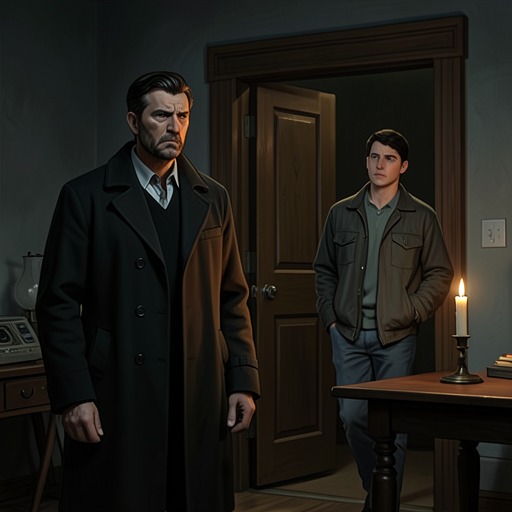
The Pale Blue EyeEdgar Allan Poe and John Allan’s relationship joins practical assistance to a bitter dispute over what that assistance meant: Poe treated Allan as a father, while Allan insisted he had never adopted him and ultimately withdrew his support. When Augustus Landor meets Allan at the United States Military Academy at West Point, Poe’s familiar account gives Allan an almost storybook presence; their encounter replaces that distant image with Allan’s own account of a bond he considers finished.
A bond without adoption
Before meeting Allan, Landor knows him through Poe’s stories and expects someone who seems almost fantastical in the telling. Allan’s appearance therefore makes Poe’s personal history newly concrete, but it does not settle how the two men understood their relationship. Landor addresses Allan as Poe’s father, reflecting the impression Poe has given him. Allan immediately rejects that description: he says he and his late wife had taken Poe in out of pity, but that he never adopted him or led Poe to believe he would do so. In Allan’s view, Poe’s claim on him is no greater than that of any other person deserving Christian charity.
That denial sits beside a more complicated history of care. Allan says his late wife was fond of Poe, and that he had tolerated Poe’s conduct partly for her sake. His account does not erase the years of housing and assistance; instead, it draws a sharp boundary around what they signify. He casts the household’s help as kindness rather than a promise of kinship, while Poe’s presentation of Allan to Landor has encouraged the language of fatherhood. The conflict is thus not simply over whether Allan helped Poe, but over whether help created an enduring obligation between them.
Money, enlistment, and contested trust
Allan recalls giving Poe one hundred dollars to pay an Army substitute, which he says was required for Poe to leave the Army and enter the Academy. According to Allan, the substitute, Sergeant Bully Graves, later sent a threatening letter claiming that he had not received the money. Allan further alleges that Poe had blamed Allan for withholding it and had described him as often not sober. These are Allan’s accusations, delivered in anger; the encounter supplies no independent confirmation of what Poe told the substitute or what became of the payment.
The episode helps explain why Allan presents distrust as central to their estrangement. He describes Poe as insincere and says he makes a point of believing nothing Poe tells him. Yet Allan also says that he secured Poe’s appointment to the Academy, placing that opportunity alongside the disputed payment as evidence of substantial assistance. The two details pull in opposite directions: Allan had used his resources to help Poe advance, but he now recalls that support through a story of alleged deception and ingratitude. His account makes financial aid both a real contribution and a grievance he can invoke when deciding to stop giving it.
Support withdrawn
Allan describes his patience as exhausted. He says Poe had been a continual irritation since reaching his majority, citing what he regarded as profligacy, snobbery, affectation, and ingratitude. Now remarried and responsible for what he calls genuine, blood relations, Allan sees no reason to continue carrying Poe. He presents the decision as a final break: Poe must make his own way from then on.
The Academy appointment remains, in Allan’s argument, an alternative to further personal support. He says Poe can rely on the United States Army, complete the four years required by his appointment, and secure a future; if he fails to do so, Allan will not grieve over another failure. The firmness of that condition makes Allan’s assistance explicitly contingent. He has helped open a path for Poe, but insists that Poe must now follow it without expecting money, indulgence, or familial recognition from him.
Landor tries to caution Allan that Poe has recently been under strain and that this may not be the right moment to confront him. Allan rejects the appeal and insists that Poe has been indulged long enough. The disagreement exposes the difference between Landor’s concern for Poe’s immediate vulnerability and Allan’s belief that continued patience would prolong dependence. Allan treats the confrontation as overdue; Landor sees a young man already under pressure facing the withdrawal of the person he has represented as his father.
Landor’s intervention and the unresolved break
Allan’s language awakens in Landor an echo of his own painful history with a rigid father. Landor recognizes the force of familiar words being wielded against someone else, and that recognition changes his conduct: he no longer feels compelled to appease Allan. His response is to accuse Allan of abruptly abandoning Poe and the past twenty years, reducing a long relationship to a few minutes of rejection. The confrontation makes Landor more than a witness to Allan’s account; it shows how Poe’s family conflict resonates with Landor’s own experience of paternal authority.
The encounter does not resolve whether Poe and Allan will reconcile, nor does the evidence establish Allan’s allegations as fact. It ends with Landor’s challenge and Allan’s reaction, leaving the relationship suspended between material aid already given and an obligation Allan refuses to acknowledge. That unresolved tension is its defining feature: Poe’s claim to a father is answered by Allan’s insistence that charity never made him one, while Landor’s intervention exposes the emotional cost of treating that distinction as decisive.