Edgar Allan Poe–Lea Marquis relationship
The Pale Blue EyeEdgar Allan Poe–Lea Marquis relationship is a love story whose promised future is abruptly consumed by the Marquis family’s final rite. Poe commits himself to Lea even when that commitment puts his military standing at risk; at the icehouse, he is nearly drained of blood while Lea believes the rite will free her to become his wife. Her apparent death turns their promise into a loss Poe says he will have to suffer again and again.
A private attachment under public scrutiny
Their connection develops in a world where cadet friendships and rivalries make a woman’s reputation a subject of male speculation. At a gathering, Randolph Ballinger taunts Artemus Marquis by asking whether Lea had dazzled Leroy Fry. Artemus restrains Augustus Landor rather than let him demand an accounting, and Ballinger replies that he had not been as close to Fry as Artemus. The exchange does not establish a relationship between Lea and Fry, but it shows how readily the men use her name to provoke one another. Against that atmosphere, Poe’s later attachment is not merely another rumor: it becomes a declared bond for which he accepts consequences.
Poe’s approach to intimacy is presented as unusually innocent. When Artemus suspects that Poe has never given himself to a woman, Poe blushes; Artemus then calls his innocence endearing and says that he counts himself among those who hold Poe dear. He takes Poe’s hands, calls them beautiful and priestly, and kisses them. This is an intimate moment between the two men, but the evidence does not make it a substitute for Poe’s attachment to Lea. Instead, it sets the scene’s charged language of tenderness beside Poe’s emerging commitment to her, without reducing either connection to a simple label.
Commitment and its cost
Poe’s attachment becomes explicit when he refuses to leave Lea during their first night alone together. He tells Landor that he would sooner resign his commission than abandon her, and insists that he will remain involved whether Landor helps him or not. The choice is concrete: Poe places his loyalty to Lea above obedience to the man trying to end his participation. His willingness to accept the institutional cost makes his devotion an action rather than a sentiment alone.
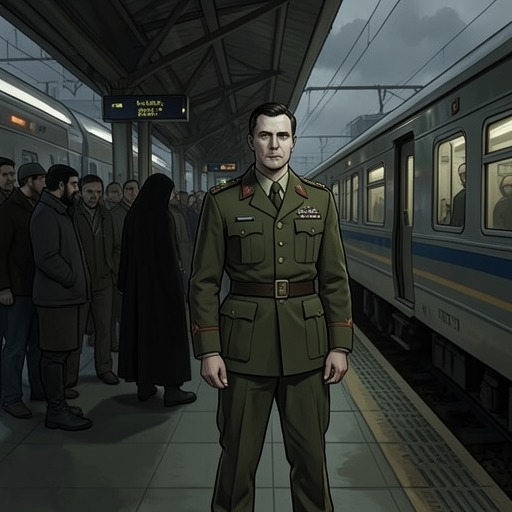
The consequences become visible when Captain Hitchcock discovers Poe wearing a uniform that does not belong to him. Poe steps forward and takes responsibility, telling Hitchcock that Landor had nothing to do with the deception and that it was entirely his own initiative. His defense protects Landor from blame while making clear that Poe has knowingly crossed a boundary in order to stay near Lea. His commitment therefore links private feeling to public risk: the relationship draws him into conduct that can damage his military career.
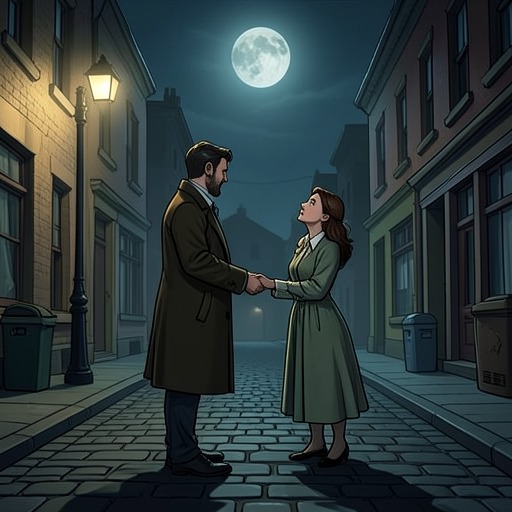
Poe later writes to Landor that he and Lea have plighted their troth. He plans to resign his Academy commission and take her away from West Point, and asks Landor for neither congratulations nor sympathy. The letter describes a future chosen by the couple, not a passing attachment: Poe intends to leave the Academy and make Lea his wife. Its farewell is also a rebuke to Landor, whom Poe accuses of hatred and recrimination. The projected departure gives their relationship a decisive turning point, even as the events that follow prevent the promised life from beginning.
The icehouse and the broken promise
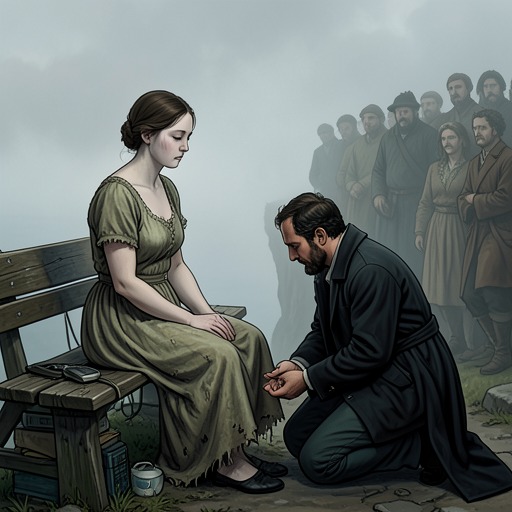
At the icehouse, Poe is discovered beneath a pile of garments, stripped of his coatee and lying rigid and pale. Artemus uncovers him; a tremor passes through Poe’s body, but the scene makes clear how close he is to death. Lea is present with the others, and her conduct toward him combines tenderness with participation in the rite: she hushes him, then allows Artemus to draw blood from Poe’s arm into a waiting vessel.
Poe wakes as the blood is being taken. He murmurs Lea’s name and sees himself being drained, but has too little strength to rise. When he asks what is happening, Lea tells him that in a few minutes it will be done and she will be free. She explains that she means to be his wife, adding that she will first have to give up the priesthood. Her words expose the cruel contradiction at the heart of the scene: the future Poe had announced in his letter is still the future Lea names, yet the rite meant to bring it about is taking his life from him.
Landor confronts Poe with the question of whether the death of a beautiful woman remains a poet’s noblest subject. Poe answers yes and falls against Landor’s shoulder. He then says that he will have to keep losing Lea again and again. His words join the literary idea of beautiful female death to immediate bereavement; the woman Poe had expected to marry is now the person whose loss defines his response to the rite. The narrative presents this as a devastating separation, not a fulfilled romance.
Loss and the relationship’s afterlife
Poe’s grief is bodily and sustained. Against Landor’s shoulder, his ribs shudder; he continues to weep without tears or sobs until, in Landor’s account, everything inside him has been turned out. The restraint of the description makes the collapse more affecting: Poe does not offer a speech of explanation, but his body registers the scale of what has happened. His earlier insistence that he would not leave Lea is answered by a scene in which he survives her, but cannot keep the future they had promised one another.
The relationship also becomes part of the novel’s larger concern with the persistence of the dead. In Landor’s closing vision of time, the living and dead occupy the same ground, and Poe writes verses with Mattie Landor while Lea studies at the feet of Henri le Clerc. This is not a continuation of Poe and Lea’s earthly engagement, nor evidence that their promised marriage occurs. Rather, their placement among the dead who remain present gives the loss an afterlife in memory and narration. Poe’s declaration that he will keep losing Lea resonates with a world in which the dead do not simply disappear, while the love they shared remains inseparable from the grief of an unfulfilled future.