Haunting and the persistence of the dead
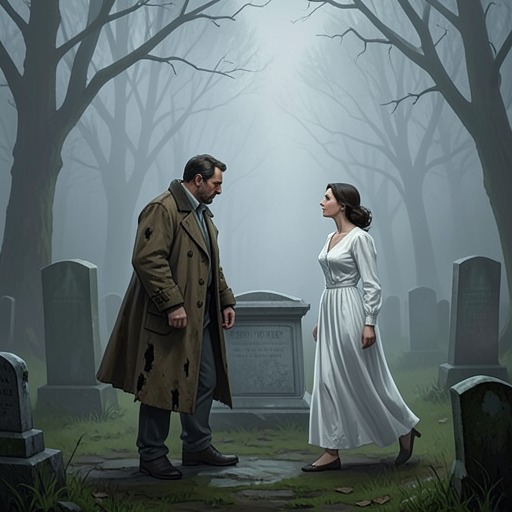
The Pale Blue EyeHaunting and the persistence of the dead is the novel’s way of holding grief, memory, and the supernatural in unresolved relation. The dead return not only as possible spirits but through dreams, treasured objects, repeated stories, and the habits of those left behind. The novel never reduces these experiences to a single explanation: remembrance can comfort the living, keep a relationship active, or make absence feel like a presence that cannot be escaped.
Competing explanations of return
Edgar Allan Poe develops two theories while describing the presence of his mother in his sleeping and waking life. Though he says she left him no living memory, she persists for him as a kind of spirit-memory. At times, he thinks the dead haunt the living because they are loved too little: grief fades, remembrance slackens, and the dead seem abandoned. Their return, in this account, is a demand to be recalled. At other times, he thinks the opposite is true. Love can hold the dead so closely within the living that they are never free to depart. The two explanations place haunting at opposite ends of attachment—neglect and devotion—without settling which one is true.
When Poe calls these figures revenants, Augustus Landor questions whether they have truly returned if they never left. The exchange gives the concept its central paradox: the dead may seem to come back precisely because the living have continued to carry them. Haunting is therefore not simply an interruption from outside ordinary life. It may also describe an inward relationship that persists after death, whether the person experiencing it understands that relationship as supernatural or emotional.
Grief in dreams and daily habits
Landor’s account of an empty bed gives this persistence a domestic form. He recalls that sharing a bed once felt difficult, yet after years of loss he cannot become accustomed to sleeping alone. He still lies to one side and tries not to use too much of the blanket. The ordinary gesture makes absence part of the body’s routine: the lost person is not present, but the survivor’s conduct remains shaped by the former closeness.
The dead also enter Landor’s sleep in images that he calls a product of fancy rather than proof of anything beyond it. In one dream, the murdered cadet Leroy Fry appears transformed: he wears an officer’s blue rather than cadet gray and holds charcoal and a cage of blue-eyed birds. The repeated message that he will not tell is joined by a woman’s singing and the continuing cadence of the West Point drums. Landor wakes with the dream still affecting him, and reflects that his time at West Point seems to blur waking and dreaming together. His qualification does not erase the dream’s force; it leaves the reader with an experience that is acknowledged as a dream but continues to trouble the boundary between the dead and the living.
Objects that carry memory forward
The account of Mattie Landor’s life and death makes remembrance material. After her death, her father finds a chain inside a volume of Byron’s poetry, a book she had loved. She had kept the chain after an attack at a ball and had concealed it from her father. Attached to it is a brass plate bearing the arms of the Corps of Engineers. The discovery changes the chain from a private keepsake into a possible message: Landor considers whether Mattie meant him to find it and use it. The object cannot explain her intention by itself, but it gives the bereaved father something left by his daughter that can shape what he does next.
The chain’s significance rests on both its concealment and its discovery after death. Mattie’s attachment to it survives her, while its hidden placement in a cherished book makes the past newly legible to her father. In this way, the novel connects haunting to interpretation: a material trace can keep a relationship active, yet what it means remains open to the living person who encounters it.
Time folded around the dead
At the close, Landor describes time as soft and pleated rather than fixed. Under pressure, he imagines, people from different generations can be brought together to occupy the same ground and breathe the same air; the distinction between living and dead no longer seems complete. His imagined company includes Lea Marquis studying with Henri le Clerc, Edgar Allan Poe writing verses with Mattie Landor, and deceased acquaintances continuing familiar occupations. They do not appear in a separate afterlife of choirs or punishment. They carry on with the business they had in life, while Landor finds their presence heartening.
This final vision turns the novel’s earlier uncertainty into a sustaining possibility, not a confirmed account of literal return. Landor wonders whether these companions will remain after his own death and whether Mattie might be among them. The thought makes facing the end easier. Haunting thus shifts from a source of fear or unsettled evidence into an image of continued relationship: the dead remain present because memory, love, and shared history have not ceased to act upon the living.