Henri le Clerc
The Pale Blue EyeHenri le Clerc is a dead priest whose story reaches the investigation through a legend of apostasy and through Lea Marquis’s reported encounters with him. Presented first as a witch hunter who crossed to the side he once opposed, then identified in a portrait and named by Lea as a gentleman she has met, he becomes a possible source of her instructions and a presence in the final ritual. The account makes his influence consequential while leaving open whether he is an actual returning ancestor, the figure through whom Lea understands her illness, or both within the story’s unsettled supernatural frame.
Identity and the old account
Augustus Landor raises Henri le Clerc’s history while questioning Professor Pawpaw about a witch hunter who went over to the other side, was burned at the stake, and cast his book into the flames. Professor Pawpaw supplies the name, Henri le Clerc, and confirms that he was a priest. The exchange gives Landor a historical identity to investigate, but it does not independently verify the particulars of the legend. Le Clerc enters the inquiry first as a story about a reversal of allegiance: a man associated with hunting supposed evil who is remembered instead as having joined it.
Professor Pawpaw then takes Landor to his library, climbs to a shelf, and retrieves a crumbling duodecimo. Its image shows a man in a priest’s collar and a richly pleated dark robe, with composed, open features. The book and portrait make the name visible in a material form, but they do not settle what kind of evidence the image provides. Landor recognizes its significance in the course of the conversation; the discovery links the old account to a recognizable face without establishing that the figure in the portrait can act in the present.
Lea Marquis and the reported encounters
Landor connects Le Clerc to Lea Marquis by confronting Dr. Marquis about his daughter’s falling sickness. He says he has seen her spells and believes that, during them, she imagines contact with someone who tells her things and sends instructions. Pointing to the portrait, he asks whether this person is Le Clerc. The question is a deduction by Landor, not a neutral account: he interprets Lea’s episodes through the image and the family mystery he has been trying to understand.
Dr. Marquis’s response adds a separate piece of testimony. When asked whether the gentleman Lea said she had met was Father Le Clerc, he confirms that it was, while describing the connection as that of her great-great-great-grandfather, or some similarly distant ancestor. His qualification matters. The reported relationship locates Le Clerc within the family’s past, but its exact degree is uncertain, and the account comes through the doctor’s recollection of what Lea said. Together, the portrait, Landor’s observation of her spells, and the doctor’s confirmation make Le Clerc more than a name in an old tale; they still do not prove that the encounters are supernatural.
The icehouse ritual
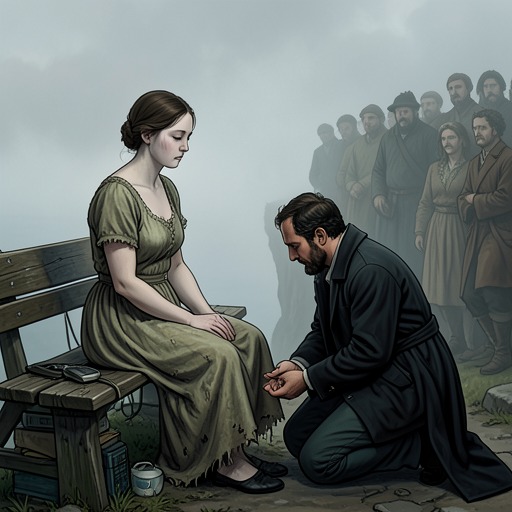
At the icehouse, Landor recognizes three figures approaching a rough-hewn rock altar: Artemus, a priest-like figure, and Lea, whom he identifies by the white collar he had torn from her outside Benny Havens’ tavern. He understands the latter two figures as Lea and Henri le Clerc. Lea speaks in a voice of unusual resonance, but Landor cannot identify the language. He speculates that it is neither Latin, French, German, nor any language people ordinarily speak, and describes it instead as something Lea and Le Clerc have newly made together.
Landor’s uncertainty is part of the scene’s evidence. He cannot transcribe the sounds intelligibly and admits that the language seems to unsettle the meaning of language itself. The passage therefore conveys the ritual through his disorientation rather than offering a translation or an independent account of Le Clerc’s words. After Lea speaks for several minutes, her voice rises in cadence, and the three figures turn together toward a shrouded bundle outside the magic circle. Landor initially sees only clothes and a bare hand protruding from them. Le Clerc’s apparent participation places him at the center of the rite, but the scene does not disclose his speech’s content or establish how he has come to be there.
Presence and uncertainty
Le Clerc’s significance rests on the gap between different kinds of evidence. A book presents his likeness; a family member confirms that Lea reported meeting him; Landor interprets her spells as contact with the figure; and, during the ritual, Landor sees what he takes to be Le Clerc beside her. Each detail strengthens the character’s presence in the narrative, yet each reaches the reader through someone’s account or perception. The story sustains the possibility that Le Clerc is more than a remembered ancestor without turning that possibility into an uncontested fact.
His role also binds the family’s private history to the ritual’s present danger. The distant ancestor is invoked as the person Lea believes she meets and as a source of instructions during her spells; at the icehouse, her speech and the assembled figures direct attention to a concealed body. Le Clerc’s history of supposed apostasy makes that association ominous, while the priestly image complicates any simple distinction between religious authority and the occult. He is thus both an object of investigation and a figure through whom the story tests the limits of explanation: Landor can connect portrait, testimony, illness, and ritual, but those connections do not finally determine whether Le Clerc is a supernatural agent or a presence given form by Lea’s experience.